 TrenchOps 🐎
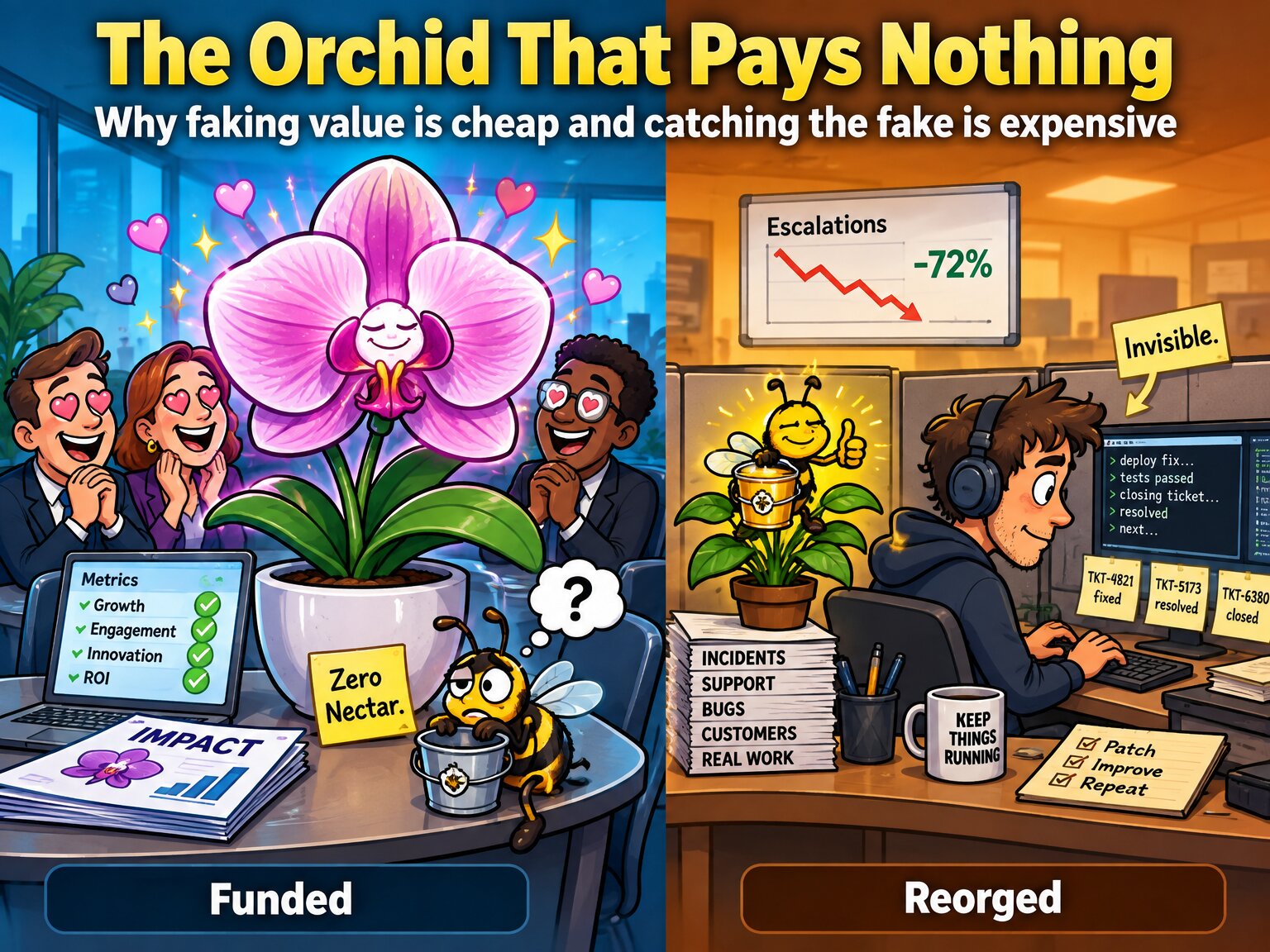
The Orchid That Pays Nothing
Why faking a signal is cheap and catching the fake is expensive - and what that does to your org chart
There is a family of orchids that has solved business development.
They advertise like a nectar plant: the right colour, the right shape, the right landing platform, sometimes even the right scent. A bee arrives, does the work, leaves with nothing. No nectar, no pollen, no deal. The orchid gets pollinated for free.
The best part is the arms race that follows. Bees are not stupid - they learn to avoid the colour that burned them. So some deceptive orchids grow in several colour variants at once. Researchers have shown this actually works: bees that learn to avoid one morph generalize their avoidance to similar shades and then go try the most *different*-looking flower in the patch. Which is also an orchid. Which also pays nothing.
Read that again. The plant needed no new intelligence. It just needed variance. The bee needed a whole new cognitive capability - discrimination, memory, resistance to generalization - and still lost.
That asymmetry is the most underrated force in corporate life.
Deception is O(1). Detection is O(n).
Producing a convincing signal of value costs roughly the same no matter how much scrutiny arrives. One deck. One dashboard. One "alignment workshop." One paragraph of AI-generated prose in a status update.
Verifying that signal costs proportional to the claim. You have to read the code, re-run the numbers, call the customer, find the ticket, reconstruct who actually fixed the incident at four in the morning while the visible people were writing the retro.
So the cost curves diverge. And in any system where the cost of faking stays flat while the cost of checking grows, the fakers win on unit economics. Not because they are smarter. Because they are cheaper.
This is the idiot index applied to trust: compare the cost of a finished, credible-looking claim against the cost of the real work inside it. When that ratio hits 50 to 1, you do not have a people problem. You have a market, and it is efficient, and it is eating you.
What this looks like in the building
I once reviewed a support organization that had a "customer advocacy" function. Beautiful mandate. Quarterly reports with customer quotes, sentiment trends, a heat map of "friction points." Very warm, very benevolent, very nectar-coloured.
I asked a simple verification question: "of the friction points listed in the last four quarterly reports, how many produced a shipped change?"
Nobody knew. Not because anyone lied - because nobody had ever paid the detection cost. Checking would have meant cross-referencing twelve months of reports against the actual backlog. A week of grim, unglamorous work that no one gets promoted for.
Meanwhile, three levels down, a support engineer with the social skills of a parking meter had personally rewritten the diagnostic path for the product's worst failure mode. Escalations on it dropped by roughly two thirds. He had mentioned this exactly once, in a ticket comment, in the passive voice. Zero colour, zero scent, all nectar. A power horse 🐎 advertising nothing.
The advocacy function was funded. His work was invisible until someone went looking. Guess which one survived the next reorg.
The variance trick, in human form
Here is the part that mirrors the orchid most exactly, and the part people miss.
Organizations do learn. Burn a management team once with "digital transformation" and they become allergic to the phrase. So the signal mutates. It becomes "operational excellence." Then "platform enablement." Then "AI-first enablement." Same flower, new colour, and the immune system you built around the old vocabulary now points in exactly the wrong direction.
This is why vocabulary-based scepticism always loses. You learn to distrust a word, the word changes, and your hard-won pattern recognition is now a liability - you wave through the new thing precisely because it doesn't look like the last thing that burned you. The bees fly to the most distant colour in the patch. The orchid planted that colour too.
Same mechanism in hiring. A résumé is a signal with a fixed production cost, and a large language model just dropped that cost to near zero. A person who forwards AI output without reading it - a meat proxy - produces exactly the same artifact as someone who thought for three days. The signal no longer separates them. If your process still reads signals, your process is now a random number generator with an HR budget.
The only defence that scales: stop reading signals, sample for nectar
You cannot out-discriminate a system whose deception costs nothing. The bee lost. Don't be the bee.
What works is changing what you measure - from the advertisement to the payload - and accepting that you can only afford to check a sample.
👉 Make claims cheap to verify, not cheap to make. Every proposal names one number that will move and one date. A claim with no falsifiable payload is a colour, not nectar.
👉 Random deep audits beat universal shallow review. Pick one initiative per quarter and trace it to the end: shipped code, closed tickets, revenue, churn. Unpredictable sampling is what makes faking expensive again. Universal review just means everyone learns the review format.
👉 Ask "who bore the downside?" Advice from people with no exposure to the outcome is advertising. Free advice from someone who will eat the consequences is nectar. This single filter removes most of the noise.
👉 Go down three levels for facts, not two. The layer that translates reality upward is the layer with the strongest incentive to colour it. Talk to the person whose hands were on the keyboard during the outage.
👉 Distrust mechanisms, not vocabulary. Don't ask what an initiative is called. Ask who gets promoted if it succeeds and who gets fired if it fails. If the answer is "nobody" to both, you're looking at an orchid.
👉 Reward under-advertised work loudly. Not out of sentimentality. If nectar-producers get nothing, they stop producing or they leave, and then you're running an organization made entirely of colour.
The orchid strategy has one limit, by the way. It only works while real nectar plants exist nearby. Deception is a parasite on a functioning market of honest signals - in a meadow of nothing but orchids, the bees stop coming and everybody starves.
Every organization eventually discovers whether it is a meadow or a monoculture. The discovery is called a crisis, and it always arrives on a quarter when the dashboards were green.
👇 What was the last initiative in your company that looked like nectar and turned out to be colour - and how long did it take anyone to check?
0 comment(s)
No comments yet. Be the first to comment.
Leave a comment