 TrenchOps 🐎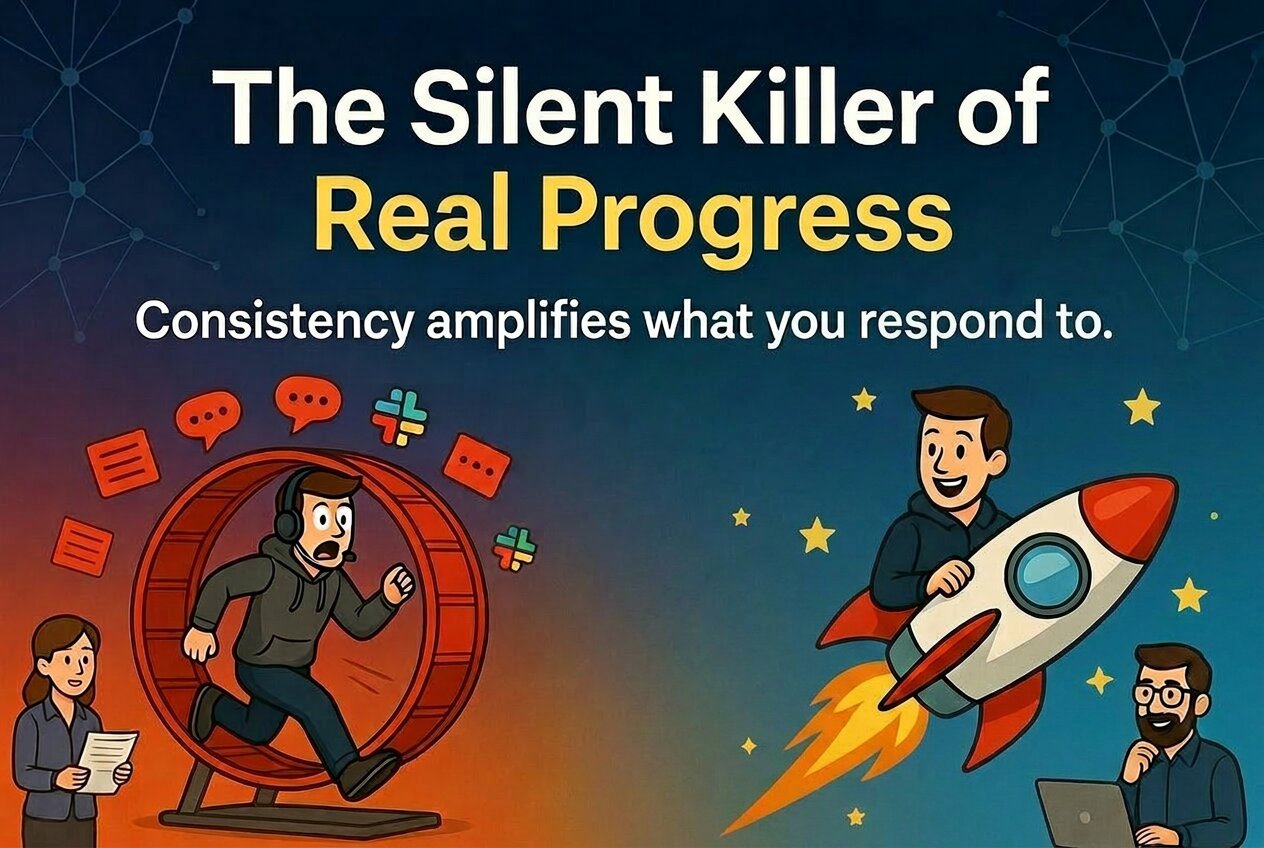
The Silent Killer of Real Progress
Why Most "Hard Workers" Stay Stuck on the Hamster Wheel
The inbox hits at 8:03 a.m. like clockwork. Twenty new tickets, three "urgent" Slacks from people who clearly didn't read yesterday's update, a fresh vanity dashboard from leadership showing likes on the internal town-hall post, and one passive-aggressive calendar invite titled "Quick sync on priorities." By 9 a.m. you're already exhausted, yet somehow the needle on actual customer outcomes hasn't moved a millimeter.
Welcome to the hamster wheel sponsored by modern corporate life. Most of us are reacting to noise and calling it productivity. The quiet power horses 🐎 figured out years ago that consistency doesn't amplify effort. It amplifies whatever you choose to respond to. Ignore that distinction, and you stay busy forever. Get it right, and you start moving like a rocket with afterburners.
I once watched a second-line support engineer I'll call Marcus live both versions in real time. Year one he was the ultimate firefighter: every ticket spike, every minor SLA blip, every random customer complaint got his full attention. He answered every Slack, joined every optional sync, chased every daily fluctuation in the support metrics. By December he was burned out, his actual impact flatlined, and the performance review read like a participation trophy: "Reliable team player who responds quickly." Translation: stayed on the wheel.
Year two, he ran an experiment on himself. He built a simple personal filter and stuck to it religiously. Before touching anything, he asked one question out loud at his desk: "Signal... or noise?" The difference was ridiculous. Same workload, same headcount, same cranky customers. But his real outcomes exploded. Mean time to resolution on critical incidents dropped 38 %. Recurring outage patterns got documented and killed once instead of patched weekly. Customer retention signals that leadership had been ignoring for quarters suddenly became visible. His review that year? The manager actually leaned in and said, "Whatever you're doing differently, keep doing it. The business noticed."
That filter isn't magic. It's just ruthless pattern recognition most of us were never taught because the system rewards noise.
Look at how the noise shows up in the trenches every single day:
- In your fitness (yes, even the metaphorical kind): daily ticket volume or response-time wiggles are noise. The six-month trend on escalation reduction and first-contact resolution is a signal. Chasing the daily graph keeps you on the wheel. Tracking the trend lets you fly.
- In learning: every random mistake or one-off bug is noise. Recurring root causes and the core concepts that keep resurfacing are signal. The engineer who documents the same workaround for the third time is spinning. The one who kills the underlying flaw compounds progress for the whole team.
- In projects and daily work: endless email threads, status meetings, and minor "quick asks" are noise. Decisions on the critical path and fixes that actually move customer outcomes are signal. Most of us spend 70 % of the week on the former and wonder why the latter never gets done.
In business metrics, the gap gets embarrassing. Vanity numbers like internal likes, comment counts, or "engagement" on a company announcement are pure noise. User behavior patterns and retention curves are signal. One tells you people clicked. The other tells you whether they stayed and paid.
The real skill, the one that separates the quietly elite from the loudly average, is knowing what to ignore. Not because you're lazy or disengaged, but because you refuse to let noise scale. Every time you treat a noisy input as signal, you compound the wrong thing. Every time you filter correctly, you compound progress.
For the neurodivergent brains in the room (and there are more of us in support and SRE roles than anyone admits), this filter is pure relief. The constant context-switching of modern tools already feels like sensory overload. Once you stop feeding the noise monster, the mental bandwidth that was being burned on irrelevant Slack threads suddenly becomes available for the deep work that actually matters. It's not about working harder or louder. It's about working smarter on the right inputs.
Practical ways to install this filter without becoming the office cynic:
- Start every morning with a two-minute ritual. Scan the inbox, the ticket queue, the meeting invites, and label them mentally: noise or signal. Move the noise to a "later or never" folder. Touch the signal first. Most days the noise never earns the right to come back.
- Keep a one-line weekly signal log. Not a brag doc for HR, just three bullet points of what actually moved an outcome. Over time you'll see the patterns that matter and stop reacting to the ones that don't. It also makes every future review season trivial because the real story is already written.
- Before you reply, act, or book time, force the question: "Is this signal... or noise?" Say it out loud if you have to. It sounds ridiculous until it becomes automatic and you watch your calendar and focus magically clear up.
For leadership reading this: if your best people are drowning in noise, the problem isn't their attitude. It's the system you built that rewards volume over velocity. The companies pulling ahead aren't giving more feedback. They're ruthlessly reducing the noise so the signal can be heard. Fewer dashboards. Fewer mandatory syncs. Clear critical-path ownership. Real-time obstacle removal instead of quarterly theater. That's not soft management. That's how you keep the power horses from quietly updating their résumés on a Tuesday afternoon.
Consistency will amplify something. The only question is whether you're amplifying busywork or actual progress. Most teams choose the wheel by default. The ones that win choose the filter on purpose.
What's the noisiest thing draining your focus right now? Drop it below. The collective trenches usually spot the signal faster than any official process. 👇
This article is also available in German.
0 comment(s)
No comments yet. Be the first to comment.
Leave a comment