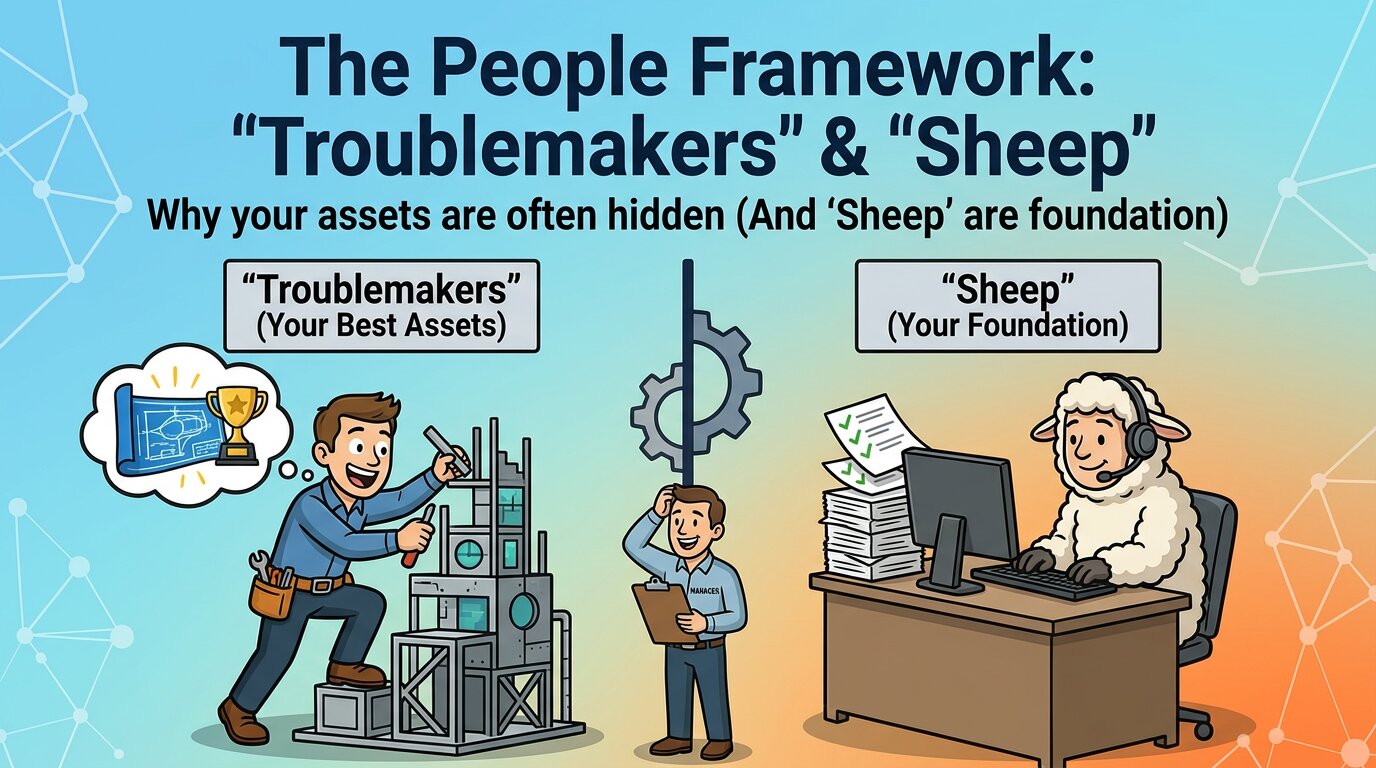
Why Your "Troublemakers" Are Your Most Valuable Assets (And Your "Sheep" Are Your Foundation)
You know the type. The engineer who has been in the same role for five years, never missed a single SLA, never complained, never suggested a change, never even looked at the process documentation because they had memorized it by year two. They just. Do. The work. Steady. Predictable. The kind of person you could set your watch by.
And then you know the other type. The one who, on day three, discovered a "creative" way to bypass the VPN because the VPN was slow and they had work to do. The one who asks "why" six times per meeting. The one who treats every rule like a suggestion and every process like a puzzle to be solved. The one who makes your compliance officer twitch.
Which one do you want on your team? Trick question. You want both, but not in the same seat. The problem is most companies treat them the same. They hire for one archetype, then promote based on another, and end up with a team that's either a zombie parade or a rebellion.
Let's be honest about human variance. Some people are deeply comfortable inside systems. They find safety in predictability. They execute reliably. Others are allergic to systems; they feel trapped by them, suffocated. Their brains light up when they spot a loophole or a way to optimize. Neither is good or bad. They are different operating systems. And if you place either one in the wrong environment, you get disaster.
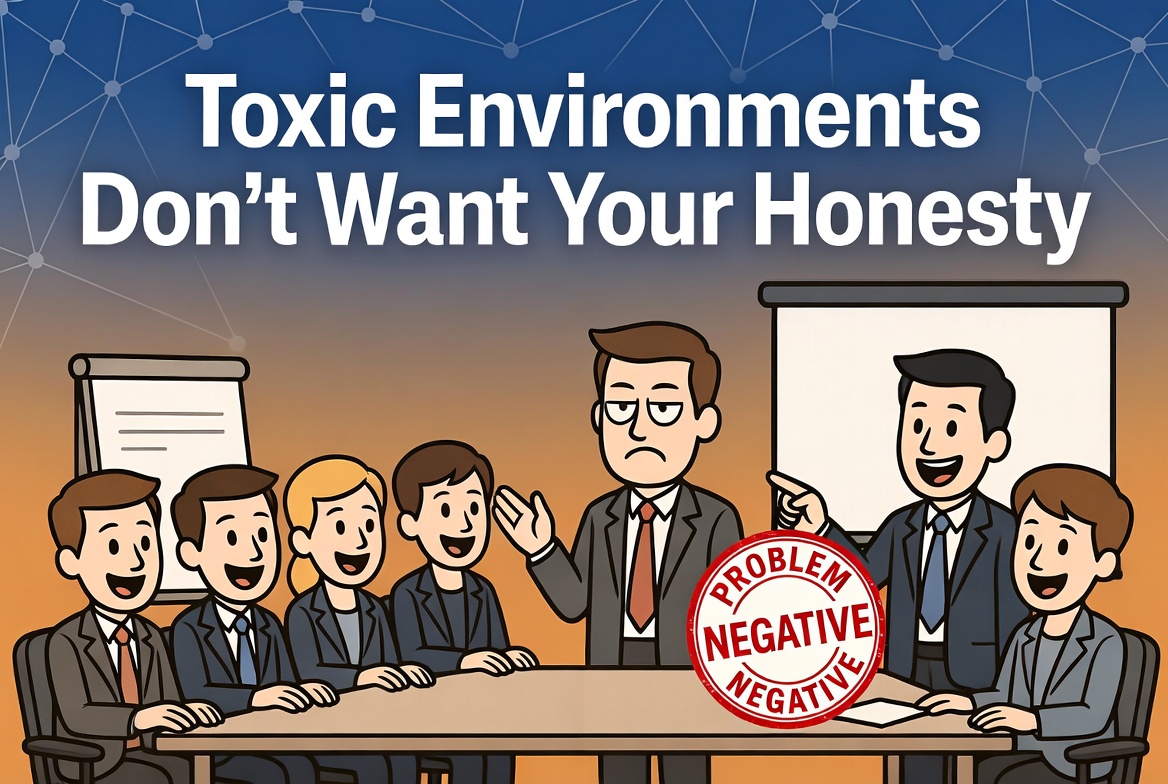
There's a quiet tax in many workplaces: the Honesty Tax. The moment you stop playing along with the comfortable illusion and start saying what's actually true, the cost of staying there goes up.
It doesn't always look dramatic. No one screams. No one calls you toxic. Instead, you start noticing small shifts: Your input is suddenly "too negative."
You're told you "need to be more of a team player."
People stop inviting you to certain discussions.
You become "difficult" - not because you're rude, but because you stopped pretending everything is fine.
The uncomfortable truth is this:
Many environments don't actually want realism. They want agreeableness. They want the version of you that keeps the peace, protects fragile egos, and doesn't make anyone feel responsible for fixing what's broken.
Authenticity is often treated as a threat in these places - not because it's aggressive, but because it disrupts the shared story everyone has agreed to maintain. That story might be "we're a high-performing team," "our leadership is supportive," or "this process works fine." When you stop participating in the story, you become a problem.
This is especially painful for power horses - the people who actually care about doing good work. They often have the clearest view of what's broken because they're the ones carrying the load. When they speak up, they're frequently labeled as negative or not aligned with the culture.
The annual self-review season rolls around again like a bad case of the corporate flu. You know the drill. The calendar invite lands with all the charm of a root canal reminder. "Reflect on your achievements." "Set SMART goals for the coming year." Meanwhile, your real goal hasn't changed since you started: collect the paycheck, keep the lights on, and maybe sneak out early on Friday before the European colleagues log off.
I've sat on both sides of that table in my time. The engineer staring at a blank form, wondering how to spin "kept production running while the business doubled the ticket volume and halved the headcount" into something that sounds humble yet heroic. And the manager on the other side, secretly praying the whole process finishes before their own review deadline. Nobody wins. Except maybe HR, who gets to file another folder of perfectly formatted theater.
One particular year stands out. Picture a solid power horse 🐎 in second-line support. This guy had spent the last twelve months single-handedly nursing a legacy system that should have been retired in 2012. He handled escalations that made senior architects sweat, documented workarounds so good the product team quietly copied them, and still found time to mentor the new hires who kept quitting for better pay. Come review time, he sits down, opens the template, and writes the honest version first: "Continued delivering under increasing load with static resources. KPI: didn't rage-quit on a Monday." Then he deletes it and replaces it with the approved corporate dialect. "Demonstrated commitment to operational excellence while embracing cross-functional synergies."
Why Most "Hard Workers" Stay Stuck on the Hamster Wheel
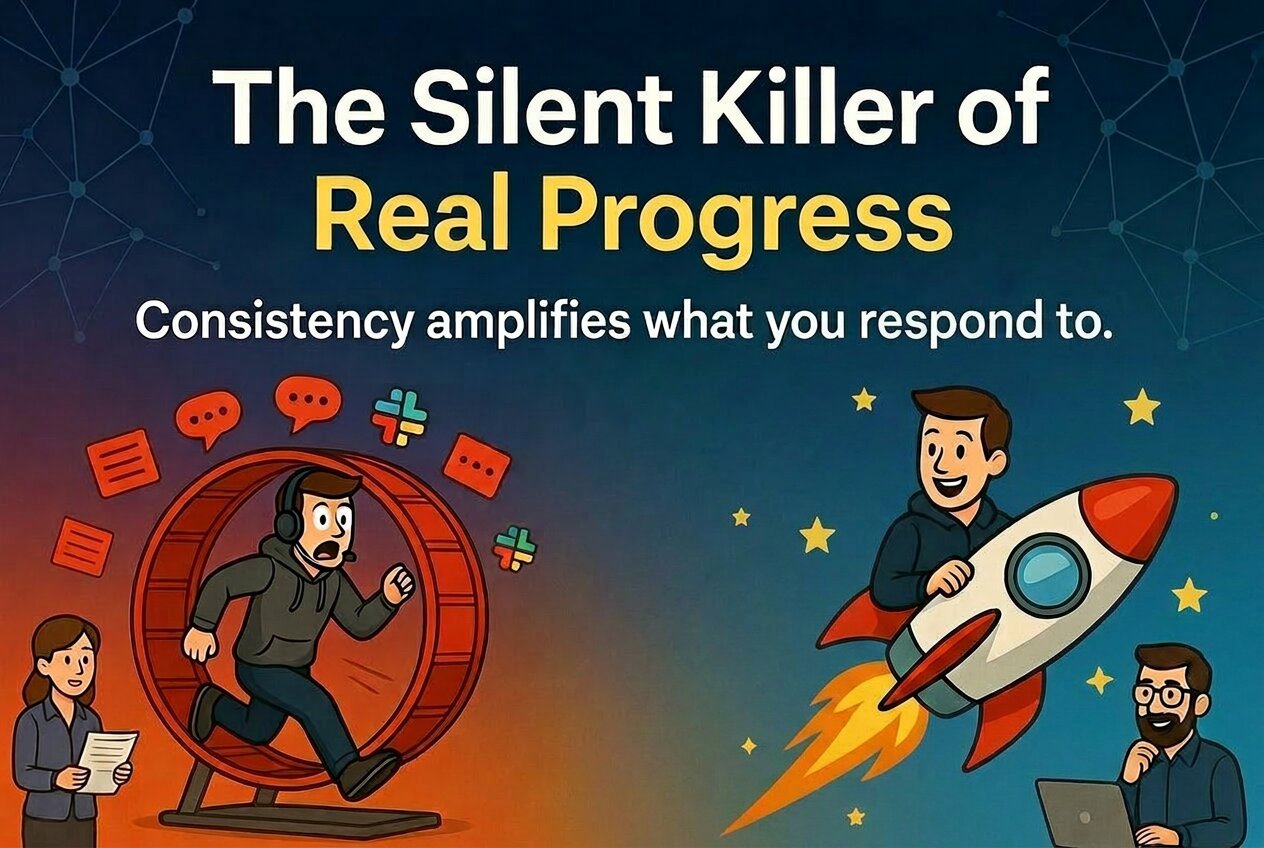
The inbox hits at 8:03 a.m. like clockwork. Twenty new tickets, three "urgent" Slacks from people who clearly didn't read yesterday's update, a fresh vanity dashboard from leadership showing likes on the internal town-hall post, and one passive-aggressive calendar invite titled "Quick sync on priorities." By 9 a.m. you're already exhausted, yet somehow the needle on actual customer outcomes hasn't moved a millimeter.
Welcome to the hamster wheel sponsored by modern corporate life. Most of us are reacting to noise and calling it productivity. The quiet power horses 🐎 figured out years ago that consistency doesn't amplify effort. It amplifies whatever you choose to respond to. Ignore that distinction, and you stay busy forever. Get it right, and you start moving like a rocket with afterburners.
I once watched a second-line support engineer I'll call Marcus live both versions in real time. Year one he was the ultimate firefighter: every ticket spike, every minor SLA blip, every random customer complaint got his full attention. He answered every Slack, joined every optional sync, chased every daily fluctuation in the support metrics. By December he was burned out, his actual impact flatlined, and the performance review read like a participation trophy: "Reliable team player who responds quickly." Translation: stayed on the wheel.
I've spent twenty years in the trenches watching two kinds of people argue about the future.
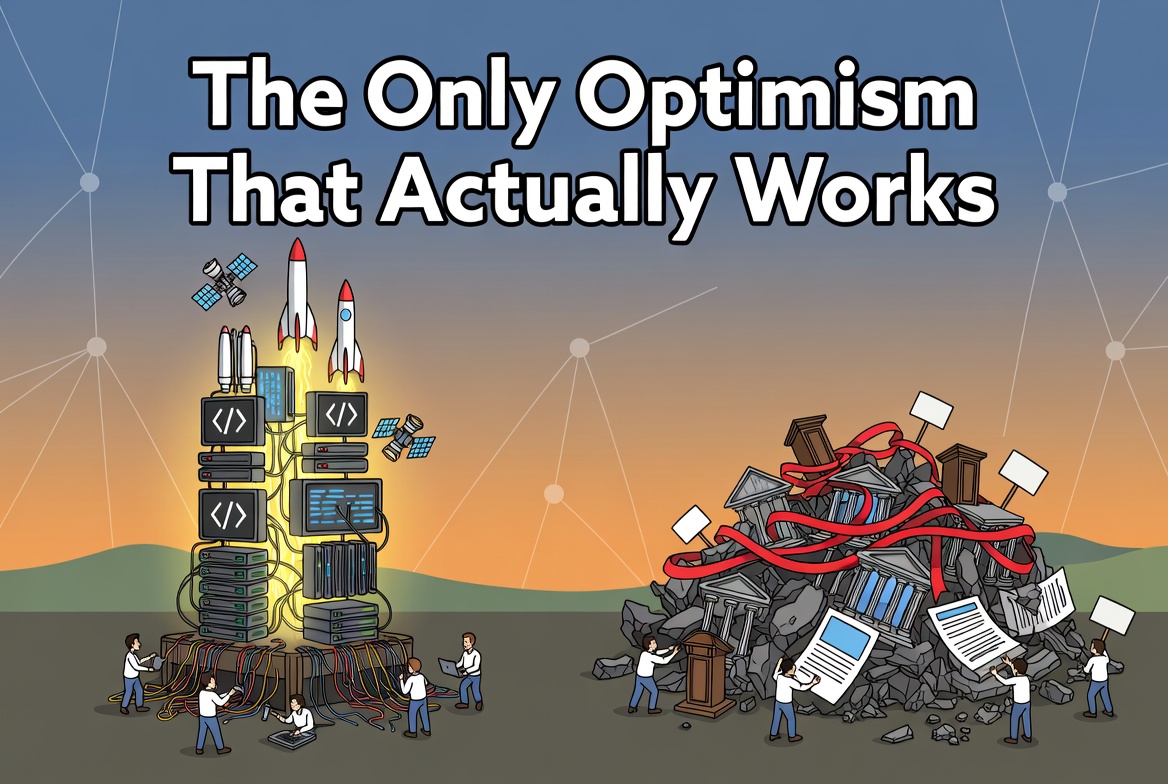
The social and political optimists say: "If we just pass the right laws, fix the culture, and get the right people in charge, everything will finally get better."
The technological optimists say: "Give humans better tools and they'll figure out the rest."
History keeps proving the second group right - and the first group spectacularly wrong.
Look at the pattern. Every decade we get grand promises about how new regulations, new social movements, or new political saviors will solve poverty, inequality, education, or healthcare. The results are usually modest at best, expensive, and sometimes actively harmful. Meanwhile, a few nerds in garages or labs quietly ship a new technology that changes daily life more in five years than ten years of policy ever could.
The smartphone didn't need a government program to connect the world. The internet didn't ask for permission to democratize knowledge. Cheap solar, Starlink, AI, and cloud computing didn't wait for the perfect political moment - they just got built.
In support, we see this every single day. We complain about broken processes, terrible CRMs, and endless bureaucracy. Social optimists would try to "fix" it with more meetings, more policies, and more mandatory training. Technological optimists ship a script, a dashboard, or an automation that actually removes the pain. Guess which one actually moves the needle?
 TrenchOps 🐎