 TrenchOps 🐎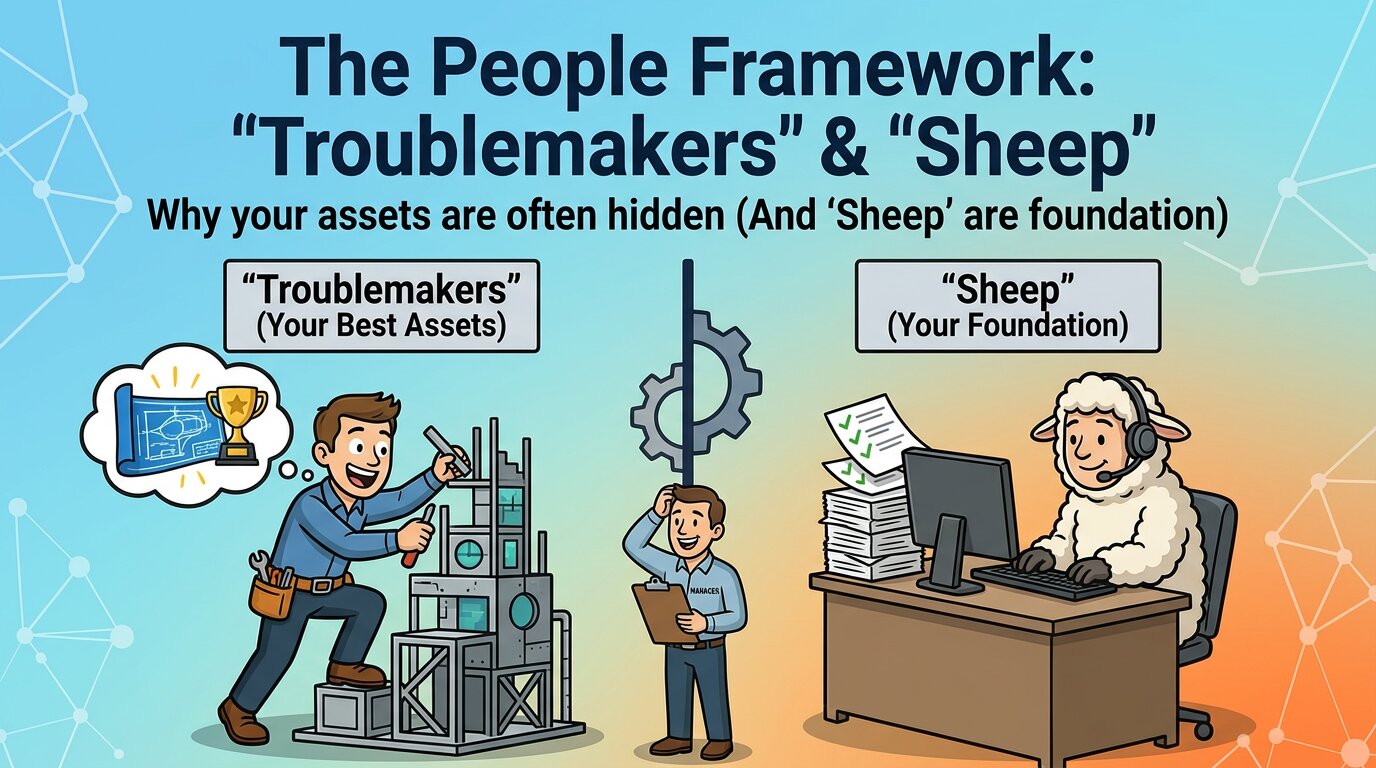
The People Framework
Why Your "Troublemakers" Are Your Most Valuable Assets (And Your "Sheep" Are Your Foundation)
You know the type. The engineer who has been in the same role for five years, never missed a single SLA, never complained, never suggested a change, never even looked at the process documentation because they had memorized it by year two. They just. Do. The work. Steady. Predictable. The kind of person you could set your watch by.
And then you know the other type. The one who, on day three, discovered a "creative" way to bypass the VPN because the VPN was slow and they had work to do. The one who asks "why" six times per meeting. The one who treats every rule like a suggestion and every process like a puzzle to be solved. The one who makes your compliance officer twitch.
Which one do you want on your team? Trick question. You want both, but not in the same seat. The problem is most companies treat them the same. They hire for one archetype, then promote based on another, and end up with a team that's either a zombie parade or a rebellion.
Let's be honest about human variance. Some people are deeply comfortable inside systems. They find safety in predictability. They execute reliably. Others are allergic to systems; they feel trapped by them, suffocated. Their brains light up when they spot a loophole or a way to optimize. Neither is good or bad. They are different operating systems. And if you place either one in the wrong environment, you get disaster.
Place the system-tolerant person in a role that demands constant creativity and challenge? They burn out or become deadweight. Place the system-resistant person on a team that needs process adherence? They become a disruption. But put them where they belong, and you get a power horse.
The Two Categories
Category A: The System-Tolerant.
They don't question the guardrails. They don't fight the tooling. They follow the playbook, and they follow it to the letter. In a ticket queue, they handle the backlog with zero drama. In operations, they keep the lights on. They are the backbone of any mature organization. They are also the first to stagnate if you don't give them new playbooks to follow. They don't need a why; they need a how. This makes them invaluable for compliance-heavy roles, regulated industries, senior support tiers where consistency is king, and any position where deviation means legal trouble or data loss.
But put them in a startup or a team that's building something from scratch? They will wait for instructions that never come. They will spin their wheels. They will look lost. That's not their fault. That's your fault as a leader.
Category B: The System-Resistant.
These are the people who rewrite the automation script that was working fine because they think it should be faster. They are the ones who skip the approval step and ask forgiveness later. They break things by accident because they were trying to improve them. They are also the ones who find the zero-day before the attackers do, who spot the process gap that saves the company millions, and who build the internal tool that cuts resolution time by 80%. They are your innovators, your security hunters, your process killers.
Put them in a strict SLA environment with rigid escalation paths? They will hate you, and you will hate them. They feel like prisoners. They will either leave or become toxic. Put them in R&D, architecture, threat hunting, or a role that explicitly rewards 'breaking the rules to find the better way'? They thrive.
How to Identify Them in Hiring
You cannot ask "Are you a rule-follower or a rule-breaker?" because everyone will give you the safe answer. You need behavioral evidence.
Ask: "Tell me about a time you followed a process you thought was wrong. What happened? What did you do?"
The System-Tolerant will say "I followed it anyway because it was the process." They might add that they documented the issue. They will not have tried to bypass it. This is not weakness - this is reliability. You want this person for certain roles.
The System-Resistant will say something like "I bypassed it to prove it was unnecessary, then I automated the whole thing." Or "I escalated directly to the VP because the process was blocking a customer fix." Or "I wrote a script that did the work without the 5-step approval because the approval took two weeks." They took action. They broke the rule. They are a compliance nightmare and a productivity goldmine.
Ask also: "What kind of work makes you lose track of time?"
- System-Tolerant: "When I have a clear queue and I can just execute."
- System-Resistant: "When I have a hard problem with no clear solution and I can experiment."
The Strategic Placement Matrix
- High compliance need, high repetition, low variation: Hire System-Tolerant. They will be happy, they will be consistent, and they will stay for years. Bonus: they are often excellent mentors for junior staff because they teach the process by example.
- High variation, high autonomy, high ambiguity: Hire System-Resistant. They will need oversight that is 'invisible' - you need someone who can guide their energy without boxing them in. Give them problems, not tickets. Give them outcomes, not steps.
- Mixed teams: This is where your leadership skill matters. You need a lead who can translate between the two worlds. The System-Resistant person will want to change the process. The System-Tolerant person will resist. As a manager, you must protect the System-Tolerant from being overwhelmed by change and the System-Resistant from being suffocated by rigidity. You create a "safe zone" for innovation (e.g., 20% time or a dedicated improvement backlog) and a "stable zone" for execution (clear boundaries for when innovation is not acceptable).
The Dark Side of Each Type
System-Tolerant, over time, can become "zombie workers" - present, but not present. No initiative. No ideas. They can also become passive-aggressive if you change the process too much. They need stability, but not too much stability. Rotate their tasks. Keep them learning new playbooks.
System-Resistant, if mismanaged, become "cowboys". They will break production. They will ignore compliance. They will create shadow IT. They can also become arrogant, thinking they are smarter than everyone else. They need a strong technical authority they respect who can say "no" when necessary, and they need clear guardrails for the "sandbox" they're allowed to break.
The Uncomfortable Truth
Most companies over-index on System-Tolerant in hiring because "culture fit" often means "someone who won't challenge me." This leads to teams that execute but never innovate. Then they wonder why they can't keep up with competitors.
The best organizations deliberately hire a percentage of System-Resistant people and protect them from the bureaucracy. They give them the "hard problems" and shield them from the process. They treat them like valuable outliers, not threats.
If you are a leader, look at your team right now. Do you have a balanced mix of system-tolerant and system-resistant people? Or do you have a room full of people who all do exactly what they are told without ever questioning it? If it is the latter - a homogeneous team of compliant executors - you have something predictable, stable, and dangerously fragile. If it is the former - a genuine mix of both archetypes - you have something a little chaotic, innovative, and occasionally painful to manage. But that mixed team wins in the long run. Both types require careful handling, but the mix gives you resilience and adaptability.
Still, this only works if you actually know which category each employee falls into and whether they are currently positioned well. If you do not have that clarity, it is time to build an internal index - a simple map of each person's natural tendencies - and redistribute roles accordingly. The wrong placement kills motivation; the right one unlocks a power horse 🐎.
So next time one of your engineers complains about the process for the hundredth time, don't sigh. Ask yourself: "is this person a System-Resistant power horse in the wrong paddock?" Move them. Don't kill them.
And the one who never complains? Give them a medal. Then give them a new playbook. They will thank you.
👇
This article is also available in German.
0 comment(s)
No comments yet. Be the first to comment.
Leave a comment