Why a five-stage interview process tells you everything about the job - before you even get it
The job post says "fast-paced environment." The process says recruiter screen, hiring manager call, take-home assignment, technical deep dive, second technical deep dive, "culture add" panel, psychometric questionnaire, and a final chat with a VP who will ask you where you see yourself in five years.
That's eight rounds. For a company that claims to "move fast".
Believe the process, not the post.
Times are rough. Plenty of good people lost their jobs to the AI wave, and plenty more are quietly refreshing job boards at their desks. My personal bet is that once the AI honeymoon ends, a lot of companies will discover that their institutional knowledge left in a cardboard box, and they'll be rehiring. Until then, desperation is a terrible career advisor. It tells you to say yes to every round, every test, every "just one more quick call with a stakeholder."
Don't. Here's why.
What an interview is actually for
A competent company reads your CV and can map your skills to its needs. With a little effort, it can verify most of your history. So the interview only has three real jobs.
The strangest math in enterprise hiring: paying sports-car money for output you then throttle by hand
A while back I sat in a coffee shop with someone from a very large, very admired technology company. Nine-figure revenue per quarter, the kind of place that puts "we hire only the top 1%" in its recruiting deck without irony.
He told me his last quarter honestly. Two weeks of real engineering. Ten weeks of alignment.
His compensation, fully loaded, was roughly the price of a mid-range sports car per year. So the company paid sports-car money and received, in terms of the thing they actually hired him for, a used scooter. Not because he was lazy. Because 80% of his calendar was owned by people whose job was to make sure nobody did anything surprising.
I hear a version of this story from nearly everyone I talk to who works inside the big names. It is consistent enough that it stopped being anecdote and started being physics.
The idiot index of a knowledge worker
There is a useful little instrument from manufacturing: take the cost of a finished part and divide it by the cost of its raw materials. A machined bracket that costs 200 euros but contains 8 euros of aluminum tells you something. Not that aluminum is expensive. That your process is stupid.
Why two equally talented people end up in completely different orbits - and what to do if you drew the short straw
There's a variable that matters more than your GPA, your interview skills, and your LinkedIn headline combined.
You can't study for it. You can't network around it. You can't optimize it with a better resume font.
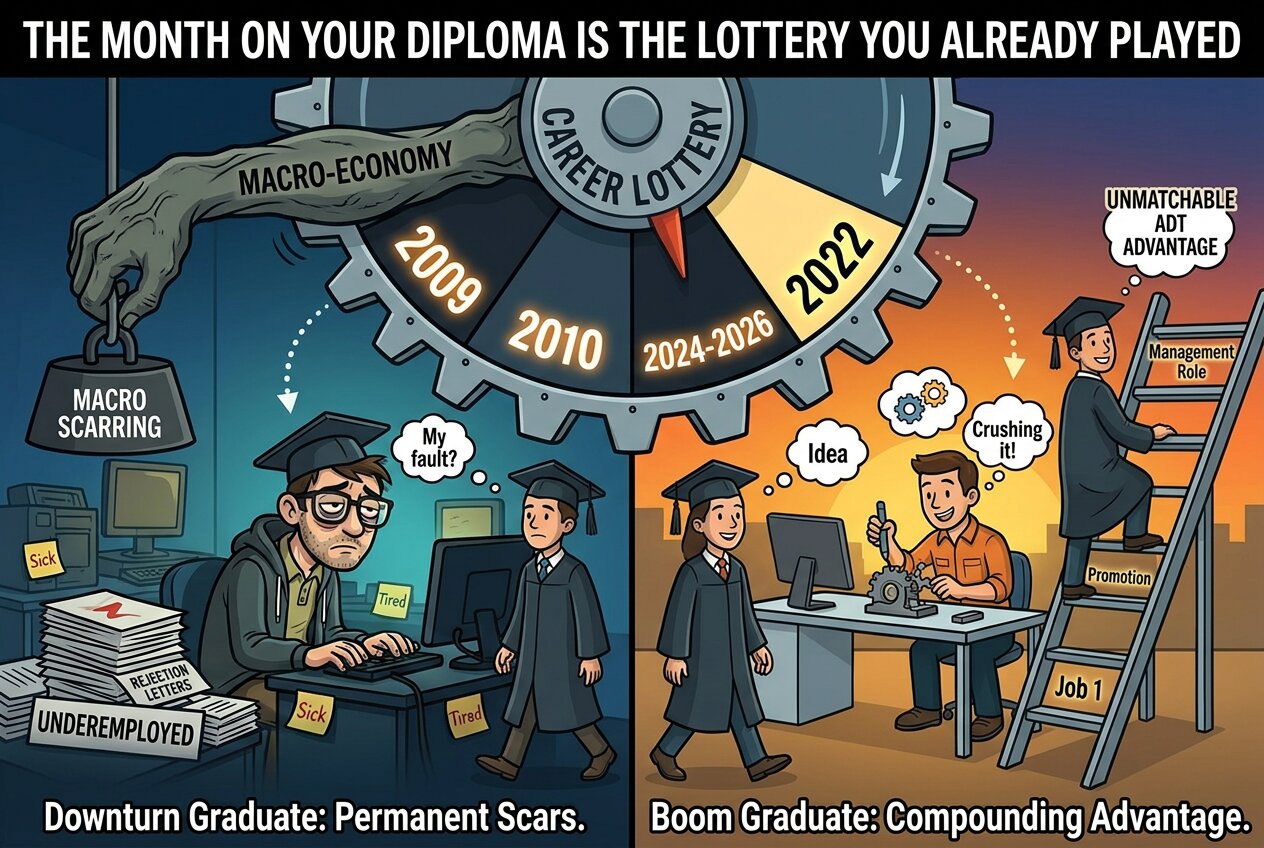
It's the month printed on your diploma.
The 2009 graduating class walked into the worst job market since the Great Depression. The jobseeker-to-opening ratio hit 8.5 to 1. Their average first-year wage? About $28,500. Fast forward to 2022 - graduates stepped into the tightest labor market on record, fewer jobseekers than openings, and landed average starting wages of $37,800. That's a 32% difference for doing the exact same degree, at the exact same school, with the exact same curriculum.
Same inputs. Wildly different outputs.
And here's where it gets darker: those recession graduates didn't just start lower. Research from the NBER shows that cohorts entering during downturns had lower employment rates throughout their entire careers. Not just for a year or two. Permanently. The wage gap? Studies document lasting losses for seven to fifteen years. Some effects dissipated after a decade. Some never did.
The fastest way to make yourself worth exactly zero
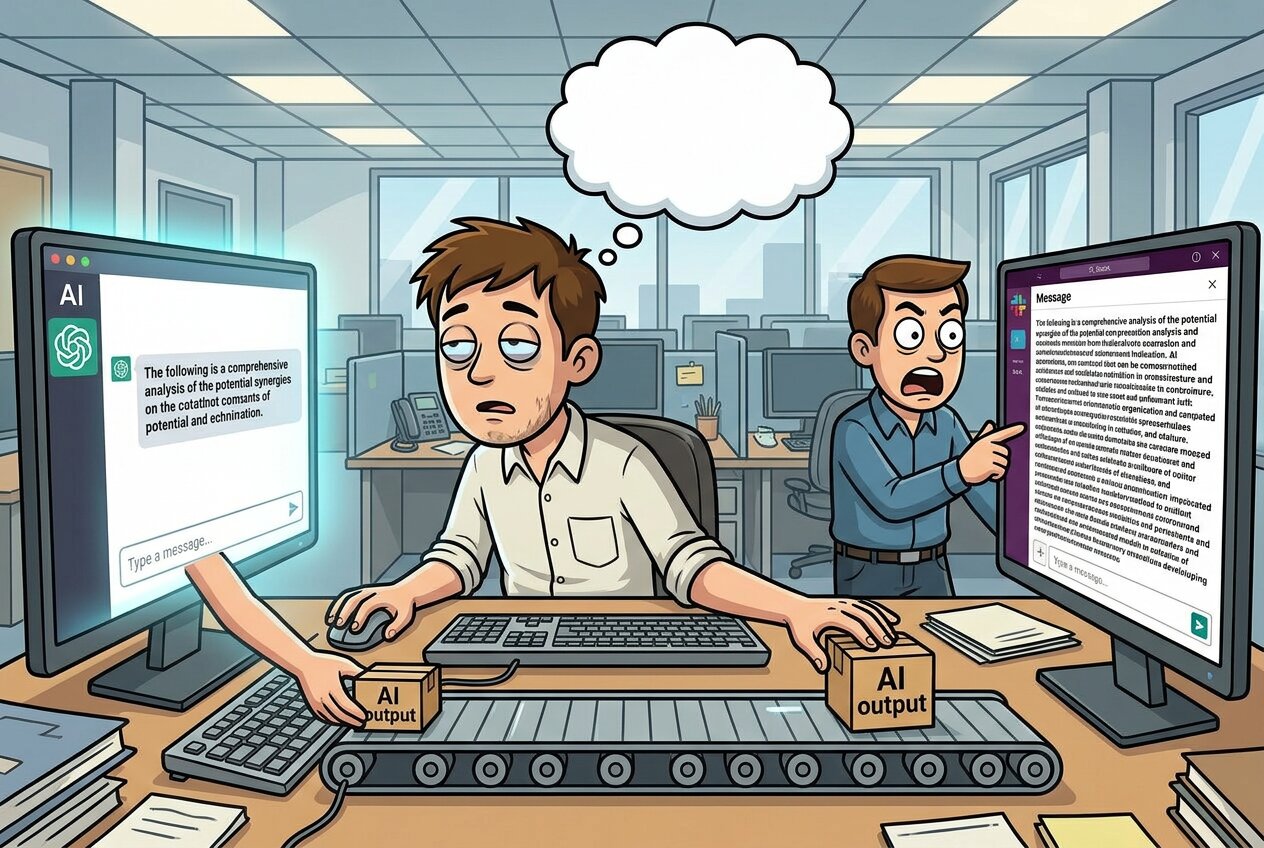
There is a new job title nobody applied for: meat proxy. A person who forwards AI-generated text, code, or output without reading, understanding, or validating it. A relay. A biological USB cable between a language model and a recipient who has the same model open in another tab.
I first noticed one in a ticket queue. A customer escalation, priority high, angry-but-still-polite tone, the kind you can fix in twenty minutes if you actually read the logs. The response that went out was 900 words of immaculate structure. Bullet points. A summary. A "next steps" section. Three suggestions, all technically plausible, none of them relevant, because the product had not behaved that way since two major versions earlier.
The customer replied in one line: "Did a human read this?"
That question is the whole problem. Once it gets asked, you never fully recover. Because the customer's next thought is the dangerous one: if a machine is answering me, why am I paying for you?
The economics are brutal and simple
Value comes from what is scarce. Text is not scarce anymore. Text is now a utility, like tap water, and roughly as expensive.
The best predictor of work ethic isn't on the CV. It's in the barn.
Engineering school, a lecture hall with bad acoustics, a course on people management and apprenticeship that most of us treated as a nap opportunity. One sentence from that semester survived everything else I learned that year:
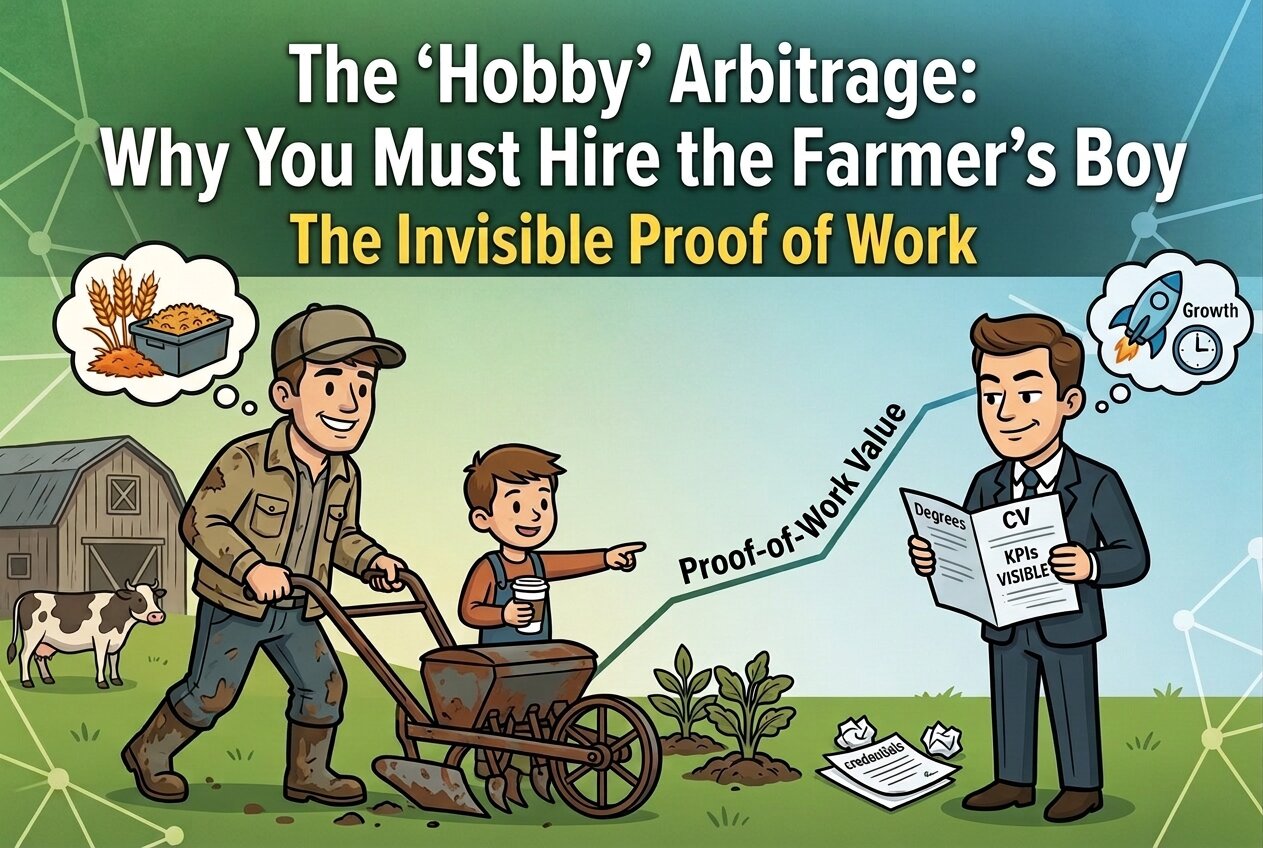
"Always hire the farmer's boy."
The professor didn't explain it as a joke. He meant it operationally.
The setup
You're a company. You post an apprenticeship. You get a stack of applications ranging from "barely finished school" to "has a degree and, apparently, questionable life choices." During the dot-com boom this got absurd - big firms hiring university graduates as apprentices, because the applicant flow was that distorted.
So you sit there with two folders.
Folder A: three years of college, decent grades, a personal statement written in the dialect of LinkedIn. Ambitious. Articulate. Knows the vocabulary of professionalism.
Folder B: high school, that's it. But the address is out of town. Family runs a farm, or a bakery, or a two-truck plumbing operation. Started helping at an age that would make a labor inspector twitch.
The professor's point: Folder B is usually the better trade. Not because of virtue. Because of training.
Why Every Great Company Eventually Micromanages Its Best People Out the Door
There is a moment in a company's life you can almost date to the week. Nobody announces it. No slide deck marks it. But if you were there early, you feel it like a change in air pressure.
It is the week the interview got shorter.
Phase one: the golden era nobody appreciates while it lasts
Small company. Twenty, maybe forty people. Hiring is brutal in the best way - four rounds, real technical depth, someone senior asking the one question that separates people who understand systems from people who memorized the vocabulary. Half the candidates fail. Good.
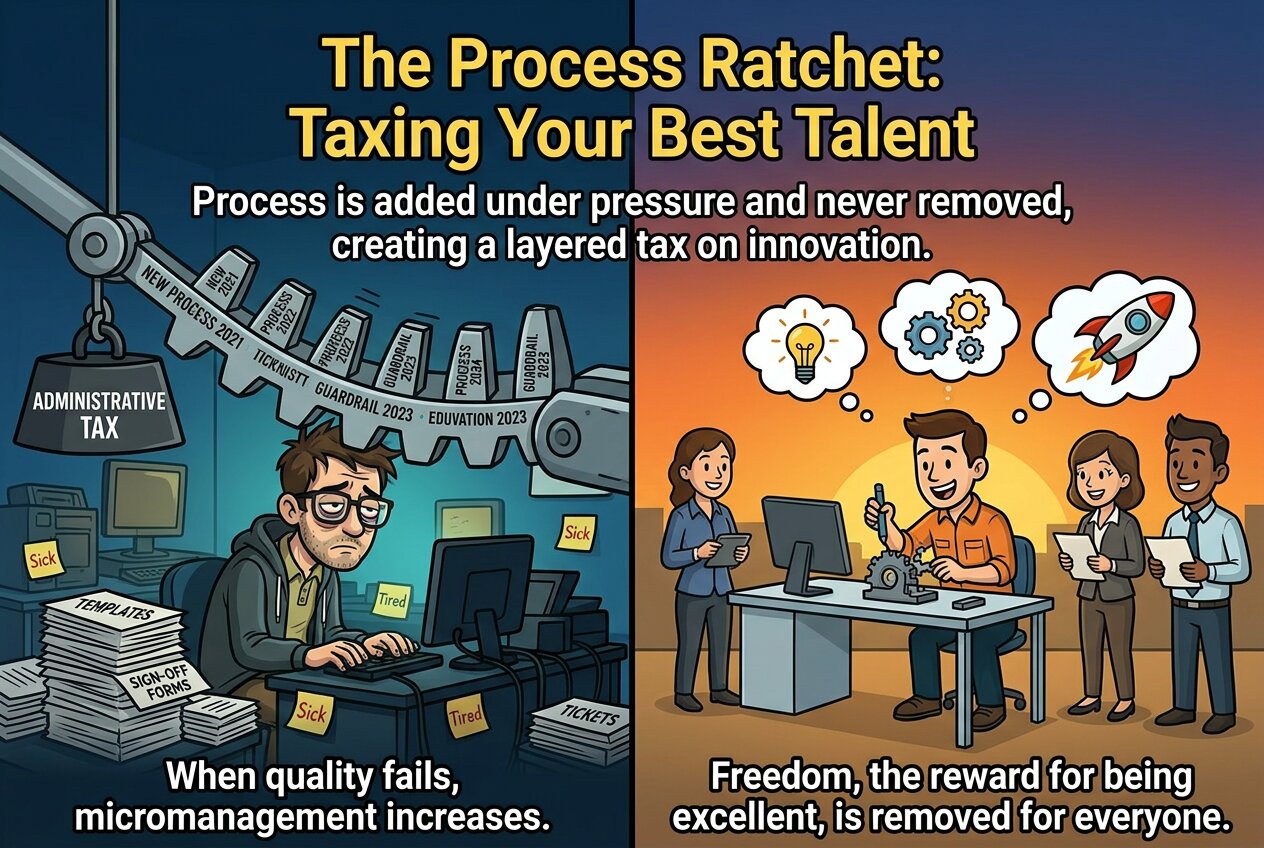
Because when you actually hire well, you don't need much else. Process count: low. Approval layers: roughly zero. Someone spots a problem in production at 22:00 and fixes it, and nobody asks whether a ticket existed first. Innovation happens because the distance between "idea" and "shipped" is one human being with permission.
And the slackers? They cannot hide. In a room of thirty, everyone knows within three weeks who carries weight and who carries a laptop. Social gravity does the performance management for free.
This is not a culture. This is a side effect of density and standards. Which is exactly why it dies.
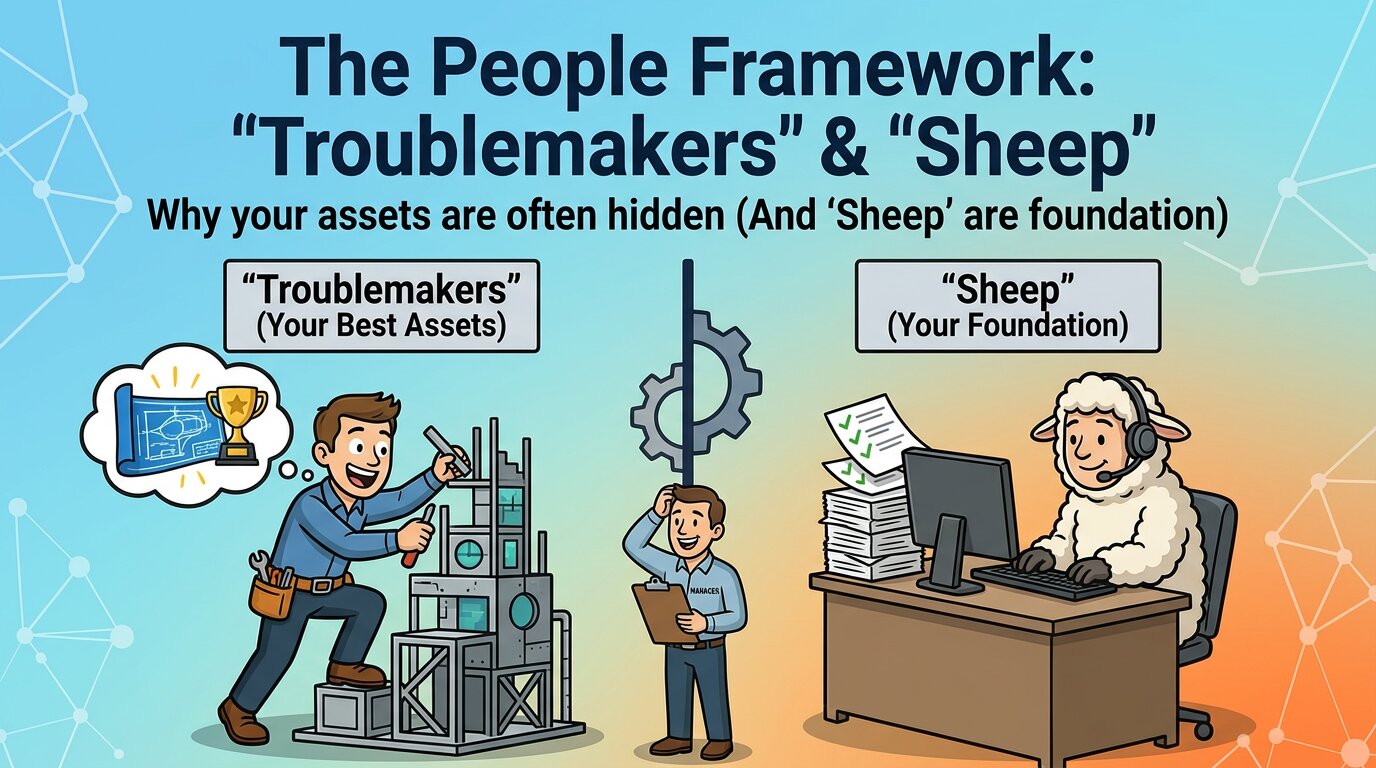
Why Your "Troublemakers" Are Your Most Valuable Assets (And Your "Sheep" Are Your Foundation)
You know the type. The engineer who has been in the same role for five years, never missed a single SLA, never complained, never suggested a change, never even looked at the process documentation because they had memorized it by year two. They just. Do. The work. Steady. Predictable. The kind of person you could set your watch by.
And then you know the other type. The one who, on day three, discovered a "creative" way to bypass the VPN because the VPN was slow and they had work to do. The one who asks "why" six times per meeting. The one who treats every rule like a suggestion and every process like a puzzle to be solved. The one who makes your compliance officer twitch.
Which one do you want on your team? Trick question. You want both, but not in the same seat. The problem is most companies treat them the same. They hire for one archetype, then promote based on another, and end up with a team that's either a zombie parade or a rebellion.
Let's be honest about human variance. Some people are deeply comfortable inside systems. They find safety in predictability. They execute reliably. Others are allergic to systems; they feel trapped by them, suffocated. Their brains light up when they spot a loophole or a way to optimize. Neither is good or bad. They are different operating systems. And if you place either one in the wrong environment, you get disaster.
 TrenchOps 🐎