 TrenchOps 🐎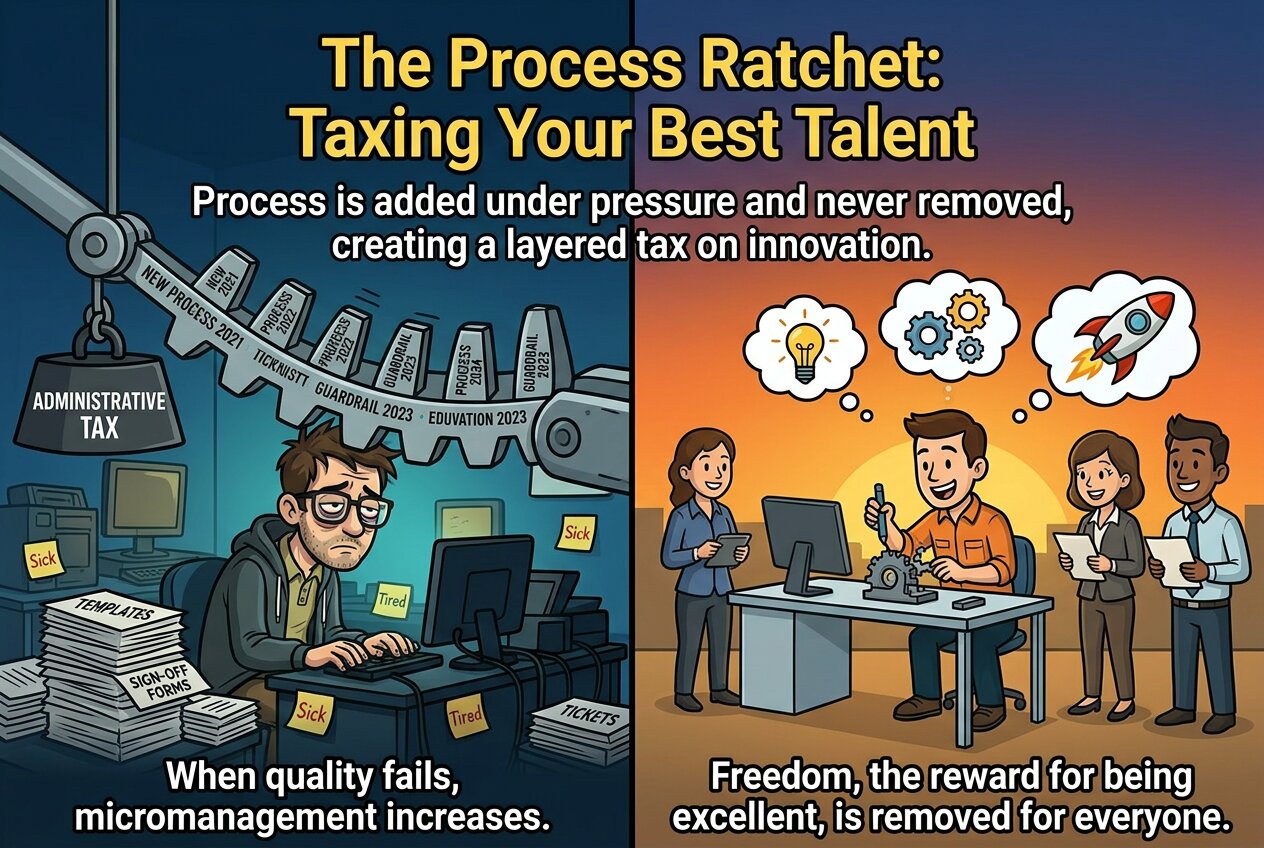
The Process Ratchet
Why Every Great Company Eventually Micromanages Its Best People Out the Door
There is a moment in a company's life you can almost date to the week. Nobody announces it. No slide deck marks it. But if you were there early, you feel it like a change in air pressure.
It is the week the interview got shorter.
Phase one: the golden era nobody appreciates while it lasts
Small company. Twenty, maybe forty people. Hiring is brutal in the best way - four rounds, real technical depth, someone senior asking the one question that separates people who understand systems from people who memorized the vocabulary. Half the candidates fail. Good.
Because when you actually hire well, you don't need much else. Process count: low. Approval layers: roughly zero. Someone spots a problem in production at 22:00 and fixes it, and nobody asks whether a ticket existed first. Innovation happens because the distance between "idea" and "shipped" is one human being with permission.
And the slackers? They cannot hide. In a room of thirty, everyone knows within three weeks who carries weight and who carries a laptop. Social gravity does the performance management for free.
This is not a culture. This is a side effect of density and standards. Which is exactly why it dies.
Phase two: the compression
Growth arrives. Suddenly the roadmap needs twelve engineers by Q3, the support queue is doubling monthly, and someone in a leadership meeting says the sentence that ends the golden era:
"We can't afford to be that picky right now."
The four-round loop becomes one screen and a manager chat. The candidate who would have been a polite no last year is now "coachable." Ten hires later, the distribution of talent inside the company has quietly shifted, and the interesting part is that nobody notices through people. They notice through output.
Bugs that shouldn't exist. Escalations that should have died at L1. A design review where someone asks what a race condition is and is not joking.
Phase three: the diagnosis that is guaranteed to be wrong
Here is where it becomes fascinating, in the way a slow-motion car crash is fascinating.
Management sees declining quality and reaches for the only lever visible from the top floor: process. Reviews. Sign-offs. Mandatory templates. Time tracking. A quality initiative with a name and a logo.
The logic is not insane. If output is inconsistent, constrain the output. Add guardrails.
But look at what actually happens. Process is applied uniformly, because that is the only way it can be applied. The freedom that was the reward for being excellent gets removed from everyone - to compensate for the people who were hired without meeting the old bar. You just taxed your best performers to subsidize your hiring shortcut.
This is a ratchet. Process gets added under pressure and never removed, because removing a control requires someone to sign their name next to "I decided we need less oversight." Nobody does that voluntarily. So the constraint layer thickens, year after year, each layer a fossil record of a hiring decision made in a hurry.
Your power horses 🐎 do the math in about a quarter. Same salary, half the autonomy, twice the meetings, and their work now arrives at the customer through four handoffs that leak energy at every step. Two outcomes, both bad for you: they regress to the company mean, or they leave.
Then they land somewhere smaller, where hiring is still brutal and process is still thin, and the golden era starts again. And people call them job hoppers.
The part where the quality project cannot save you
I have watched several of these initiatives. The outcome is binary and both branches are dead ends.
Branch one: an honest, capable person runs the review. They produce a clear report that says the root cause is roughly sixty hires from a specific eighteen-month window and a couple of managers who cannot evaluate technical work. Acting on this means mass dismissals and admitting a very expensive mistake at board level. Probability of execution: near zero. The report gets "phased."
Branch two: the review is owned by one of the people who caused it. Findings: process maturity needs improvement, tooling investment recommended, mandatory training rolled out. Everyone nods. More process. Ratchet clicks. The problem is now officially addressed and permanently unsolved.
You cannot audit your way out of a selection problem. The measurement is downstream of the cause, and the cause has hiring authority.
The bad manager multiplier
One hire in that panic window matters more than all the others: the manager who cannot tell good work from confident work.
Because that person does not underperform once. They hire. And they hire people who do not threaten them, who talk fluently in status updates, who are excellent at the appearance of work. Within two years, they have built a small parallel organization optimized for looking busy, and it is politically load-bearing - you cannot remove it without a reorg, and reorgs get postponed.
Bureaucracy-servers reliably outmaneuver mission-servers, and they do it with paperwork, not malice. The mission-servers are busy serving the mission. That is the entire asymmetry.
One bad manager in a desperate quarter is not a personnel issue. It is a compounding liability with hiring rights.
What actually works
I will not pretend this is fully solvable. But the failure has a mechanism, and mechanisms have pressure points.
👉 Freeze the bar, flex the timeline. You can hire slower or hire worse. Only one of those is reversible. A role empty for three months costs you a quarter of output; a wrong hire costs you two years, the process layer they trigger, and the two good people who quit because of it.
👉 Never delegate the hiring bar to whoever owns the deadline. The person under headcount pressure will always find a reason the candidate is good enough. Separate the two roles structurally, and give the bar-owner a veto that survives escalation.
👉 Give every new process an expiry date. Written down, with a name attached. If it still earns its keep in twelve months, renew it. Most won't. This is the only thing I have ever seen break the ratchet - default deletion instead of default accumulation.
👉 Ask the inverted question in the leadership meeting. "If we wanted to guarantee our best engineers leave within eighteen months, what would we do?" Then count how many items are already on your roadmap. It takes ten minutes and it is more accurate than any engagement survey.
👉 Watch the manager layer three times harder than the IC layer. A weak individual contributor costs you one salary. A weak manager costs you their entire hiring output, permanently.
👉 If you are the power horse: measure trajectory, not state. Bad quarters happen. What matters is whether autonomy is being restored or removed. If the process layer has grown for two consecutive years and the last three senior hires came in above the people who built the thing, you already have your answer. Adjust to the new reality with open eyes, or leave early and cleanly. Waiting for it to improve is the expensive option, and hope is not a retention strategy.
Companies do not lose their edge because they stopped caring about quality. They lose it because they lowered the entry bar once, then spent the next five years building process to contain the consequences - and charged the bill to the people who never needed containing.
👇 What is the most absurd process in your company that exists purely because someone was once hired too fast?
This article is also available in German.
0 comment(s)
No comments yet. Be the first to comment.
Leave a comment