 TrenchOps 🐎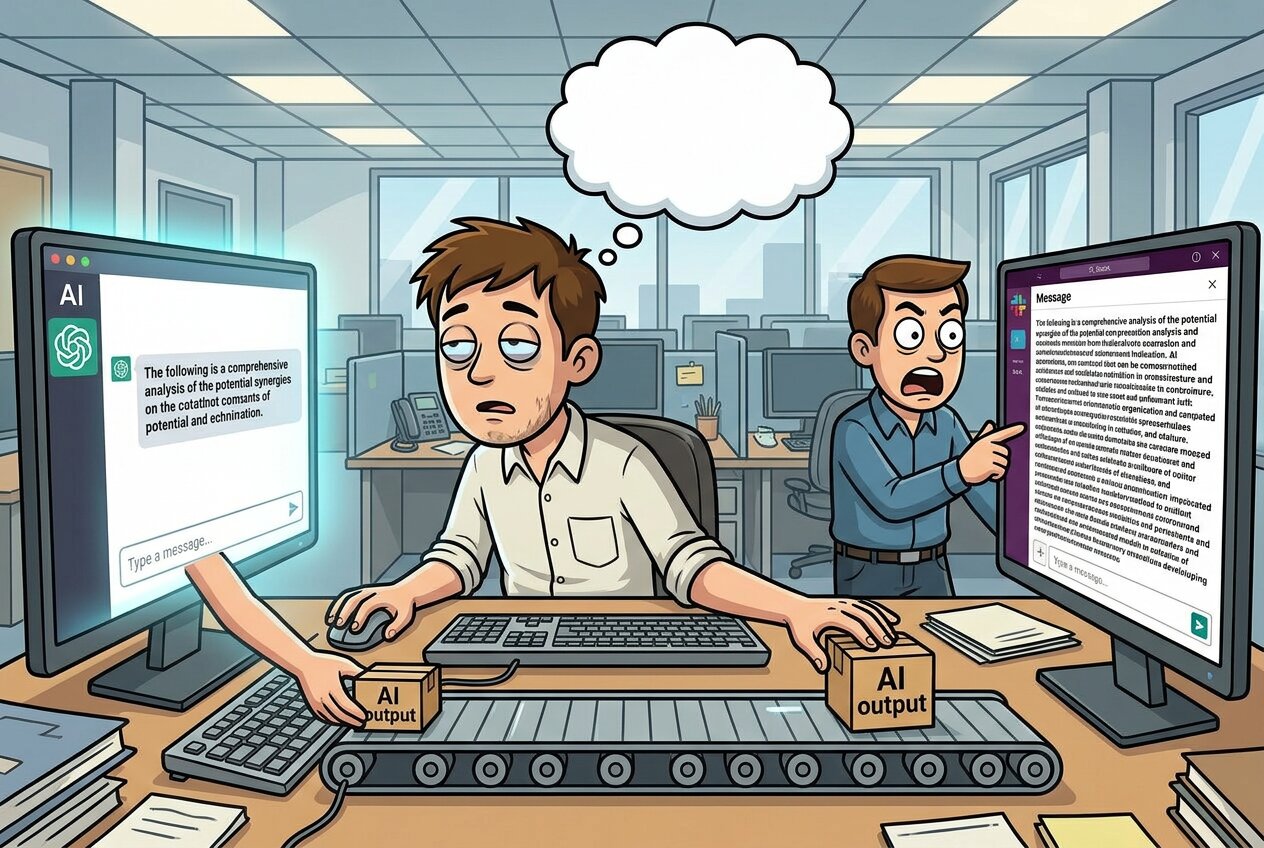
Don't Be a Meat Proxy
The fastest way to make yourself worth exactly zero
There is a new job title nobody applied for: meat proxy. A person who forwards AI-generated text, code, or output without reading, understanding, or validating it. A relay. A biological USB cable between a language model and a recipient who has the same model open in another tab.
I first noticed one in a ticket queue. A customer escalation, priority high, angry-but-still-polite tone, the kind you can fix in twenty minutes if you actually read the logs. The response that went out was 900 words of immaculate structure. Bullet points. A summary. A "next steps" section. Three suggestions, all technically plausible, none of them relevant, because the product had not behaved that way since two major versions earlier.
The customer replied in one line: "Did a human read this?"
That question is the whole problem. Once it gets asked, you never fully recover. Because the customer's next thought is the dangerous one: if a machine is answering me, why am I paying for you?
The economics are brutal and simple
Value comes from what is scarce. Text is not scarce anymore. Text is now a utility, like tap water, and roughly as expensive.
What is scarce: knowing which of the three plausible answers is the one that will not detonate in production. Knowing that this customer's environment has a legacy config nobody documented. Knowing that the elegant recommendation violates a contractual clause somebody negotiated years ago in a room full of lawyers.
That is judgment. Judgment is proof of work - it costs you something to acquire, which is exactly why it cannot be faked. Forwarding output is proof of title: it looks like the work of someone who knows, without any of the cost. And systems secured by appearance instead of cost get gamed, always, immediately, by everyone.
The meat proxy has voluntarily moved from the scarce side of the equation to the abundant side. Then acts surprised when the budget conversation goes badly.
The tell is always the same
People do smell it from a mile away, and not because of vocabulary. Nobody gets caught for saying "moreover."
They get caught because the text is too smooth for the situation. Real expertise is lumpy. It has an opinion, a caveat, a "we tried that in March and it made things worse," a sentence that ends abruptly because that is genuinely all there is to say. AI output is uniformly confident and uniformly polished across every paragraph, including the paragraphs that should have been uncertain.
Confidence that does not vary with the evidence is the signature. It reads like a colleague who has never once said "I don't know" - and you already know how much you trust that colleague.
There is a second-order effect that makes this worse. Language models are trained to be agreeable, and a preprint making the rounds argues that sycophantic chatbots can push users into escalating spirals of wrong belief - even users who update on evidence perfectly rationally. Not because the machine lies, but because a stream of validation is itself evidence to a mind counting agreements. So the meat proxy is not just forwarding text. They are forwarding a mirror, growing more certain with every round, while their actual understanding of the system quietly rots.
The part that should scare managers
Another preprint calls it the tragedy of the cognitive commons: expertise regenerates through juniors doing the annoying, low-value, character-building work. The Level 1 tickets. The stupid config errors. The four hours of log reading that produce one sentence of insight.
That work is exactly what is easiest to hand to a model. So we automate away the training ground and keep the senior roles that can only be filled by people who once survived the training ground. Everyone books a productivity win this quarter. In five years, the org discovers the seniors did not spawn from anywhere.
I have seen this fail before AI existed, in a smaller and more embarrassing form: outsource all first-level support, and eventually nobody left in the building knows what customers actually break. Same mechanism. New tooling, better grammar.
The part that should terrify executives
Here is the twist that makes the cognitive commons problem immediate, not theoretical: companies are not just automating the training ground. They are actively optimizing for meat proxies while firing the people who actually know things.
The numbers are not subtle. Entry-level tech hiring at major companies is down roughly 65% compared to pre-pandemic levels. At early-stage startups, it is down 76%. Meanwhile, 32% of US hiring managers have already eliminated a role because of AI - and then rehired for the same or a similar position after the automation failed to deliver. Ford brought back hundreds of engineers after automated systems could not handle quality issues. Commonwealth Bank reversed customer service layoffs after an AI voice bot increased call volume instead of reducing it. IBM automated HR functions, watched the bot handle 94% of routine requests beautifully, then discovered that the remaining 6% - the ones involving actual judgment - went catastrophically wrong.
The pattern is always the same. The expensive senior engineer 🐎 who costs 180k and has fifteen years of scar tissue in their head gets cut. Three juniors with "AI skills" get hired at 60k each. On the spreadsheet, headcount went up while cost stayed flat. Looks like a win. The juniors prompt their way through the first few months of routine work, and someone presents a slide about productivity gains.
Then a production incident hits that requires knowing why that particular microservice was architected that way in 2019, or which customer has a contractual SLA that overrides the standard escalation path, or that the monitoring dashboard has been lying since the last infrastructure migration because nobody recalibrated the thresholds. The juniors ask the model. The model answers confidently. The answer is wrong in ways that require the exact expertise that just got walked out the door with a cardboard box.
This is not a hypothetical. Quality is visibly degrading across industries right now - in support responses, in code reviews, in architecture decisions, in customer-facing documentation. Anyone who has worked with enterprise software in the last year can feel it. Responses are faster and more polished than ever, and also more wrong than ever. The grammar improved while the accuracy collapsed. We achieved the remarkable engineering feat of making failure look professional.
The senior market tells the story in reverse: 71% of the rebound in software development job postings over the past year came from senior positions. Companies are starting to realize they need people who actually know what they are doing. Some of them are the same companies that cut those people eighteen months ago.
There is a term in manufacturing for the ratio between what a finished product costs and what its raw inputs cost. When the ratio is enormous, it means the process is broken - not that the inputs are expensive. Right now, companies are looking at senior engineer salaries and concluding the inputs are too expensive. They are not asking why it costs so much to produce working software in their organization, which is the question that would actually save them money.
Cutting the person who holds the judgment and hiring three people who hold a subscription to the same tool the customer already has access to is not cost optimization. It is the corporate equivalent of selling your foundation to pay for a nicer facade.
So what do you actually do
👉 Use the model to draft, never to decide. The decision is the only part anyone is paying for.
👉 If you cannot defend every sentence in a meeting without help, you cannot send it. That is the entire quality gate.
👉 Delete more than you add. The AI's second paragraph is almost always padding, and padding is a confession.
👉 Deliberately keep some work manual, especially for juniors. Not for nostalgia - for the pipeline. The struggle is the curriculum.
👉 Add the lump. One specific detail from this customer, this environment, this history. It is the cheapest proof of humanity available and it is unforgeable.
👉 Never let output go out that you would be embarrassed to be asked about. Ask yourself: would I bet my reputation on paragraph four?
The model is a fast intern with a perfect memory, no shame, and zero consequences. You are the one with skin in the game - act like it, or someone will eventually notice they can cut out the middleman, and the middleman is you.
👇 What is your tell? How do you spot forwarded output in a ticket, a pull request, or a job application?
This article is also available in German.
0 comment(s)
No comments yet. Be the first to comment.
Leave a comment