 TrenchOps 🐎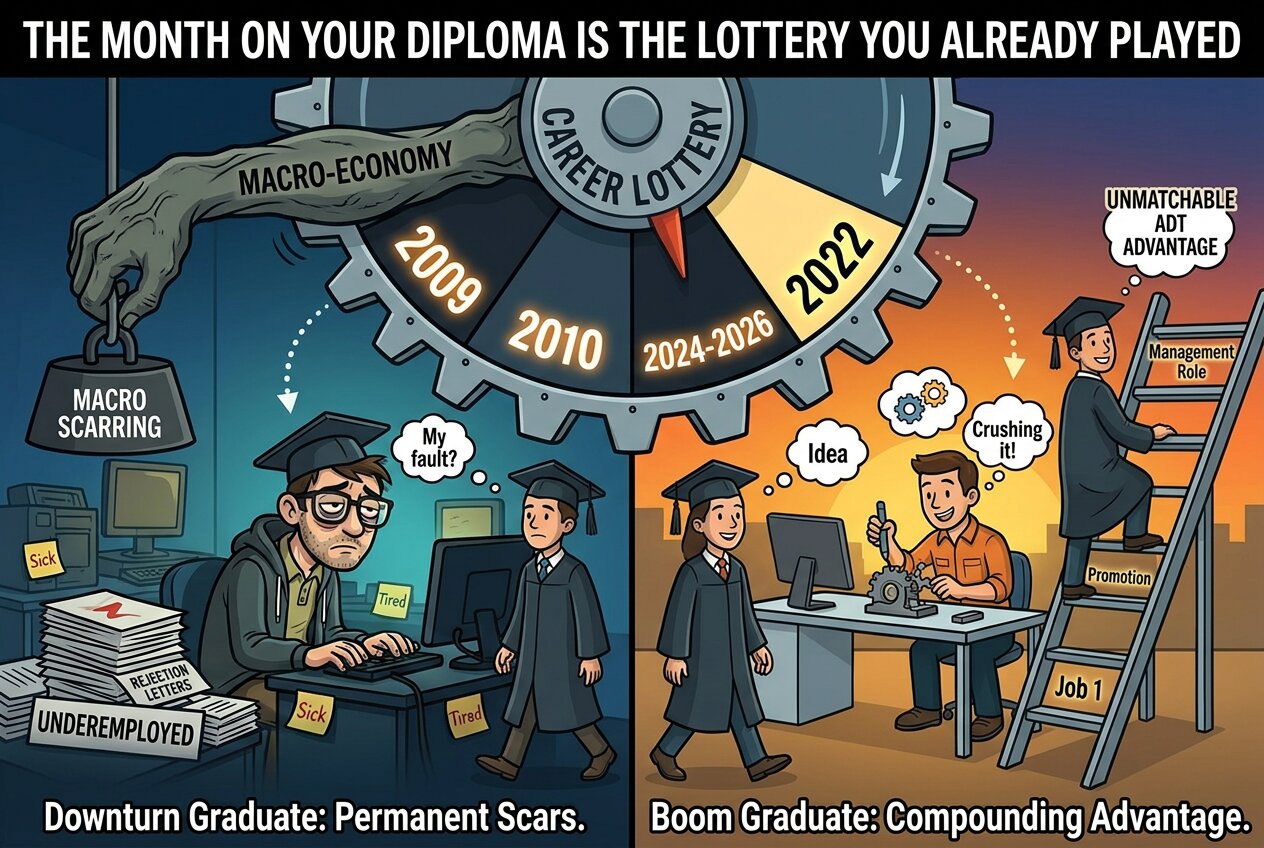
The Career Lottery You Already Played
Why two equally talented people end up in completely different orbits - and what to do if you drew the short straw
There's a variable that matters more than your GPA, your interview skills, and your LinkedIn headline combined.
You can't study for it. You can't network around it. You can't optimize it with a better resume font.
It's the month printed on your diploma.
The 2009 graduating class walked into the worst job market since the Great Depression. The jobseeker-to-opening ratio hit 8.5 to 1. Their average first-year wage? About $28,500. Fast forward to 2022 - graduates stepped into the tightest labor market on record, fewer jobseekers than openings, and landed average starting wages of $37,800. That's a 32% difference for doing the exact same degree, at the exact same school, with the exact same curriculum.
Same inputs. Wildly different outputs.
And here's where it gets darker: those recession graduates didn't just start lower. Research from the NBER shows that cohorts entering during downturns had lower employment rates throughout their entire careers. Not just for a year or two. Permanently. The wage gap? Studies document lasting losses for seven to fifteen years. Some effects dissipated after a decade. Some never did.
The 2009-2010 cohort experienced this firsthand. By the time they hit their early thirties, fewer than 10% held management positions - compared to 12% for pre-recession cohorts doing the same work at the same age. They were more likely to be underemployed, more likely to be in roles that didn't match their education, more likely to be working part-time involuntarily.
And now? The 2024-2026 graduates are walking into their own version of this. Different flavor, same mechanism. Tech layoffs, AI anxiety, frozen headcount, "we're not backfilling that role." The specifics change. The math doesn't.
Two equally talented people. Two completely different trajectories. Because of a date on a calendar.
The part nobody tells you
Here's what makes this truly insidious: the effects are invisible to the people experiencing them.
When you graduate into a bad market, you don't think "I'm being scarred by macroeconomic conditions." You think "I'm not good enough." You watch people who graduated two years earlier sitting in roles you can't even get interviews for, and your brain does what brains do - it constructs a story about personal failure.
Meanwhile, the person who graduated into a boom doesn't think "I got lucky with timing." They think "I'm crushing it." They get the first rung on the ladder, which leads to the second, which leads to the third. Compounding works in careers exactly like it works in finance. A 15% head start in year one becomes an uncatchable gap by year ten.
This is the cruel math of initial conditions. Physicists call it sensitivity to initial conditions. Chaos theory. The butterfly effect, except the butterfly is a central banker who moved interest rates six months before your graduation.
And organizations make it worse. Because hiring managers screen resumes for trajectory. A two-year gap after graduation? A lateral move when you "should have" been climbing? A stint in retail when your degree says engineering? Recruiters don't see macroeconomics. They see a candidate who "couldn't hack it." The scar becomes self-reinforcing.
What actually helps (and what doesn't)
Let me be honest: there is no hack that fully neutralizes bad timing. Anyone selling you "recession-proof your career in 5 easy steps" is lying. The data is clear - timing effects are real and they persist.
But "persist" is not "permanent." And the research also shows something else: the gradient matters. Workers with higher education and more specialized skills were less harmed by recessions and recovered faster. Not because the degree itself was magic, but because specialized, demonstrable skill creates demand that survives downturns.
So here's what I'd actually tell someone graduating into a bad market, based on two decades of watching careers play out:
👉 Take the job that teaches, not the job that pays. In a down market, your first role probably won't match your expectations. That's fine. Optimize for skill acquisition speed, not title. The person who spent two "lost years" learning systems architecture in a role that was technically beneath them came out ahead of the person who held out for the "right" title and spent those years sending applications into the void.
👉 Build proof of work, not proof of credentials. When the market is tight, credentials are table stakes. When it's loose, they're noise. What cuts through in any market: tangible evidence you can do the thing. Open source contributions. A homelab. A blog that shows your thinking. A side project that solved a real problem. Hiring managers in bad markets get 500 applications per role. They're not reading cover letters. They're looking for signal.
👉 Stop comparing your trajectory to people who entered in different conditions. This sounds like therapy advice, and it is, but it's also strategic. The moment you internalize "I'm behind" as an identity, you start making defensive career moves - taking safe roles, avoiding risk, staying too long in places that feel secure but teach you nothing. The person who graduated into a boom and got promoted twice isn't smarter than you. They had tailwinds. Comparing your climb against their glide is a category error.
👉 Understand that the gap closes - but only if you keep compounding. The research consistently shows recession scarring effects dissipate over roughly ten years. But that's an average. It dissipates because people keep building skills, keep moving, keep stacking experience. If you stall out in a comfortable-but-dead-end role because you're grateful someone finally hired you, the gap never closes.
👉 If you're a hiring manager: recognize the lottery for what it is. Some of the best people I've ever worked with had "weird" early careers because they graduated into terrible markets. They took detours. They have resume gaps. They spent time in roles that don't look linear. That's not a red flag. That's someone who survived a down market and kept going. Those people tend to be resilient, resourceful, and deeply motivated. They're 🐎 power horses with unconventional paperwork.
The part that should make leaders uncomfortable
Here's what bothers me about this entire dynamic: organizations benefit from recession timing just as much as individuals suffer from it.
When the market is bad, companies get to hire overqualified people for underqualified pay. They get grateful employees who don't negotiate, don't push back, and don't leave. They get a buyer's market and they squeeze it for every drop.
Then, five years later, those same companies wonder why their "loyal" employees seem disengaged. Why the people they hired cheaply during the downturn aren't performing like the people they had to fight for during the boom.
The answer is obvious if you think about incentives for more than thirty seconds. You hired people in a moment of maximum desperation and minimum leverage, and you built their entire compensation and career trajectory on that foundation. You didn't get loyalty. You got captivity. And captive employees perform exactly like captive animals - they survive, but they don't thrive.
The companies that win long-term are the ones that re-price their recession hires when the market recovers. Proactively. Without being asked. Because they understand that someone's starting salary in 2009 says nothing about their value in 2015, and anchoring to it is just a slow way to lose your best people.
There's no moral to the story of timing. It's not fair. It was never going to be fair. The economy doesn't care about your potential, your work ethic, or your four-year plan.
But here's what I've seen over and over: the people who got dealt a bad hand and understood it was a bad hand - not a personal failing - played the long game differently. They stopped chasing titles and started chasing skills. They stopped comparing timelines and started building compounding advantages. They came out the other side slightly later, slightly angrier, and significantly more dangerous.
The market decides your starting position. You decide your velocity. And velocity, compounded over a career, always beats a head start that got comfortable.
👇 Did you graduate into a boom or a bust? How did it shape your first five years - and did the effects ever fully fade?
This article is also available in German.
0 comment(s)
No comments yet. Be the first to comment.
Leave a comment