Three things kill small businesses that never appear in a business plan: the room you work in, the stories you absorb, and the money that was never yours.
I have been self-employed a few times. Before my enterprise career, between two of them, and on the side. None of it made me rich. All of it taught me things you cannot learn from a startup podcast, because podcasts talk about scaling and my problem was that a customer's dog did not like me.
Let me hand over the three lessons that actually cost me something
Your business has a physical address, even when you think it doesn't
Everyone starts in the bedroom, the garage or the study. Fine. Nobody plans the other rooms.
One of my ventures was classic IT service. Persuading stubborn printers to acknowledge the existence of WiFi. Removing pre-installed bloat from our favorite corporate operating system. Explaining, for the fourth time, that a tablet needs updates. Mostly on-site, at people's homes.
Some clients objected to travel fees. Reasonable. They wanted to come to me. Slight problem: I had no office and no presentable workshop. So I invited them into my dining room - statistically the least private room in the house, right up until a stranger sits in it holding a coffee cup and telling me about his divorce while I diagnose a random reboot.
Why a five-stage interview process tells you everything about the job - before you even get it
The job post says "fast-paced environment." The process says recruiter screen, hiring manager call, take-home assignment, technical deep dive, second technical deep dive, "culture add" panel, psychometric questionnaire, and a final chat with a VP who will ask you where you see yourself in five years.
That's eight rounds. For a company that claims to "move fast".
Believe the process, not the post.
Times are rough. Plenty of good people lost their jobs to the AI wave, and plenty more are quietly refreshing job boards at their desks. My personal bet is that once the AI honeymoon ends, a lot of companies will discover that their institutional knowledge left in a cardboard box, and they'll be rehiring. Until then, desperation is a terrible career advisor. It tells you to say yes to every round, every test, every "just one more quick call with a stakeholder."
Don't. Here's why.
What an interview is actually for
A competent company reads your CV and can map your skills to its needs. With a little effort, it can verify most of your history. So the interview only has three real jobs.
Why two equally talented people end up in completely different orbits - and what to do if you drew the short straw
There's a variable that matters more than your GPA, your interview skills, and your LinkedIn headline combined.
You can't study for it. You can't network around it. You can't optimize it with a better resume font.
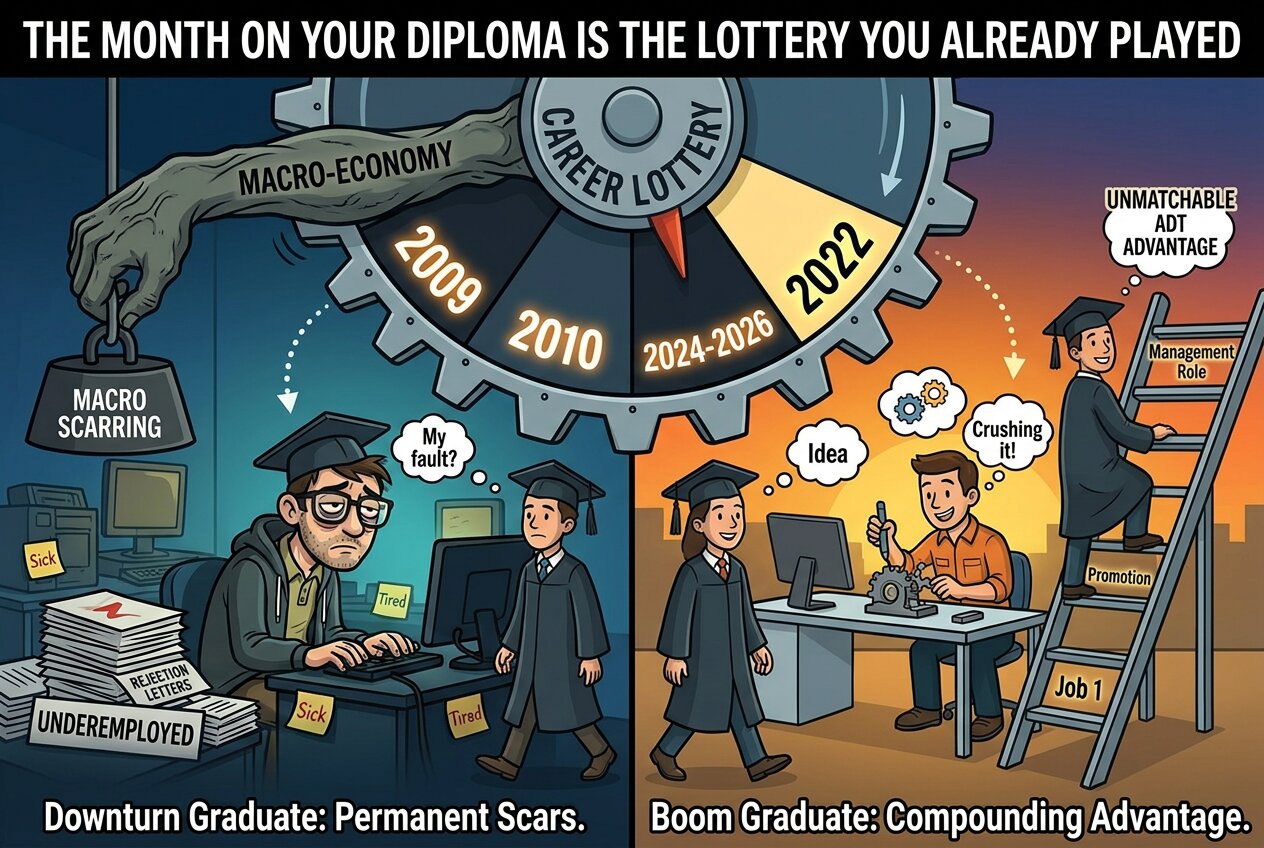
It's the month printed on your diploma.
The 2009 graduating class walked into the worst job market since the Great Depression. The jobseeker-to-opening ratio hit 8.5 to 1. Their average first-year wage? About $28,500. Fast forward to 2022 - graduates stepped into the tightest labor market on record, fewer jobseekers than openings, and landed average starting wages of $37,800. That's a 32% difference for doing the exact same degree, at the exact same school, with the exact same curriculum.
Same inputs. Wildly different outputs.
And here's where it gets darker: those recession graduates didn't just start lower. Research from the NBER shows that cohorts entering during downturns had lower employment rates throughout their entire careers. Not just for a year or two. Permanently. The wage gap? Studies document lasting losses for seven to fifteen years. Some effects dissipated after a decade. Some never did.
I earned 50k a year and was still broke - here's the physics of getting out
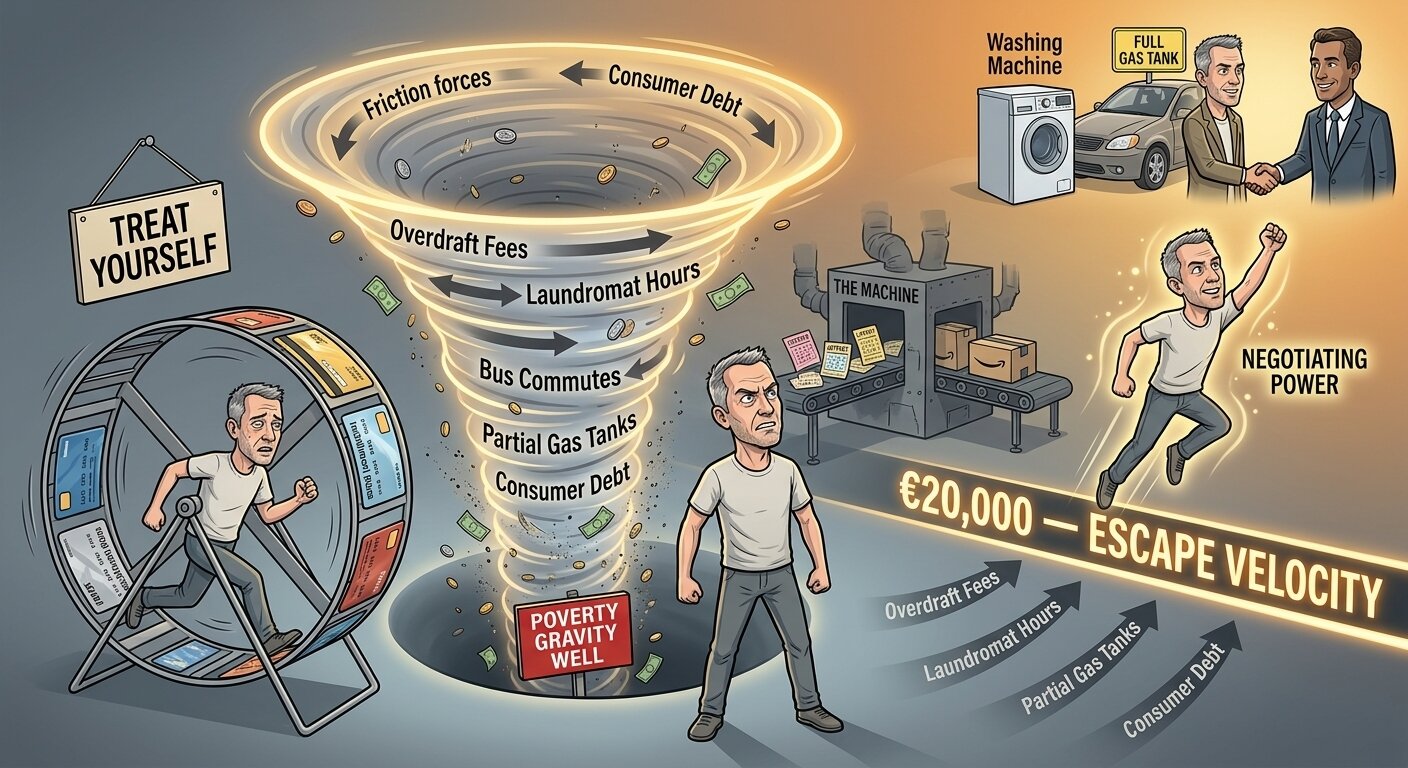
I once earned 50,000€ a year - roughly an average German household income at the time - and I had nothing. No savings, no buffer, overdraft fees every other month. That number shouldn't exist. But it sits in millions of bank accounts, and it proves something uncomfortable: poverty is rarely an income problem. It's a behavior problem wrapped in a physics problem.
This might hurt some feelings. It hurt mine first.
Hand a broke person a pile of money and check back in a few years. Lottery winners do this experiment for us constantly, and plenty end up worse off than before the win. The money didn't change the machine that burns it.
I know the machine from the inside. When I was young, payday meant Amazon order day. A side gig paid me 100€ cash? Straight to McDonald's to celebrate. My family was the hardest-working family I knew, and they lived paycheck to paycheck their entire lives. Not because they were lazy - because they never negotiated, never walked away from an abusive employer, and ruined their bodies for a wet handshake, terrified they'd never find work again.
Here is a fun statistic nobody keeps: how many careers get quietly strangled in a classroom before they ever begin. No dashboard for that. No postmortem. Just a tired adult with tenure telling a kid to give up, and the kid believing them.
Many years ago I attended a vocational school for information technology. It was there, ironically, that I met some of the most incompetent people I have ever encountered in IT. Not the students. The teachers.
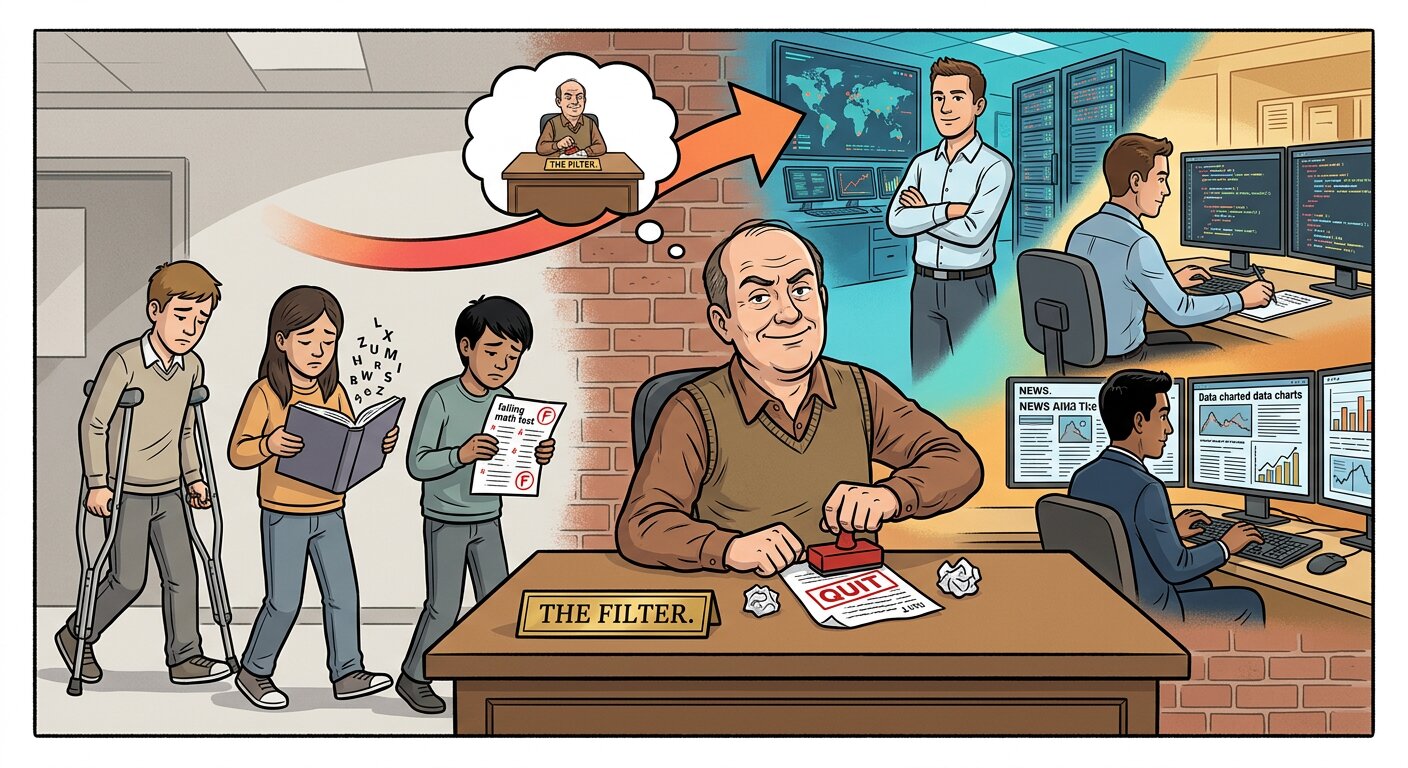
They were all civil servants. Which in Germany means roughly the professional equivalent of a load-bearing wall - you can repaint it, you can complain about it, but you are not removing it. Performance was optional. Consequences were theoretical. And a few of them wore this like a medal. One openly bragged about his failure rates, as if drowning students early was a public service. In his mind he was a filter, weeding out the untalented before they could embarrass the profession.
Let me introduce you to three of the people he filtered.
👉 The foreigner who came to IT through a broken body.
The first kid had already finished an apprenticeship in a skilled trade. Loved it, was good at it, had a plan. Then a village festival, a fight he did not start, and an injury that ended his ability to do the work he had trained for. The employment office paid for a two year retraining program into IT. That was the deal, and the deal had no plan B. No completion meant no more support. On top of that, he carried a very specific cultural weight - the fear of disappointing his family, which for him was not a mood but a load-bearing beam of his entire identity.
If your European tech company is not making these demands of every vendor, you are subsidizing the offshoring of your own economy and gambling with your sovereignty. I once sat through a postmortem with a German SaaS company that had a Severity 1 outage lasting 38 hours. Their vendor had a platinum support contract with "30-minute first response" but the first response was from Bangalore, asking, "Have you tried restarting the service?" After escalating for 6 hours, they got someone who knew the product - but that someone was in the US and needed to wake up. The contract had no teeth, the data was on AWS us-east-1, and the vendor's escalations went through three continents before reaching someone with decision power.
This is not a support experience. It is a hostage situation.
If you are a larger European tech company, you are actually in a position to make demands. You have the leverage. Use it. Here is the minimum you should enforce with every vendor and service provider. Do not apologize. Do not negotiate on the top items.
Top Priority - Non-Negotiable Core
Data hosted exclusively in Europe
Your PII, your customer data, your telemetry, your configuration, your logs - everything must be stored and processed within the EU. That means no data replication to US regions, no backup in Israel, no disaster recovery in Singapore unless it meets the same standard. The US has the Cloud Act and the Patriot Act. Europe has GDPR, and it is the strongest data protection framework on earth, but it only works if your data never leaves. Include contractual language that forbids data transfer to any territory without adequate protection, with explicit penalties for violating data residency.
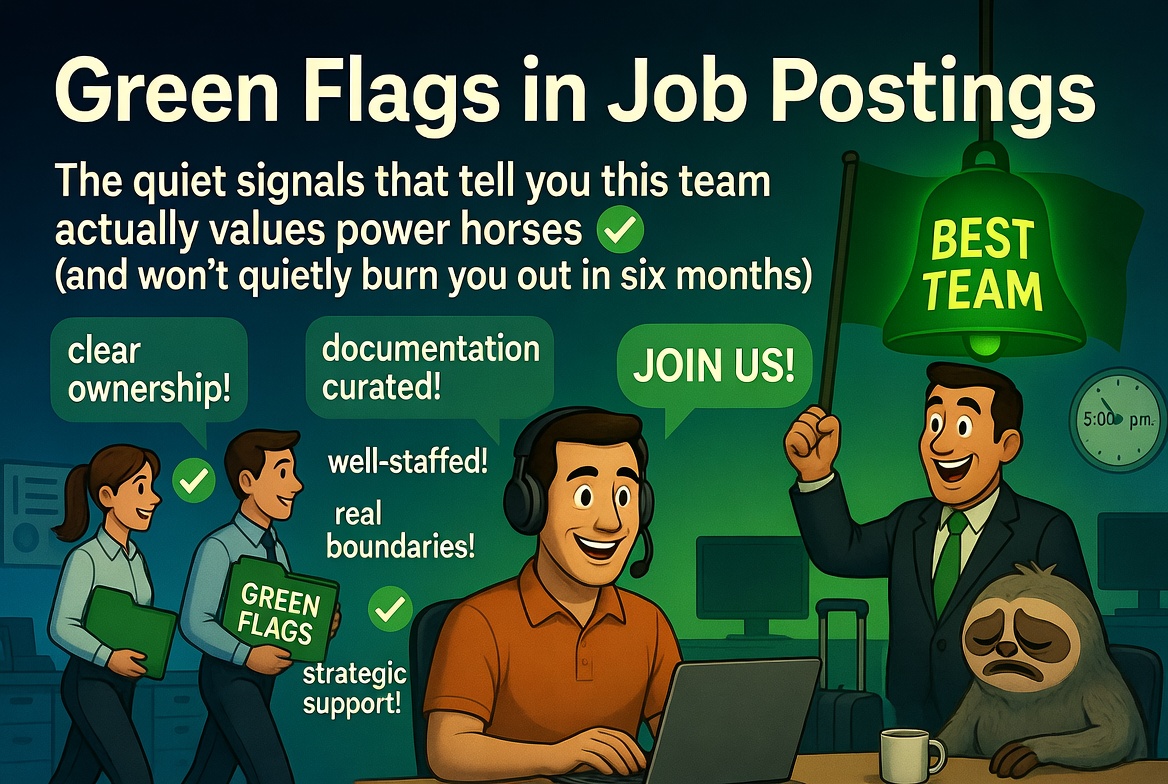
The quiet signals that tell you this team actually values power horses 🐎 (and won't quietly burn you out in six months)
You're scrolling LinkedIn again, another cold coffee, when the posting stops you mid-scroll. No "fast-paced" nonsense. No "wear many hats" poetry. Instead it says things like "We keep our support ratio at 1:80 customers per engineer because we want you to solve problems, not triage chaos."
Your inner power horse 🐎 sits up straight.
This one feels... different.
I've chased enough shiny offers in twenty-plus years to know the difference between marketing fluff and the real thing. Allow me to share the green flags I now treat as gold-decoded from actual job postings that turned into places where the best engineers stayed, grew, and actually got to do elite work instead of corporate theater.
A couple of years back, I joined a team that checked every box below. I stayed three years longer than anywhere else, shipped some of my best fixes, and left on my own terms with zero burnout. The power horses around me did the same. The sloths? They quietly moved on because the pace actually required substance.
Here are the green flags worth bookmarking. Spot most of them, and you've probably found a keeper.
 TrenchOps 🐎