 TrenchOps 🐎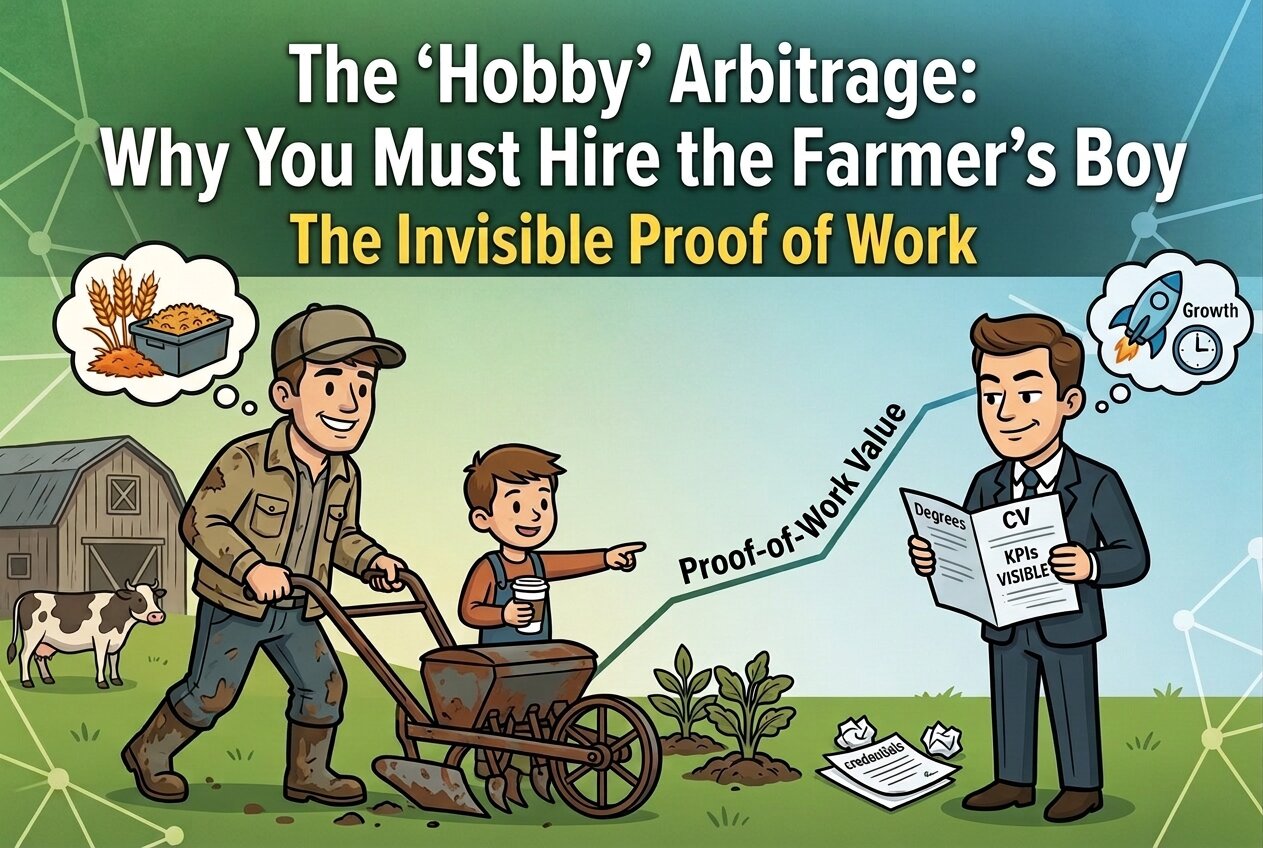
Always Hire the Farmer's Boy
The best predictor of work ethic isn't on the CV. It's in the barn.
Engineering school, a lecture hall with bad acoustics, a course on people management and apprenticeship that most of us treated as a nap opportunity. One sentence from that semester survived everything else I learned that year:
"Always hire the farmer's boy."
The professor didn't explain it as a joke. He meant it operationally.
The setup
You're a company. You post an apprenticeship. You get a stack of applications ranging from "barely finished school" to "has a degree and, apparently, questionable life choices." During the dot-com boom this got absurd - big firms hiring university graduates as apprentices, because the applicant flow was that distorted.
So you sit there with two folders.
Folder A: three years of college, decent grades, a personal statement written in the dialect of LinkedIn. Ambitious. Articulate. Knows the vocabulary of professionalism.
Folder B: high school, that's it. But the address is out of town. Family runs a farm, or a bakery, or a two-truck plumbing operation. Started helping at an age that would make a labor inspector twitch.
The professor's point: Folder B is usually the better trade. Not because of virtue. Because of training.
What a farm actually teaches
Nobody on a farm asks whether they feel motivated today. The cows do not care about your energy levels. The harvest window does not move because you had a rough week. You plan in seasons, not sprints - you plant something in spring whose payoff arrives in autumn, and you do the boring maintenance in between because skipping it costs you the entire year.
That is long-horizon conviction, learned before puberty. Try teaching that to a 26-year-old in a two-day workshop.
Add the second thing: farm kids barely get sick. Or rather - they get sick and still show up, because the alternative was never presented as an option. I am not romanticizing presenteeism, and yes, sometimes people should absolutely stay home. But there is a measurable difference between someone whose default is "how do we get this done" and someone whose default is "who is responsible for this being unpleasant for me."
And the third thing, the one that actually pays your rent as an employer: moral values around loyalty. Local kid, local company, family in the same postal code. Your company is not a line item on his ascent. It's the place he tells people he works at, proudly.
The other folder
The career guy is not evil. He's optimizing correctly for his own incentives, and the incentives he's been trained on say: eighteen months, then jump. He's fluent in performance reviews. He knows how to be visible. He will produce excellent slides about the work while someone else does the work.
I have watched people change companies faster than they change their laundry. Every move framed as "growth." Every departure timed precisely three weeks before the thing they built needed to survive contact with production.
Here's the part nobody says out loud: that person is often more pleasant to interview. Aggressive opportunism sounds exactly like ambition when you're sitting across a table for 45 minutes. Rhetoric wins interviews. Proof of work wins quarters.
Why the CV is the wrong instrument
A degree is a proof-of-title system. It certifies that someone passed through a filter, mostly under conditions of comfort, with a safety net, on a schedule someone else enforced.
A childhood of unpaid mandatory labor at 5 a.m. is a proof-of-work system. It cannot be faked, cannot be crammed for, and does not appear anywhere on the application form. Which is exactly why almost nobody screens for it.
That's the arbitrage. Everybody bids on the credential because the credential is legible. The trait that actually predicts whether someone finishes hard things in year three sits in the blank space next to "hobbies: helping at home."
You're not hiring the farm. You're hiring twelve years of enforced discipline that your competitors can't see on the CV, priced at zero.
The honest caveats
Don't turn this into a fetish. I have met farm kids who were lazy and stubborn in the wrong direction, and university graduates who worked like machines because their parents ran a restaurant and they'd been carrying crates since age nine. The signal isn't agriculture. The signal is: was this person ever required to do unglamorous work with real consequences, for someone other than themselves?
Waitressing. Night shifts. Caring for a sick relative. A family business of any kind. Anything where "I didn't feel like it" was not a valid input.
And the flip side of loyalty: if you hire people who will bleed for your company, you have a moral obligation not to bleed them. The power horse 🐎 who never complains is also the one who will quietly work himself into the ground while your dashboard shows green. That's not his failure. That's yours.
👉 Screen for consequence exposure, not credentials. Ask what they were responsible for before age 18, and who suffered if they got it wrong.
👉 "Biggest failure" is a good question, but "what's the longest you ever stuck with something boring" is better. Loyalty is a duration metric.
👉 Local roots are an underpriced retention feature. Someone whose reputation lives in the same town as your office has skin in the game your equity plan can't buy.
👉 The most articulate candidate is optimizing for the interview, not the job. Weight demonstrated persistence over demonstrated polish.
👉 If you land a farmer's boy, protect him. Uncomplaining people are invisible to management systems built on complaint volume.
Anyone can learn your product in six months. Nobody learns work ethic in six months - they either got it handed to them at 5 a.m. in a cold barn, or they didn't.
👇 What's the least prestigious item on someone's CV that turned out to be the best predictor of how they'd perform?
This article is also available in German.
0 comment(s)
No comments yet. Be the first to comment.
Leave a comment