Why five years at the same job feels like a long weekend
A colleague once told me he had fifteen years of experience. His manager, in a rare moment of honesty, replied: "You have one year of experience, fifteen times."
Brutal. Also, physiologically accurate.
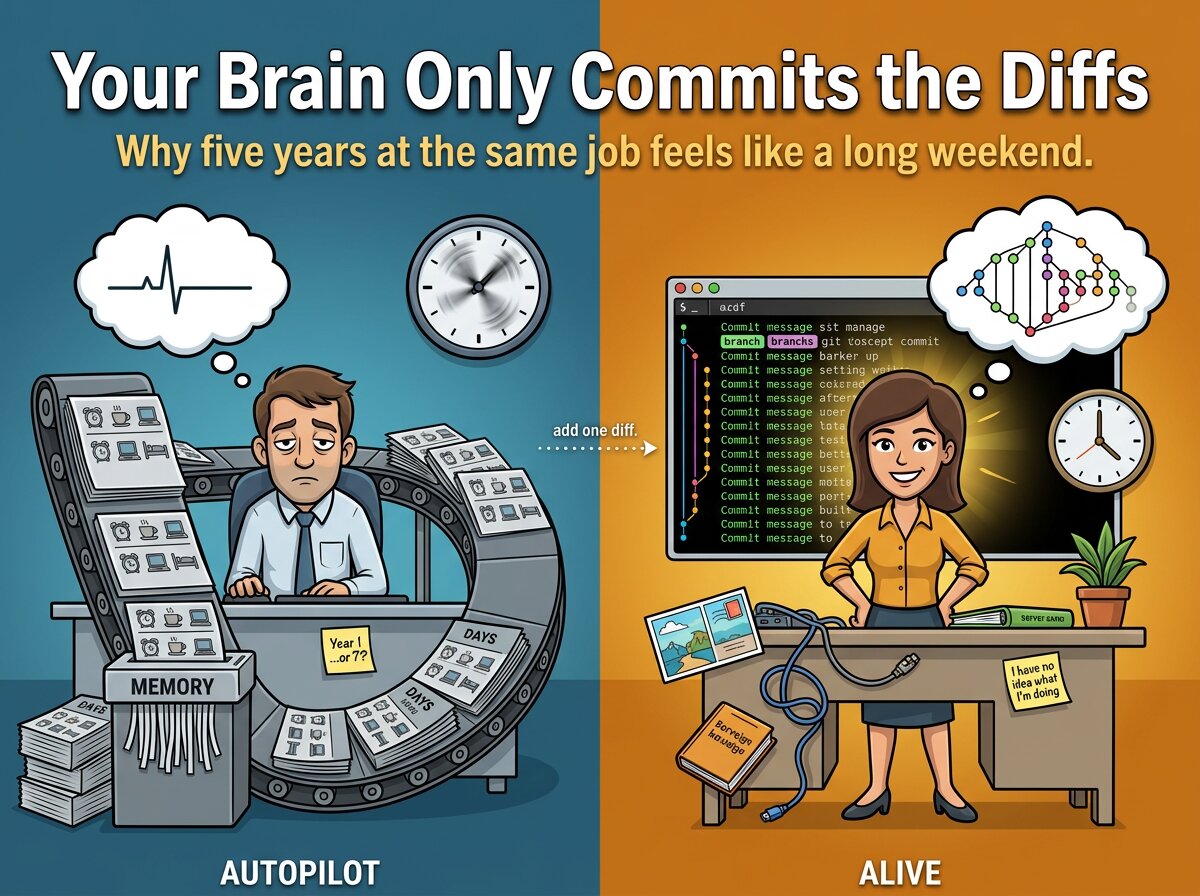
Here is the mechanism. Your brain does not store duration. It stores change. It works like a version control system with aggressive deduplication: if today is byte-identical to yesterday, no commit gets written. Same alarm, same commute, same standup where six people say "nothing from my end", same lunch, same evening scroll, same bed. Nothing new to encode, so nothing gets encoded. And when you later ask your memory "how long was that?", it does not count days. It counts commits.
Empty log, short history. That is time compression - and it is why a week of travel feels longer in hindsight than the four months of office routine that funded it.
Researchers have a name for the small-scale version: the oddball effect. Drop something unexpected into a stream of repetitive stimuli and the brain rates the surprise as having lasted measurably longer than the identical repeats around it. Attention spikes, uncertainty spikes, encoding spikes. The stretch is on the order of tens of milliseconds in lab conditions - tiny, but it proves the machinery exists. Scale it up to weeks and you get the reason your thirties evaporated.
I once watched a senior engineer - twenty years of experience, could read a stack trace like a bedtime story - try to learn to juggle at a company offsite. Three balls, two hands, zero dignity. She dropped everything for twenty minutes straight while interns filmed it.
Six months later she told me that offsite was the week she finally cracked a certification she'd been stuck on for a year. She was convinced it was the juggling. She might have been right.
Here's the mechanism, and it's backwards from what most people believe: the adult brain doesn't rewire because you feed it information. It rewires because you feed it errors. When your predictions about the world fail hard and repeatedly, your nervous system releases the neuromodulators - dopamine, norepinephrine - that mark active circuits for change. No errors, no chemical signal, no rewiring. Recent neuroscience even points to a dedicated brain-wide "model failure" alarm system (the locus coeruleus) whose whole job is shouting "your predictions are garbage, update everything."
That feeling of frustration? That's not a bug. That's the smell of the signal being released. The brain games industry sells you comfortable puzzles you're already decent at. Comfortable means low error rate. Low error rate means the alarm never fires. You're paying a subscription to not learn.
Why Most "Hard Workers" Stay Stuck on the Hamster Wheel
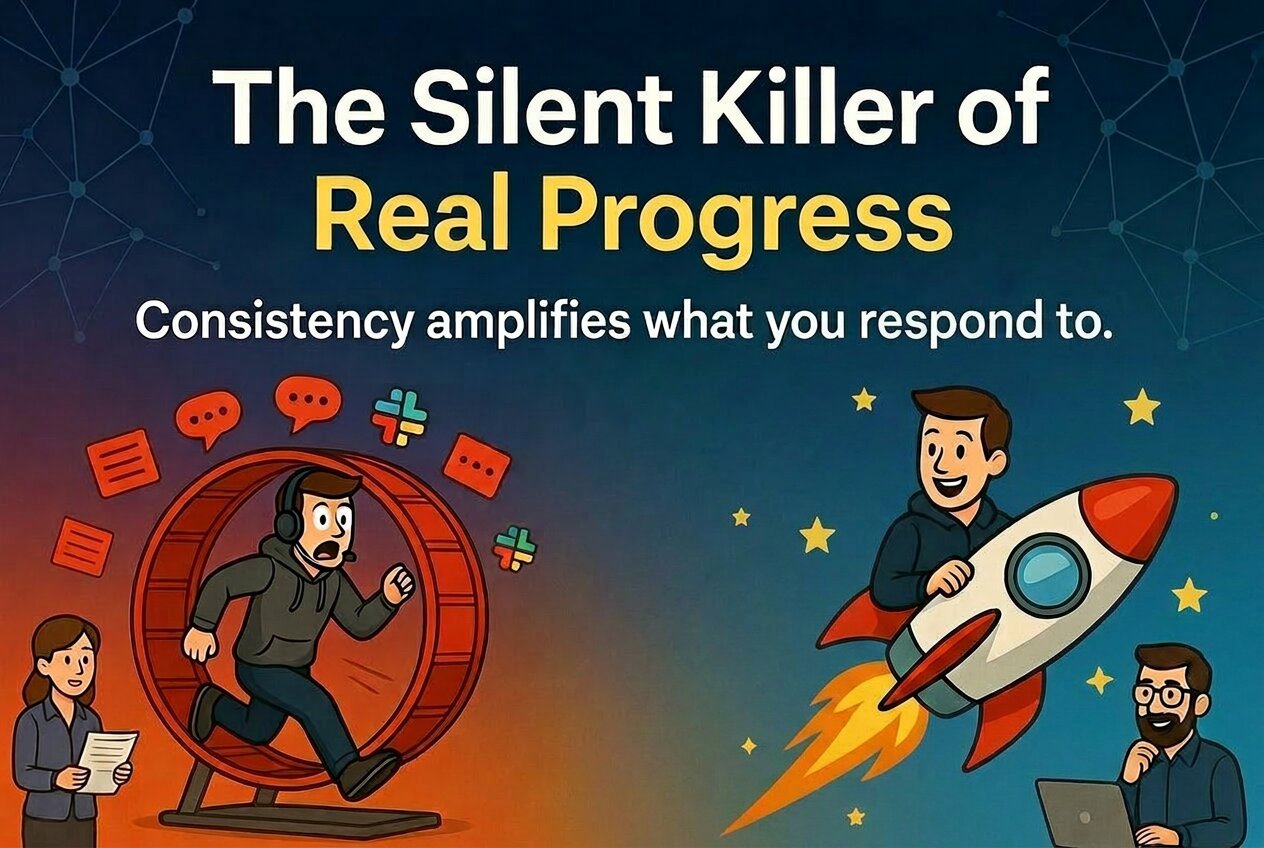
The inbox hits at 8:03 a.m. like clockwork. Twenty new tickets, three "urgent" Slacks from people who clearly didn't read yesterday's update, a fresh vanity dashboard from leadership showing likes on the internal town-hall post, and one passive-aggressive calendar invite titled "Quick sync on priorities." By 9 a.m. you're already exhausted, yet somehow the needle on actual customer outcomes hasn't moved a millimeter.
Welcome to the hamster wheel sponsored by modern corporate life. Most of us are reacting to noise and calling it productivity. The quiet power horses 🐎 figured out years ago that consistency doesn't amplify effort. It amplifies whatever you choose to respond to. Ignore that distinction, and you stay busy forever. Get it right, and you start moving like a rocket with afterburners.
I once watched a second-line support engineer I'll call Marcus live both versions in real time. Year one he was the ultimate firefighter: every ticket spike, every minor SLA blip, every random customer complaint got his full attention. He answered every Slack, joined every optional sync, chased every daily fluctuation in the support metrics. By December he was burned out, his actual impact flatlined, and the performance review read like a participation trophy: "Reliable team player who responds quickly." Translation: stayed on the wheel.
I've spent twenty years in the trenches watching two kinds of people argue about the future.
The social and political optimists say: "If we just pass the right laws, fix the culture, and get the right people in charge, everything will finally get better."
The technological optimists say: "Give humans better tools and they'll figure out the rest."
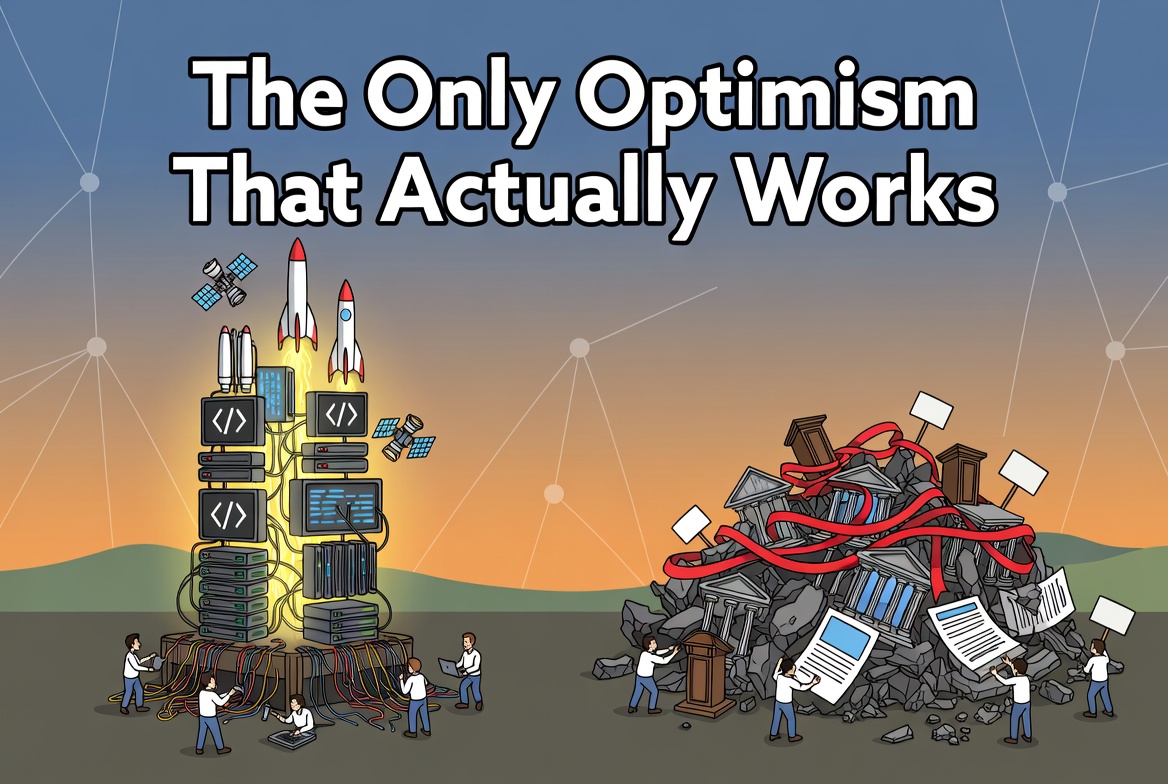
History keeps proving the second group right - and the first group spectacularly wrong.
Look at the pattern. Every decade we get grand promises about how new regulations, new social movements, or new political saviors will solve poverty, inequality, education, or healthcare. The results are usually modest at best, expensive, and sometimes actively harmful. Meanwhile, a few nerds in garages or labs quietly ship a new technology that changes daily life more in five years than ten years of policy ever could.
The smartphone didn't need a government program to connect the world. The internet didn't ask for permission to democratize knowledge. Cheap solar, Starlink, AI, and cloud computing didn't wait for the perfect political moment - they just got built.
In support, we see this every single day. We complain about broken processes, terrible CRMs, and endless bureaucracy. Social optimists would try to "fix" it with more meetings, more policies, and more mandatory training. Technological optimists ship a script, a dashboard, or an automation that actually removes the pain. Guess which one actually moves the needle?
 TrenchOps 🐎