 TrenchOps 🐎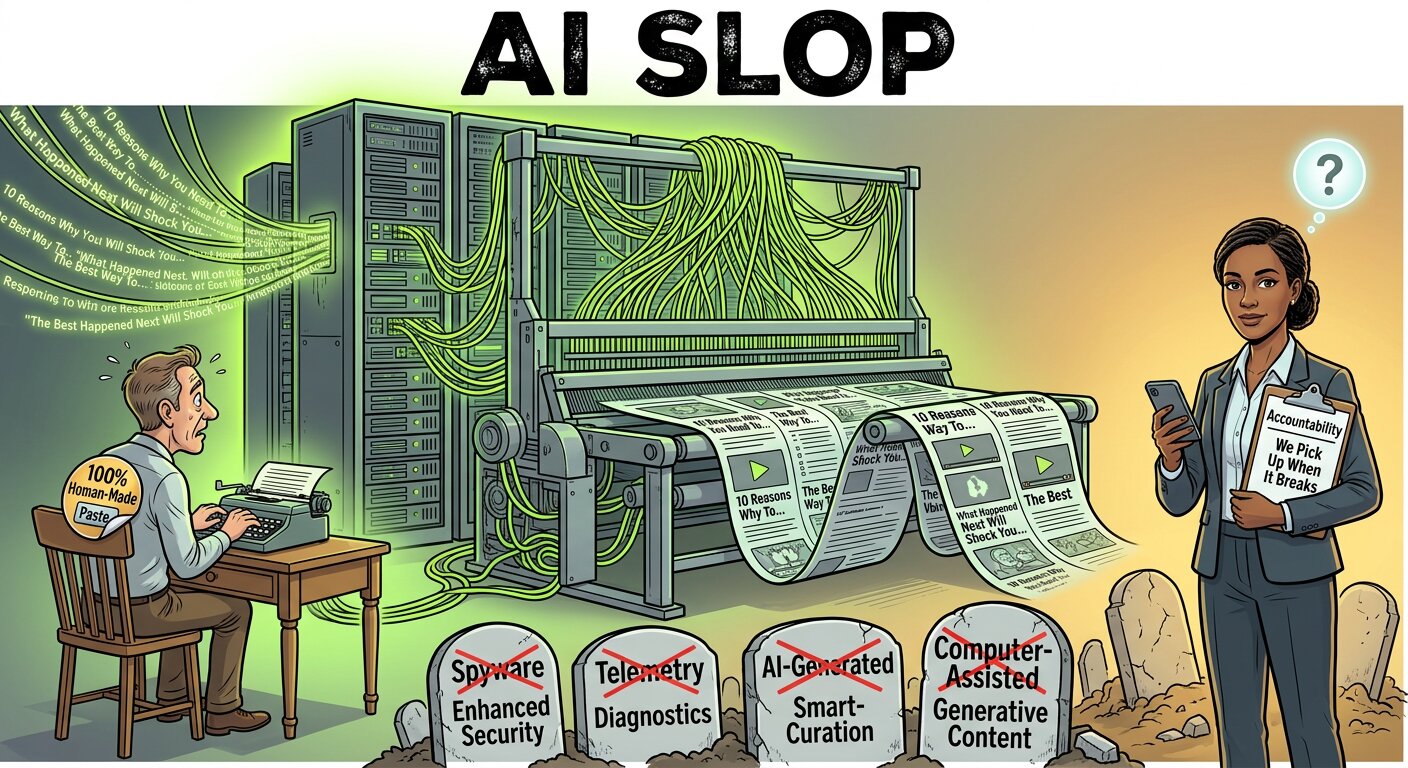
Nobody Complains About Spyware Anymore
And that silence is the most accurate forecast we have for AI content
Remember when installing a free screensaver was an act of war?
Twenty years ago, the internet had a moral panic with its own industry attached: spyware. Purple gorillas reading your email. Browser toolbars reproducing like rabbits. People wrote furious forum posts. Lawmakers held hearings. Anti-spyware was an entire software category with boxed products and annual renewals.
Today your TV, your car, your phone, and - God help us - your fridge all phone home continuously, and the strongest public reaction is a mildly annoyed click on "Accept all."
What happened? The users didn't win. The word lost.
Spyware became "telemetry." Telemetry became "diagnostics." Diagnostics became "personalized experiences." The practice never changed - the vocabulary did. A controversial technology doesn't need to be accepted to win. It just needs its name retired. Once nobody can say the old word without sounding like a crank in a tinfoil hat, the practice has become infrastructure.
Now watch the same movie on 4x speed.
Stage one: ridicule. Hands with seven fingers. A Hollywood star unhinging his jaw over a plate of spaghetti. That was the golden age - spotting AI was a party trick, and some of us pattern-matchers enjoyed it the way birdwatchers enjoy rare warblers.
Stage two: ubiquity. "Slop" was Merriam-Webster's word of the year for 2025. Researchers tracking the open web say machine-generated articles passed human-written ones around late 2024. One study estimates over half of longer English posts on the big professional network are machine-assisted. Another analysis found roughly a fifth of the short videos served to a fresh account were low-grade AI. The warblers learned to fly silent.
Stage three: renaming. Already underway. Nobody serious says "AI-generated" anymore - it's "AI-assisted," "AI-enhanced," "human-led, AI-accelerated." Give it a few years and the qualifier vanishes entirely, the way "computer-assisted" vanished from design. When did you last demand to know whether a photo was "Photoshop-made"?
Stage four: silence. No ceremony, no surrender speech. One day you'll realize you haven't heard the phrase "AI-generated" in months. That's the white flag - and it's in your own hand.
You can hate this. It's happening anyway. The steam engine of media doesn't care about your opinion. And honestly? The weavers' argument was never as strong as nostalgia makes it sound.
Let's stop romanticizing "human content." Before the machines, the internet was already a slop factory. Content farms paid five dollars for articles written by freelancers who had googled the topic eleven minutes before you did. Listicles recommending products nobody had touched. "Human-written" was never a quality seal - it was a description of the typing. AI didn't lower the floor. It made the floor visible by cutting the cost of production to zero.
This is also where the usual take - "people will pay a premium for human-made content" - collapses. People won't pay it long-term, correct. Nobody uses a typewriter anymore, and "human-written" will become the vinyl record of media: charming, expensive, and mostly a statement about the buyer. But the deeper problem is the label itself. "We don't sell your data" meant "we share it with 400 partners." "100% human-written" will mean "a human pressed paste." Origin labels are badges. Badges cost nothing, and anything that costs nothing gets faked at industrial scale.
What survives is cost. Not "who wrote this?" but "who pays if this is wrong?" A name with twenty years of scar tissue behind it. A company that picks up the phone when the documentation lies. A consultant whose next contract depends on the last one having worked. That's the only signal machines can't counterfeit, because counterfeiting it requires actually bleeding.
Full disclosure, since we're being honest: I use the loom. This site runs on experience, scar tissue, and caffeine, and I won't insult you by claiming I chisel every draft out of marble by candlelight. The difference between slop and leverage isn't the tool. It's whether a findable human stands behind the output when it's wrong.
What this means in the trenches:
Your knowledge base: let AI draft the articles. The value was never the prose - it's the line that says "this fix works unless the customer still runs the 2014 plugin," the edge case you only meet at 3 a.m. in a Sev-1. If your KB contains nothing a generic model couldn't produce, it was slop before any AI touched it. Your power horses 🐎 were never paid for typing speed.
If you lead teams: stop selling "human-made" nostalgia and start selling answerability. Customers won't pay extra for a human on a normal Tuesday. They will pay almost anything on the worst day of their year, when the chatbot enters its third loop of "I'm sorry you're experiencing this." Human accountability isn't a lifestyle product. It's insurance. Price it like insurance.
If you're junior or job hunting: don't train to out-weave the loom. Train to catch it. The scarce job of the next decade is the person who can tell, fast, when a confident machine is confidently wrong.
And yes, the noise will get filtered eventually - but filters aren't weather, they don't just happen. Filters are people and institutions spending reputation. When generation costs zero, trust is the only scarce resource left. The market won't reward "human-made." It will reward "vouched-for."
👉 Controversies die by renaming, not by resolution. When "AI-generated" leaves the vocabulary, the takeover is complete.
👉 AI didn't invent slop - it made slop free. Content with no thinking in it was already slop; the machine just exposed the ratio.
👉 Origin labels are badges, and badges get faked. Ask who pays if it's wrong.
👉 If your skill is producing words, the loom is here. If your skill is knowing which words are true, you just got leverage.
👉 Human accountability won't sell as a lifestyle premium. It sells as insurance - on the worst day of your customer's year.
You can't out-argue a steam engine, and you can't out-type one either. The only moat left is bleeding when you're wrong.
What's the "telemetry" of your industry - the thing everyone hated until it got a friendlier name? 👇
This article is also available in German.
0 comment(s)
No comments yet. Be the first to comment.
Leave a comment