 TrenchOps 🐎
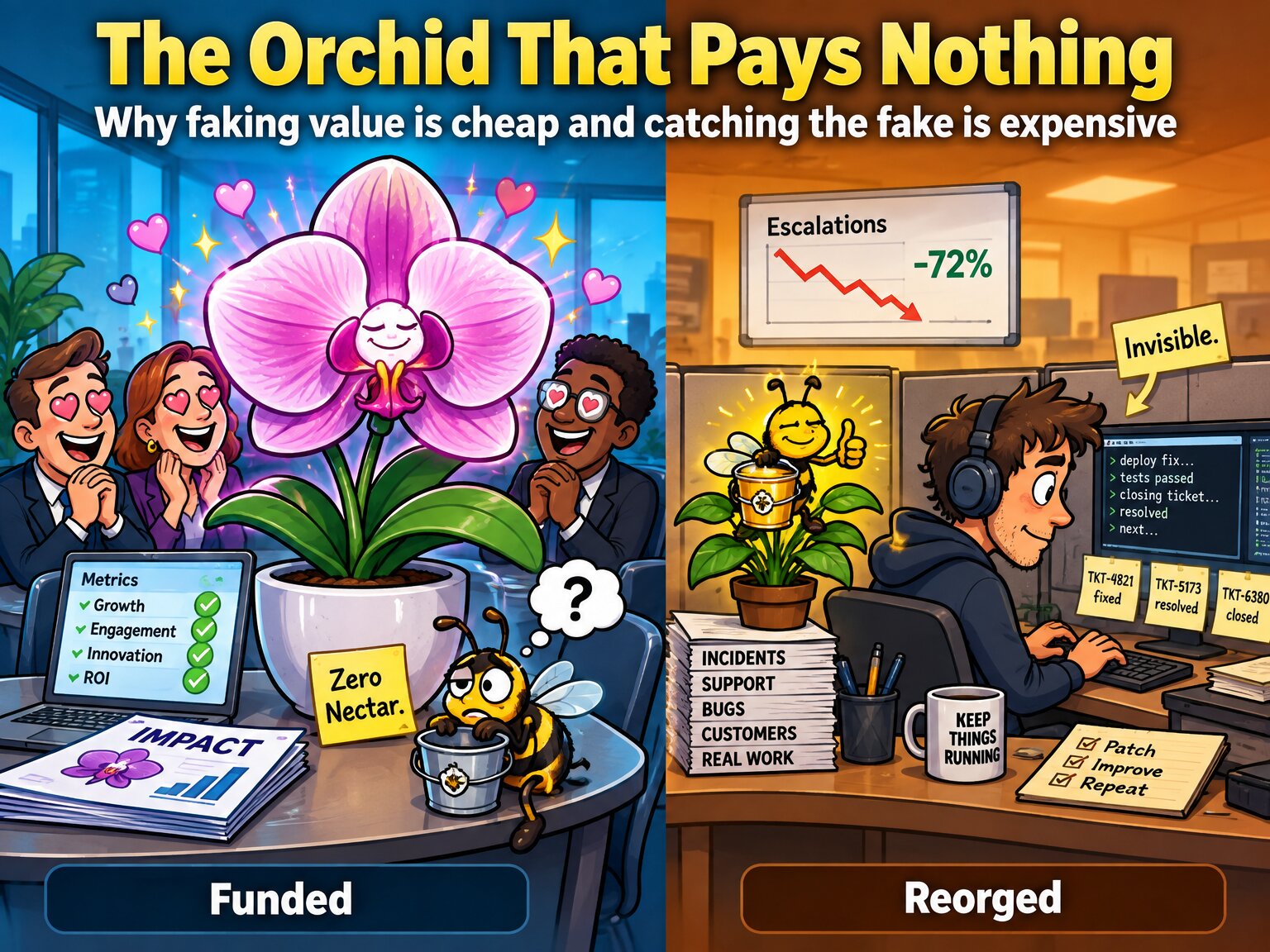
The Orchid That Pays Nothing
Why faking a signal is cheap and catching the fake is expensive - and what that does to your org chart
There is a family of orchids that has solved business development.
They advertise like a nectar plant: the right colour, the right shape, the right landing platform, sometimes even the right scent. A bee arrives, does the work, leaves with nothing. No nectar, no pollen, no deal. The orchid gets pollinated for free.
The best part is the arms race that follows. Bees are not stupid - they learn to avoid the colour that burned them. So some deceptive orchids grow in several colour variants at once. Researchers have shown this actually works: bees that learn to avoid one morph generalize their avoidance to similar shades and then go try the most *different*-looking flower in the patch. Which is also an orchid. Which also pays nothing.
Read that again. The plant needed no new intelligence. It just needed variance. The bee needed a whole new cognitive capability - discrimination, memory, resistance to generalization - and still lost.
That asymmetry is the most underrated force in corporate life.
Deception is O(1). Detection is O(n).
Producing a convincing signal of value costs roughly the same no matter how much scrutiny arrives. One deck. One dashboard. One "alignment workshop." One paragraph of AI-generated prose in a status update.
Read more