Three things kill small businesses that never appear in a business plan: the room you work in, the stories you absorb, and the money that was never yours.
I have been self-employed a few times. Before my enterprise career, between two of them, and on the side. None of it made me rich. All of it taught me things you cannot learn from a startup podcast, because podcasts talk about scaling and my problem was that a customer's dog did not like me.
Let me hand over the three lessons that actually cost me something
Your business has a physical address, even when you think it doesn't
Everyone starts in the bedroom, the garage or the study. Fine. Nobody plans the other rooms.
One of my ventures was classic IT service. Persuading stubborn printers to acknowledge the existence of WiFi. Removing pre-installed bloat from our favorite corporate operating system. Explaining, for the fourth time, that a tablet needs updates. Mostly on-site, at people's homes.
Some clients objected to travel fees. Reasonable. They wanted to come to me. Slight problem: I had no office and no presentable workshop. So I invited them into my dining room - statistically the least private room in the house, right up until a stranger sits in it holding a coffee cup and telling me about his divorce while I diagnose a random reboot.
I once watched a senior engineer - twenty years of experience, could read a stack trace like a bedtime story - try to learn to juggle at a company offsite. Three balls, two hands, zero dignity. She dropped everything for twenty minutes straight while interns filmed it.
Six months later she told me that offsite was the week she finally cracked a certification she'd been stuck on for a year. She was convinced it was the juggling. She might have been right.
Here's the mechanism, and it's backwards from what most people believe: the adult brain doesn't rewire because you feed it information. It rewires because you feed it errors. When your predictions about the world fail hard and repeatedly, your nervous system releases the neuromodulators - dopamine, norepinephrine - that mark active circuits for change. No errors, no chemical signal, no rewiring. Recent neuroscience even points to a dedicated brain-wide "model failure" alarm system (the locus coeruleus) whose whole job is shouting "your predictions are garbage, update everything."
That feeling of frustration? That's not a bug. That's the smell of the signal being released. The brain games industry sells you comfortable puzzles you're already decent at. Comfortable means low error rate. Low error rate means the alarm never fires. You're paying a subscription to not learn.
The three words that reveal exactly how little we understand the machines we now depend on
The funniest prompt in modern computing is three words long, and it appears in production systems at companies with actual revenue.
"Don't make mistakes."
Sometimes with emphasis. DO NOT MAKE MISTAKES. Sometimes with a threat attached, as if the model has a family. Sometimes with a promise of a tip, which is my favorite genre of magical thinking - bribing a probability distribution.
Sit with the assumption for a second. Telling a system not to make mistakes implies the system was previously choosing to make them. Which means one of three things must be true: it was trained to err, it was instructed to err (perhaps by a vendor who bills per token - a delightfully paranoid theory that dies the moment you notice open-weight models behave identically), or errors are an opt-in feature that ships enabled by default.
None of it survives ten seconds of contact with how the thing actually works. A language model does not have a laziness dial. It has no intent to be sloppy, because it has no intent at all. It produces the statistically plausible continuation of your text. "Don't make mistakes" is not an instruction. It is a mood. It shifts the output slightly toward the register of text that appears near careful, hedged, authoritative-sounding language in the training data - which is why the response often sounds more confident while being exactly as wrong. You did not reduce the error rate. You upgraded the packaging.
A rhetoric crash course for engineers who think being right should be enough
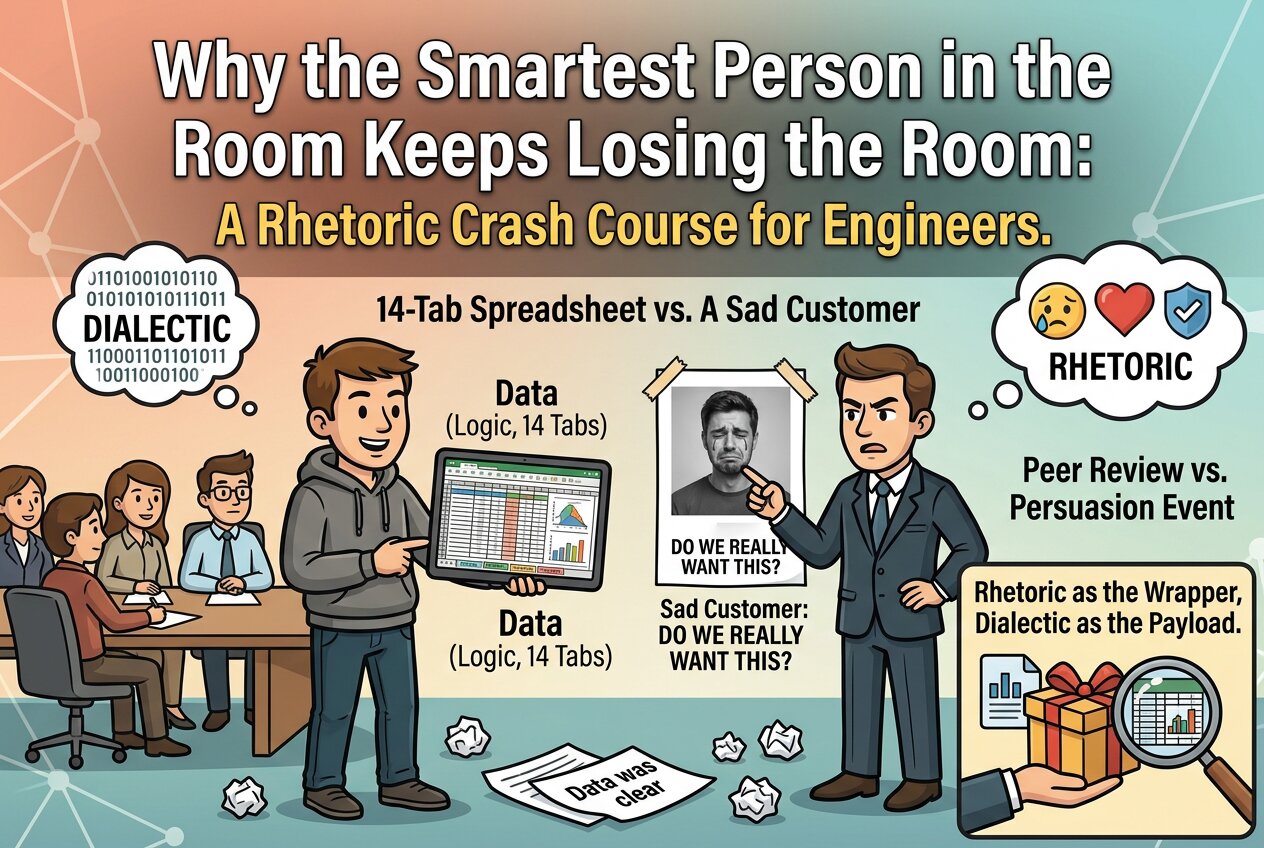
I once watched a brilliant engineer lose a budget fight to a manager armed with nothing but a stock photo of a sad customer and the sentence "Do we really want to be the company that lets this happen?"
The engineer had a spreadsheet. Fourteen tabs. Error bars. He was right about everything. He lost 9 votes to 1, and the one vote was his own.
That day I understood something that took me embarrassingly long in a 20+ year career: being right is a necessary condition for winning almost nowhere. Meetings are not peer reviews. They are persuasion events. And most technical people show up to a persuasion event with the wrong toolset, then walk out confused, muttering "but the data was clear."
This article is the crash course I wish someone had given me. No books, no courses, no Toastmasters. Just the operating manual, translated into engineering speak.
The two operating systems: dialectic and rhetoric
Aristotle - who was, in modern terms, the first systems architect of human communication - split persuasion into two modes.
Dialectic is logic-based debate. Facts, evidence, syllogisms. If A and B, then C. It works beautifully on people who are trained, willing, and incentivized to follow logic. Congratulations: that's you, your fellow engineers, and roughly nobody in your steering committee.
The internet already ran this experiment. We just didn't like the results.
Do you remember dial-up? Paying per minute to access the sum of human knowledge, and using those precious minutes to download a 400x300 JPEG of a cat in a shoebox?
Then the meter went away. Flat rate. Then mobile. Then free WiFi in the average bakery. Suddenly every human on the planet had a portal to every library, every lecture, every tutorial, every trade skill ever documented. Universities put their entire curriculum online for free. MIT did it. Harvard did it. Nobody had to ask permission anymore.
And what happened?
TikTok happened. Instagram happened. LinkedIn happened, which is basically Instagram for people who own a blazer. Millions of educational videos exist on YouTube, and the most watched content is people reacting to other people reacting to video games.
This is not a rant. I like cat pictures. I have watched a man restore a rusty axe for 22 minutes and felt genuine peace afterwards. The observation is colder than judgment: unlimited access to knowledge did not redistribute outcomes. The people who were competent before the internet were mostly competent after it. The people who were drifting kept drifting, just with better graphics.
Why two equally talented people end up in completely different orbits - and what to do if you drew the short straw
There's a variable that matters more than your GPA, your interview skills, and your LinkedIn headline combined.
You can't study for it. You can't network around it. You can't optimize it with a better resume font.
It's the month printed on your diploma.
The 2009 graduating class walked into the worst job market since the Great Depression. The jobseeker-to-opening ratio hit 8.5 to 1. Their average first-year wage? About $28,500. Fast forward to 2022 - graduates stepped into the tightest labor market on record, fewer jobseekers than openings, and landed average starting wages of $37,800. That's a 32% difference for doing the exact same degree, at the exact same school, with the exact same curriculum.
Same inputs. Wildly different outputs.
And here's where it gets darker: those recession graduates didn't just start lower. Research from the NBER shows that cohorts entering during downturns had lower employment rates throughout their entire careers. Not just for a year or two. Permanently. The wage gap? Studies document lasting losses for seven to fifteen years. Some effects dissipated after a decade. Some never did.
The fastest way to make yourself worth exactly zero
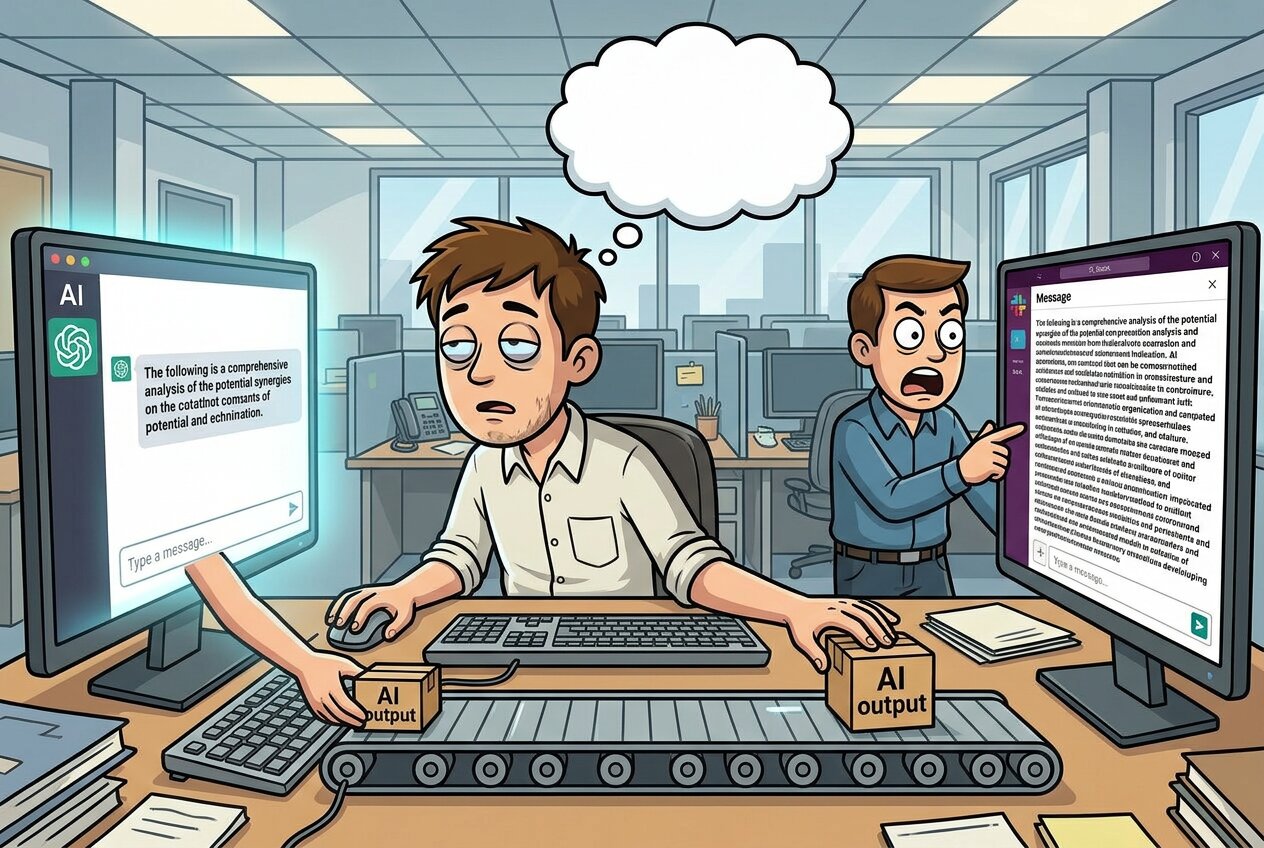
There is a new job title nobody applied for: meat proxy. A person who forwards AI-generated text, code, or output without reading, understanding, or validating it. A relay. A biological USB cable between a language model and a recipient who has the same model open in another tab.
I first noticed one in a ticket queue. A customer escalation, priority high, angry-but-still-polite tone, the kind you can fix in twenty minutes if you actually read the logs. The response that went out was 900 words of immaculate structure. Bullet points. A summary. A "next steps" section. Three suggestions, all technically plausible, none of them relevant, because the product had not behaved that way since two major versions earlier.
The customer replied in one line: "Did a human read this?"
That question is the whole problem. Once it gets asked, you never fully recover. Because the customer's next thought is the dangerous one: if a machine is answering me, why am I paying for you?
The economics are brutal and simple
Value comes from what is scarce. Text is not scarce anymore. Text is now a utility, like tap water, and roughly as expensive.
Job security through indispensable spaghetti code worked great - until it didn't.
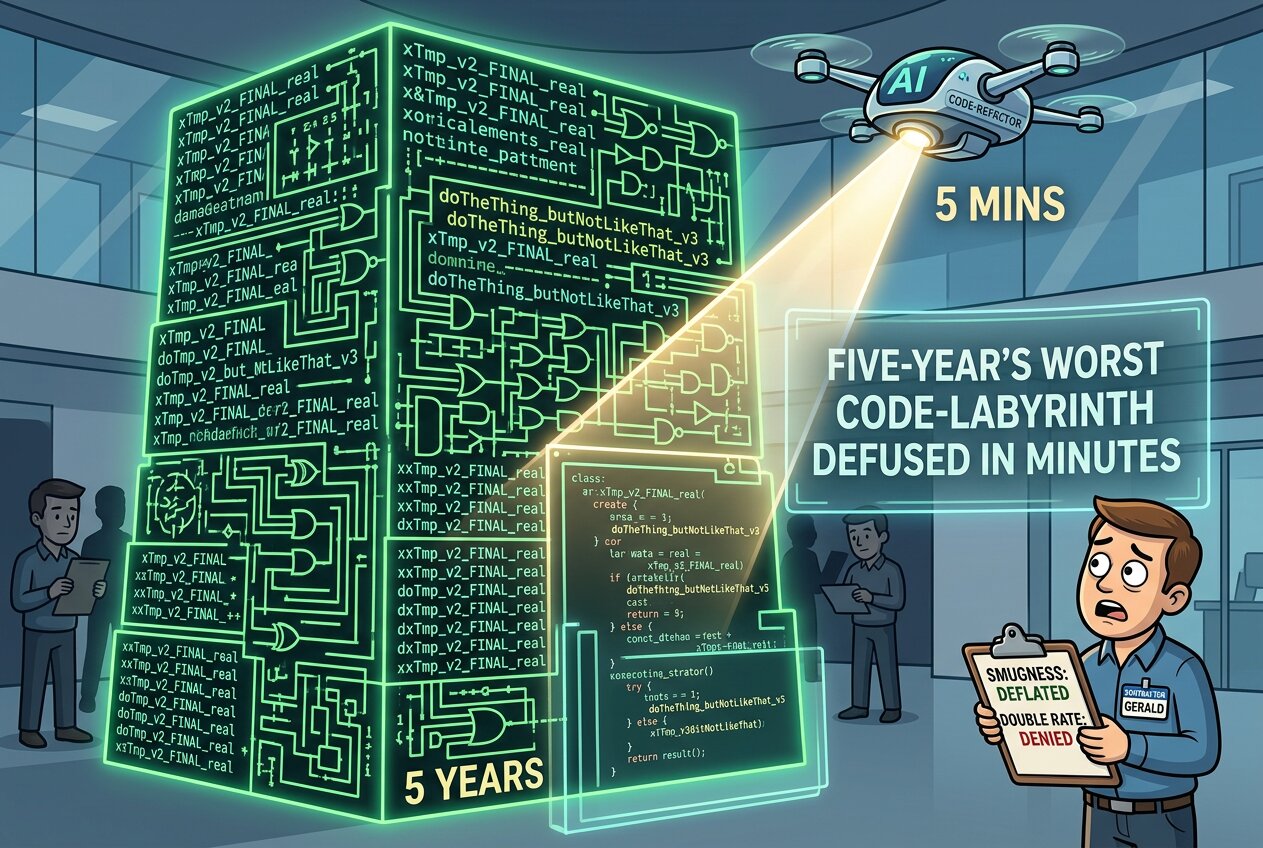
Every engineering org has one. The guy whose code looks like it was written during a fever dream in a language he invented on the spot. No comments. No docs. Variable names like xTmp_v2_FINAL_real. Functions that call themselves through three other files for no discernible reason.
And nobody touches it. Because nobody understands it. And nobody understands it because that's the whole point.
I worked with an engineer - let's call him Gerald - who had perfected this art over five years. Five years of building what was essentially a hostage situation disguised as a codebase. Every module he owned was a booby-trapped labyrinth. New developers assigned to his area would last about two sprints before requesting a transfer, a therapist, or both.
Management knew the code was bad. They could smell it. But Gerald had made himself the only person who could navigate the maze, and the business logic underneath was critical. Classic single point of failure wrapped in a single point of attitude.
The implicit threat was never spoken out loud, but everyone understood it: fire me and enjoy your next six months of outages.
Why I moved back to SUSE after two decades - and why you should re-evaluate your stack while it still works
Somewhere around the year 2000, I bought a computer magazine because it had a CD glued to the cover. SUSE Linux 6.4. ReiserFS. I got as far as "select a mount point for root" and stopped, because I had no idea what a mount point was, and no realistic way to find out. No search engine within reach. No forum. Just me, a beige tower, and a dialog box asking me a question in a language I didn't speak.
I abandoned the installation. My first contact with Linux ended in surrender at the partitioning screen, which I suspect is the most common origin story in our industry.
A few months later, SUSE 7 came out and I ordered the boxed set. Seven CDs. A printed manual thick enough to stop a small projectile. A t-shirt. A sticker of a chameleon. And most importantly: no license key scrawled on a disc in marker by someone's cousin. I installed an operating system that nobody asked me to prove I deserved. That smell of freedom stayed with me longer than the T-shirt did.
Rehearsing in your head is the corporate equivalent of "it works on my machine"
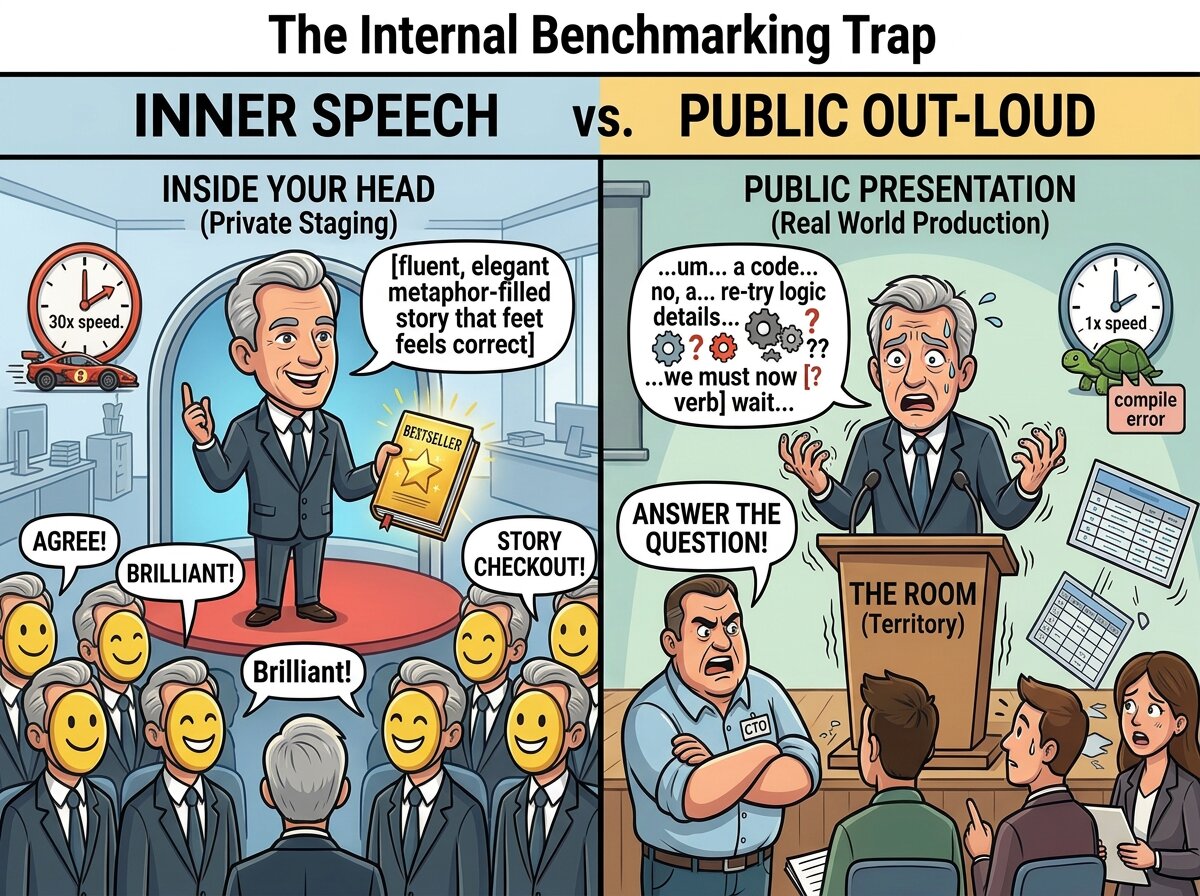
One estimate puts inner speech at around 4,000 words per minute. You speak out loud at maybe 130 to 150. So the version of you that rehearses the big presentation in your head is running at roughly 30x the clock speed of the version that has to show up in the room.
That is not confidence. That is a benchmark run on hardware you do not own.
I learned this from a colleague I'll call the Cathedral Builder. Brilliant systems engineer, the kind of power horse 🐎 who could hold an entire distributed architecture in his head and tell you which node would fail on a Tuesday. We had a customer escalation heading for the executive floor: eight weeks of instability, a CTO who had run out of patience and vocabulary, and a 15-minute slot to explain the root cause and the plan.
He prepped for three days. I asked him to run it past me. He said he had it, he'd been through it several times.
In his head.
He had, genuinely. Every argument in perfect order, every objection anticipated, every metaphor elegant. In there it was a TED talk with a standing ovation and a book deal.
 TrenchOps 🐎