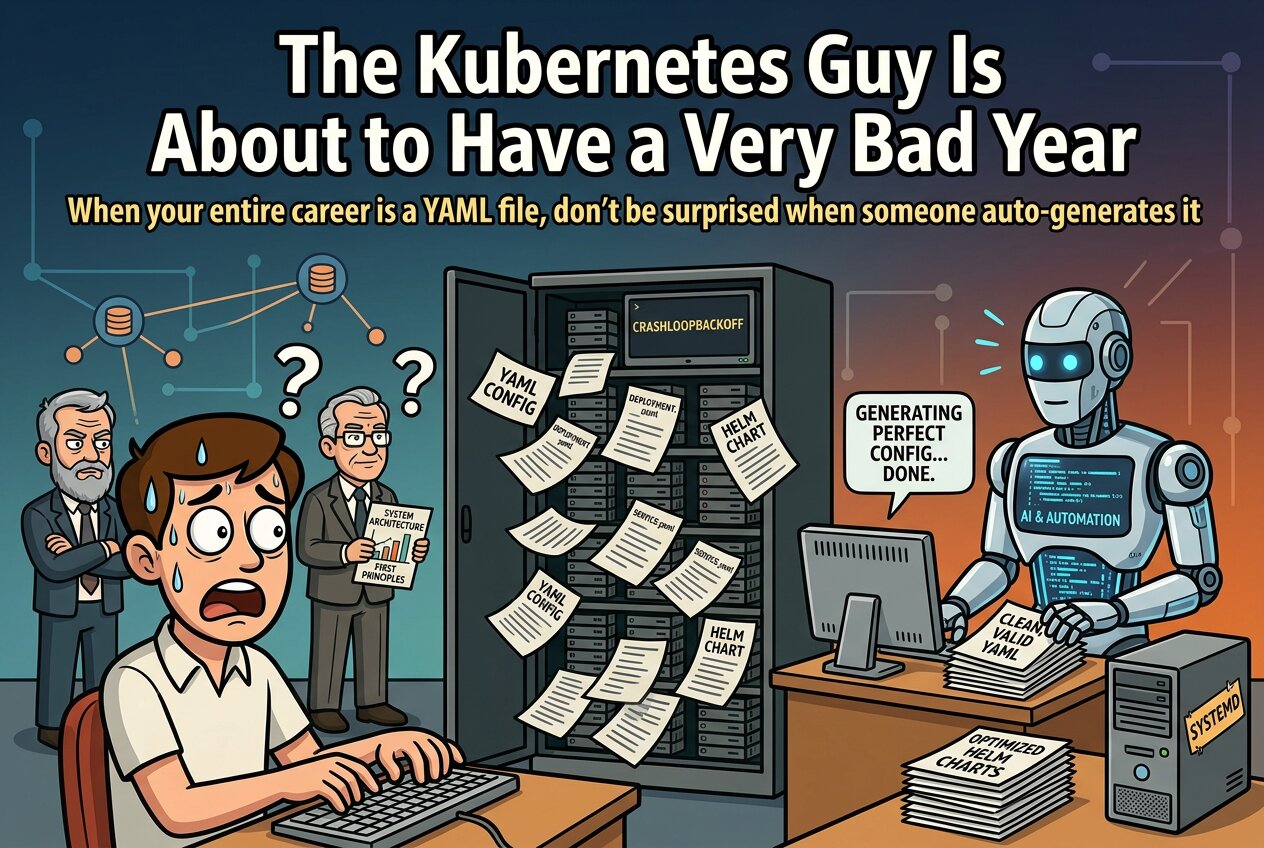
When your entire career is a YAML file, don't be surprised when someone auto-generates it
A while back, I made an offhand remark somewhere about Kubernetes being overkill for a particular use case. Nothing radical. Just pointing out that a single application serving a few thousand users probably doesn't need a container orchestration platform designed to run Google's entire production fleet.
Within minutes, the clergy arrived.
"C'mon bro. Just pipe your Jsonnet through the Kluster Konfig Kompiler, deploy the sidecar injector via a mutating webhook, add the ChaosMonkeyMesh operator for resilience testing, sync your GitOps state through FluxKapacitor, and tail the logs from the Kloud-Native Kombined Kockpit. It's literally five steps. Why are you so afraid of YAML?"
I'm not afraid of YAML. I'm afraid of people who think memorizing a toolchain is the same as understanding infrastructure.
Here's the thing about Kubernetes. It's a genuinely good piece of technology. Google donated it to the world, the CNCF nurtured it, and it solved a real problem - orchestrating containers at scale across distributed systems. If you're running hundreds of microservices across multiple regions with complex networking, auto-scaling requirements, and zero-downtime deployments, Kubernetes is probably the right call.
But somewhere along the way, "right tool for certain jobs" became "the only tool for every job." And an entire professional subculture emerged around that confusion.
And that silence is the most accurate forecast we have for AI content
Remember when installing a free screensaver was an act of war?
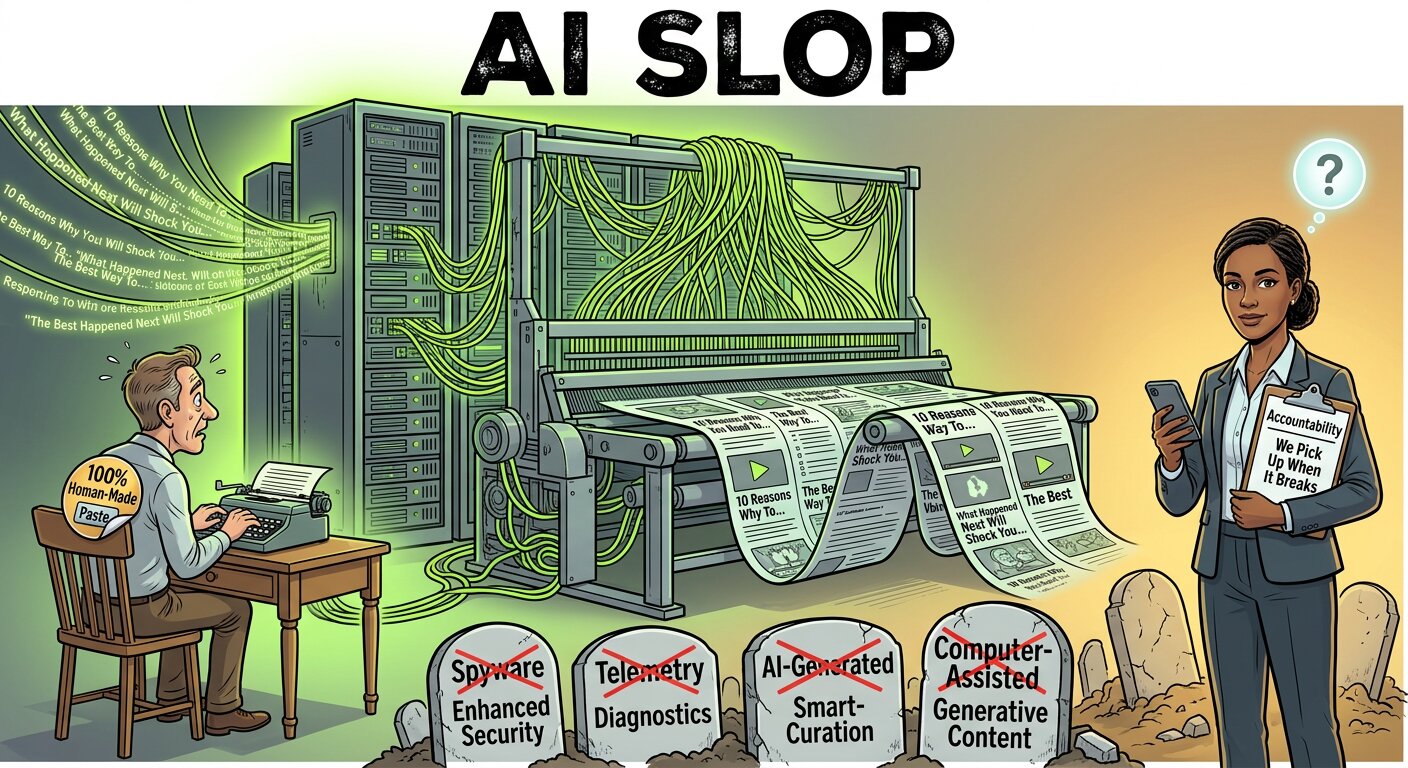
Twenty years ago, the internet had a moral panic with its own industry attached: spyware. Purple gorillas reading your email. Browser toolbars reproducing like rabbits. People wrote furious forum posts. Lawmakers held hearings. Anti-spyware was an entire software category with boxed products and annual renewals.
Today your TV, your car, your phone, and - God help us - your fridge all phone home continuously, and the strongest public reaction is a mildly annoyed click on "Accept all."
What happened? The users didn't win. The word lost.
Spyware became "telemetry." Telemetry became "diagnostics." Diagnostics became "personalized experiences." The practice never changed - the vocabulary did. A controversial technology doesn't need to be accepted to win. It just needs its name retired. Once nobody can say the old word without sounding like a crank in a tinfoil hat, the practice has become infrastructure.
Now watch the same movie on 4x speed.
Stage one: ridicule. Hands with seven fingers. A Hollywood star unhinging his jaw over a plate of spaghetti. That was the golden age - spotting AI was a party trick, and some of us pattern-matchers enjoyed it the way birdwatchers enjoy rare warblers.
Why "the teacher will notice" is not a talent strategy
The most important talent scout in the history of physics was a random customer with spare tickets.
London, 1812. A blacksmith's son named Michael Faraday is apprenticed to a bookbinder. No formal education worth mentioning. But he reads what he binds, and one day a customer hands him tickets to Humphry Davy's lectures at the Royal Institution. Faraday goes, takes obsessive notes, binds them into a book - of course he does - and sends them to Davy. Davy, who has just injured his eyes in a lab explosion and needs an assistant, hires him.
The result: electromagnetic induction, the electric motor, the generator. The device you are reading this on traces back to a stranger's spare tickets.
That was the net. One man's generosity. And here is the uncomfortable part: two centuries later, the net is still mostly luck. We just added paperwork.
In most countries, the entire identification infrastructure for exceptional young minds is this: a teacher notices. One adult, 25 to 30 kids, measured on class averages and standardized test results, with exactly zero KPIs called "outliers surfaced." A system does what it is paid to do. This one is paid to move the middle of the curve. The edges are rounding errors. Goodhart's law with a school bell, if you want the technical term.
Here is a fun statistic nobody keeps: how many careers get quietly strangled in a classroom before they ever begin. No dashboard for that. No postmortem. Just a tired adult with tenure telling a kid to give up, and the kid believing them.
Many years ago I attended a vocational school for information technology. It was there, ironically, that I met some of the most incompetent people I have ever encountered in IT. Not the students. The teachers.
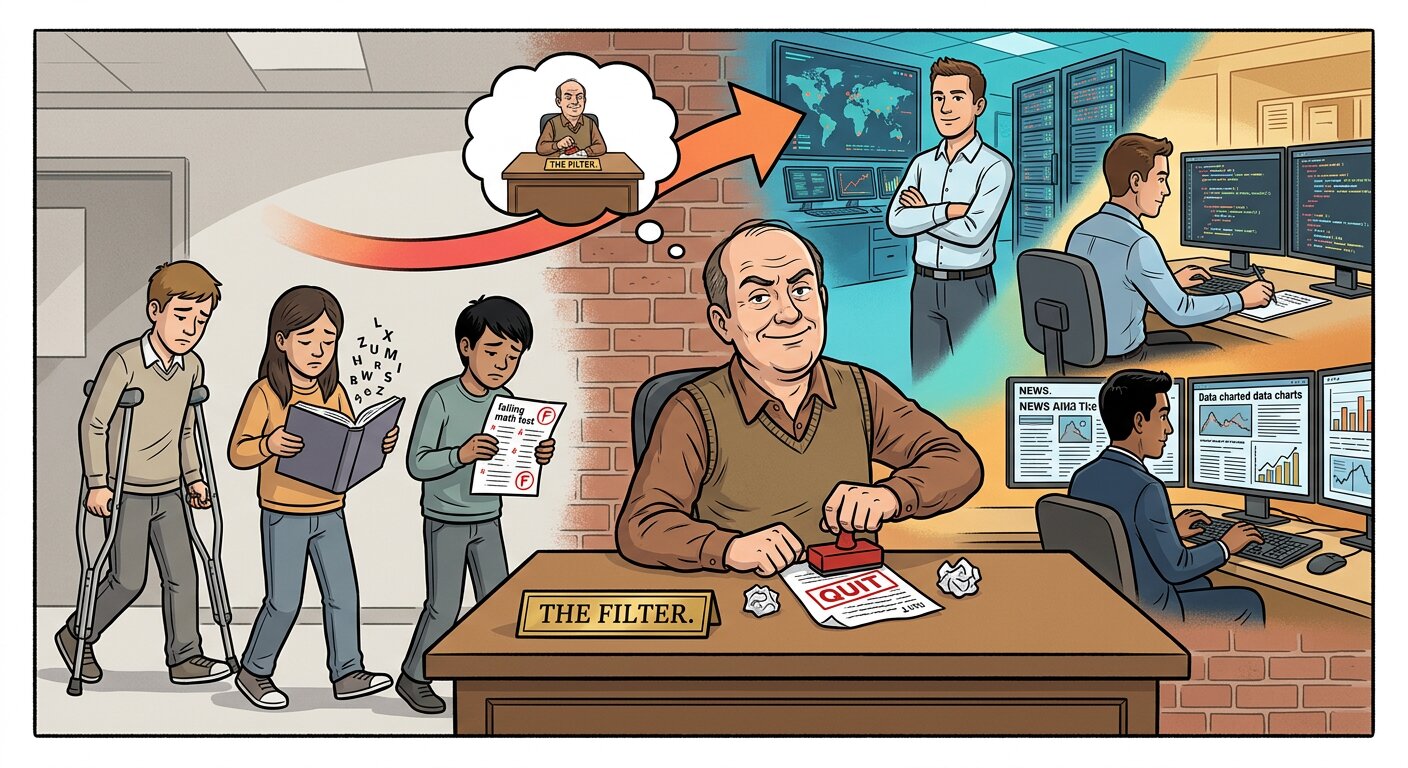
They were all civil servants. Which in Germany means roughly the professional equivalent of a load-bearing wall - you can repaint it, you can complain about it, but you are not removing it. Performance was optional. Consequences were theoretical. And a few of them wore this like a medal. One openly bragged about his failure rates, as if drowning students early was a public service. In his mind he was a filter, weeding out the untalented before they could embarrass the profession.
Let me introduce you to three of the people he filtered.
👉 The foreigner who came to IT through a broken body.
The first kid had already finished an apprenticeship in a skilled trade. Loved it, was good at it, had a plan. Then a village festival, a fight he did not start, and an injury that ended his ability to do the work he had trained for. The employment office paid for a two year retraining program into IT. That was the deal, and the deal had no plan B. No completion meant no more support. On top of that, he carried a very specific cultural weight - the fear of disappointing his family, which for him was not a mood but a load-bearing beam of his entire identity.
 TrenchOps 🐎