 TrenchOps 🐎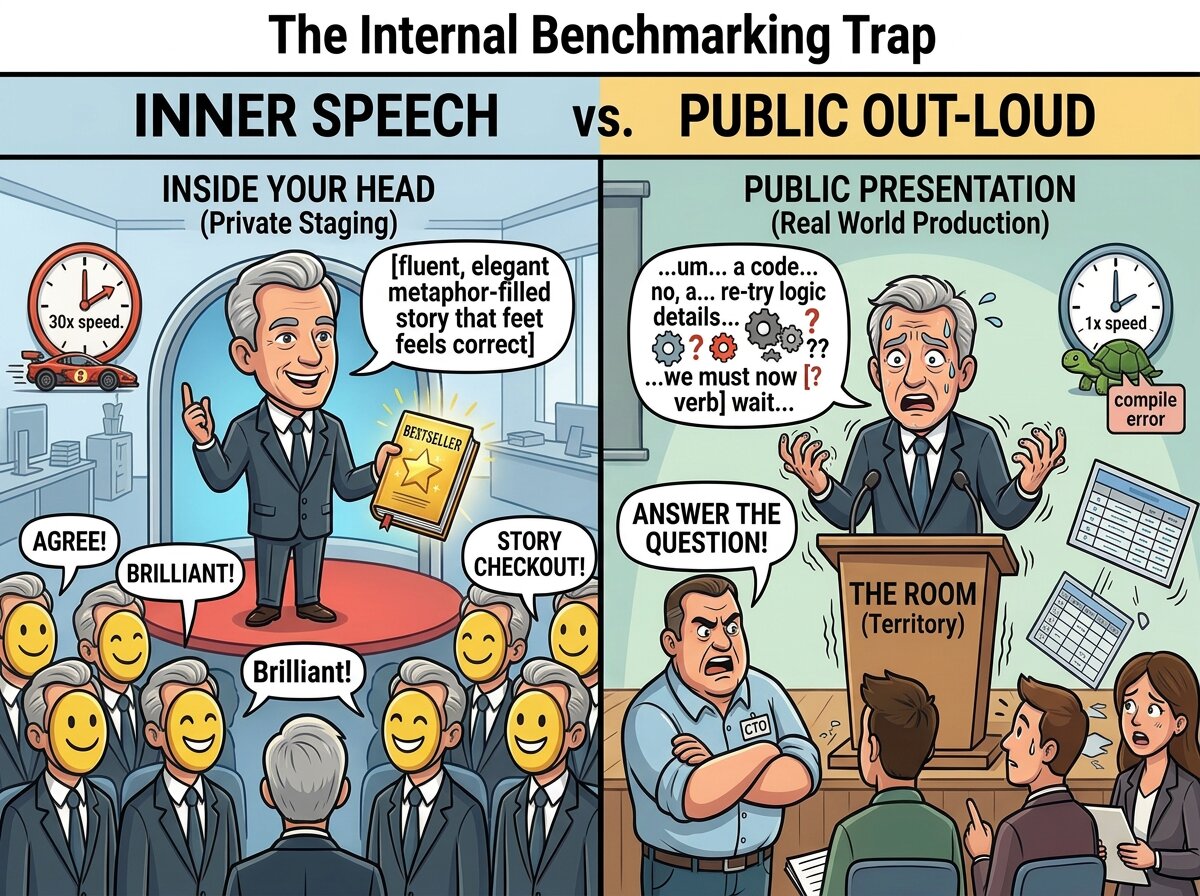
Your Inner Monologue Is Fluent in a Language You Cannot Speak
Rehearsing in your head is the corporate equivalent of "it works on my machine"
One estimate puts inner speech at around 4,000 words per minute. You speak out loud at maybe 130 to 150. So the version of you that rehearses the big presentation in your head is running at roughly 30x the clock speed of the version that has to show up in the room.
That is not confidence. That is a benchmark run on hardware you do not own.
I learned this from a colleague I'll call the Cathedral Builder. Brilliant systems engineer, the kind of power horse 🐎 who could hold an entire distributed architecture in his head and tell you which node would fail on a Tuesday. We had a customer escalation heading for the executive floor: eight weeks of instability, a CTO who had run out of patience and vocabulary, and a 15-minute slot to explain the root cause and the plan.
He prepped for three days. I asked him to run it past me. He said he had it, he'd been through it several times.
In his head.
He had, genuinely. Every argument in perfect order, every objection anticipated, every metaphor elegant. In there it was a TED talk with a standing ovation and a book deal.
On the call he made it 90 seconds before the CTO interrupted with "so was this a code problem or a config problem?" - and something in the pipeline snapped. He started a sentence he could not finish. Then he started it again, differently, and could not finish that one either. Then he explained the retry logic. In detail. For four minutes. To a man who wanted a one-word answer.
The technical content was flawless. The meeting was a disaster. We got a second call only because the account manager did some highly skilled emergency diplomacy afterwards, and the fix landed a week late because of it.
Your head is staging with no traffic
Here is the mechanism, and it is depressingly mundane.
When you rehearse silently, you are testing in an environment that shares almost nothing with production.
No motor system. Speaking out loud is a physical act coordinating roughly a hundred muscles - breath, larynx, tongue, jaw. Your inner voice skips all of it. It is a simulation of the output, not the output.
No compilation step. Inner speech is compressed and abbreviated. You do not think in complete sentences, you think in meaning-shaped blobs that feel like sentences. In the room, you have to compile those blobs into grammar, in real time, in front of witnesses. That compiler has never been tested under load.
No adrenaline. Under stress, working memory tightens up and word retrieval gets worse. The words are still in there. The retrieval index just got slower at exactly the moment you needed it fastest.
No audience. This is the worst part. The audience in your head is magnificent. They nod. They follow. They never ask "sorry, can you go back two slides", never check their phone, never say "I'm not sure I agree with the premise." They have no follow-up questions because they are made of you, and you already agree with you.
So what you actually rehearsed was not the presentation. You rehearsed the feeling of having given it. That feeling is free, and anything free gets counterfeited. Learning research has known this for decades under a different name: re-reading your notes feels fluent and produces almost nothing, while forcing yourself to retrieve the material out loud feels clumsy and works. Fluency in the head is the least reliable signal you have. It is the map. The room is the territory.
The fix is annoying, cheap and unpopular
Say it out loud. Standing. Once, badly, on day one - not on the evening before.
The first time you speak a prepared thing aloud, you get a free defect report: the sentence that has no ending, the transition that does not exist, the number you cannot actually recall, the joke that is only funny in your skull. That report costs you three minutes. Getting the same report live from a CTO costs you a project.
For non-native speakers, add a layer. I think in German. German is happy to park the verb at the end of a long sentence and let everyone wait for the punchline. Improvised English under pressure is not. In my head, the translation is seamless. Out loud, at minute nine, with a hostile question incoming, I have started sentences whose grammar had no exit strategy. You only find those by producing them.
Some specifics that earn their keep:
👉 Memorize the first 30 seconds verbatim. Adrenaline peaks at the start. Give yourself an autopilot runway, then switch to bullets. Full scripts fail because the moment you lose your place you have nothing to fall back on but the script.
👉 Rehearse the joints, not the paragraphs. Presentations don't collapse mid-section, they collapse at transitions. Practice the five sentences that get you from A to B.
👉 Practice the questions you're praying nobody asks. One hour on the three ugly questions beats six hours on slide alignment. If you can't answer one out loud, that's not stage fright, that's a hole in your case.
👉 Practice the recovery, not just the content. When a word won't come, stop and breathe instead of filling the gap with "um, so, basically." A two-second silence reads as authority. Six filler words read as panic. Drill the pause until it's boring.
👉 Record it once on your phone and watch it. Yes, it is horrible. It is also the only honest mirror you have, and it costs nothing but your dignity, which was never load-bearing.
👉 Same rule for writing. Re-reading your own escalation email in your head applies your intonation, your good intentions and your smile. The customer applies theirs. Read it aloud in the voice of your least patient stakeholder - you will delete two sentences every time.
The confident voice in your head has never once had to stand up, breathe, and be heard by a stranger. Stop taking career advice from it.
👇 What's the worst thing you've ever heard yourself say out loud in a high-stakes meeting - and did you find it in rehearsal, or in the room?
This article is also available in German.
0 comment(s)
No comments yet. Be the first to comment.
Leave a comment