 TrenchOps 🐎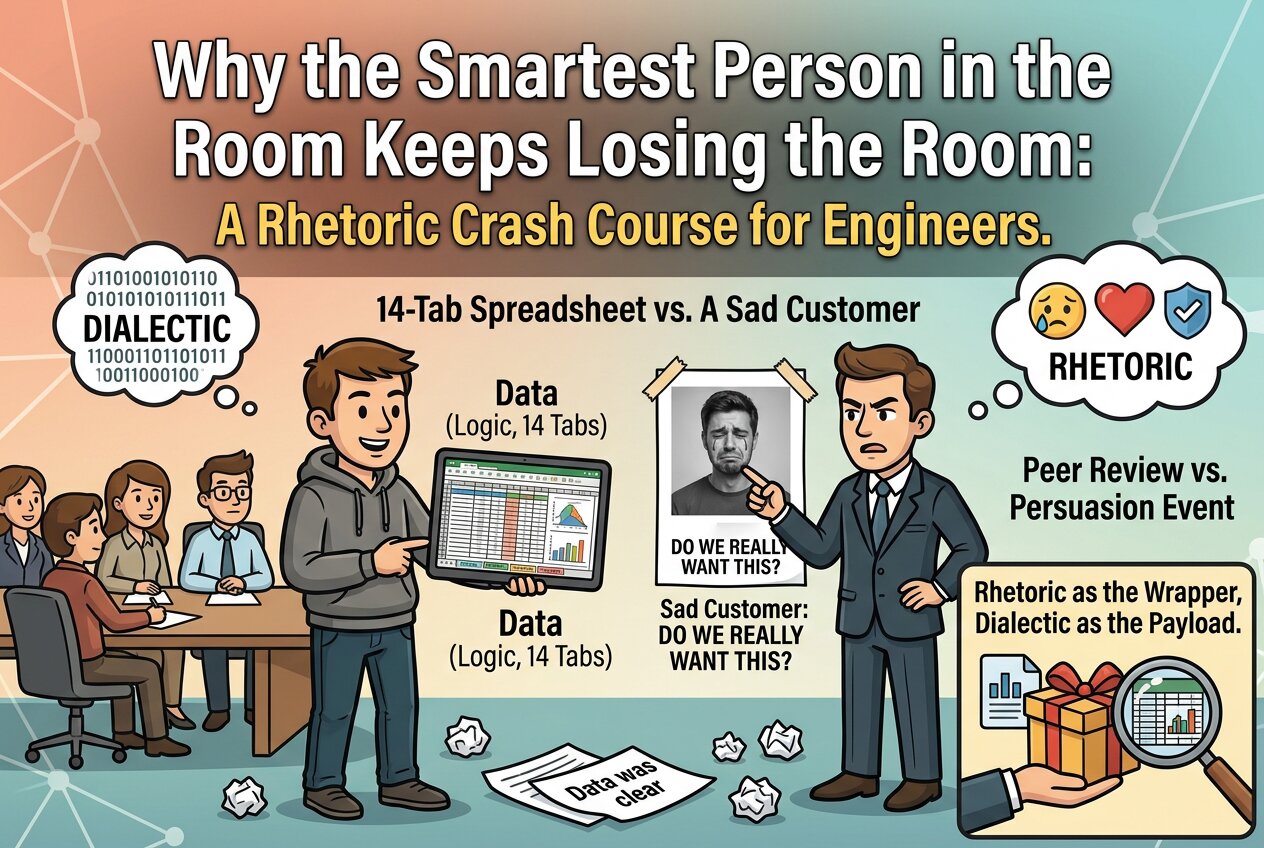
Why the Smartest Person in the Room Keeps Losing the Room
A rhetoric crash course for engineers who think being right should be enough
I once watched a brilliant engineer lose a budget fight to a manager armed with nothing but a stock photo of a sad customer and the sentence "Do we really want to be the company that lets this happen?"
The engineer had a spreadsheet. Fourteen tabs. Error bars. He was right about everything. He lost 9 votes to 1, and the one vote was his own.
That day I understood something that took me embarrassingly long in a 20+ year career: being right is a necessary condition for winning almost nowhere. Meetings are not peer reviews. They are persuasion events. And most technical people show up to a persuasion event with the wrong toolset, then walk out confused, muttering "but the data was clear."
This article is the crash course I wish someone had given me. No books, no courses, no Toastmasters. Just the operating manual, translated into engineering speak.
The two operating systems: dialectic and rhetoric
Aristotle - who was, in modern terms, the first systems architect of human communication - split persuasion into two modes.
Dialectic is logic-based debate. Facts, evidence, syllogisms. If A and B, then C. It works beautifully on people who are trained, willing, and incentivized to follow logic. Congratulations: that's you, your fellow engineers, and roughly nobody in your steering committee.
Rhetoric is persuasion aimed at how people actually decide: through emotion, identity, trust, and self-interest. It is not lying. It is the delivery protocol for truth to receivers that don't speak your protocol.
Here is the part that stings. Engineers treat rhetoric as dirty - manipulation for people who can't argue properly. So they refuse to learn it. Meanwhile, mediocre operators fluent in rhetoric take their budgets, their headcount, and eventually their roadmaps. Refusing to learn rhetoric because "logic should be enough" is like refusing to learn TCP/IP because "my data is correct." Correct data that never arrives is worthless.
One more thing before the toolbox: dialectic is not superior to rhetoric or vice versa. They are different protocols for different receivers. The skill is protocol detection. Debating architecture with a senior engineer? Dialectic. Asking a CFO for two more headcount? Rhetoric, with dialectic as the payload. Talking to a mixed room? Rhetoric as the wrapper, dialectic available on request.
The three channels: logos, ethos, pathos
Aristotle again. Every persuasive message travels over three channels simultaneously. You've been broadcasting on one and wondering why nobody receives you.
Logos - the argument itself
Facts, reasoning, evidence. Your home turf. I won't teach you logic; you have it. I'll teach you the three logos mistakes engineers make:
Mistake 1: Too much of it. Fourteen tabs is not fourteen times more convincing than one number. It's fourteen times less, because attention is a scarce resource and you just spent the room's entire budget on tab three. Rule of thumb: one killer number, two supporting facts, everything else in an appendix you offer but never open unprompted.
Mistake 2: Precision theater. "This will reduce ticket resolution time by 23.7%" invites someone to attack the 0.7. "This roughly cuts resolution time by a quarter" is unattackable and lands harder. Calibrate confidence to your actual evidence - overclaiming is the fastest way to torch your credibility, and audiences smell it instantly.
Mistake 3: Making the audience build the bridge. You show a chart, you assume the conclusion is obvious. It is - to you. Always say the bridge out loud: "This matters because it means we're paying senior engineer salaries to do password resets." Never make the room do inference work. Rooms don't infer. Rooms nap.
Ethos - why they should believe YOU
Ethos is your credibility as perceived by this audience, right now. Not your actual competence. Perceived. This is where power horses 🐎 quietly bleed out: enormous real credibility, zero transmitted credibility, because they never learned that ethos must be actively established.
How to build ethos without bragging:
Specific attribution. "In my experience" is weak. "When I ran escalations for a 40-person support org, we tried exactly this and it failed in month three because..." is strong. Specificity is proof-of-work. Vagueness is proof-of-nothing.
Steelman the opposition first. "The strongest argument for outsourcing this is the cost line, and honestly, on paper it's compelling" - and then dismantle it. The moment you fairly state the other side's best case, the room recategorizes you from "advocate" to "judge." Judges get believed.
Admit a small weakness voluntarily. "I don't have great data on the second-year costs, I'll be honest." Counterintuitively this raises trust in everything else you say, because you've demonstrated you're calibrated, not selling.
Composure. The person who stays calm when challenged is presumed right by default. The person who gets visibly irritated is presumed defensive, and defensive is presumed wrong. Unfair? Completely. Also unchangeable. Practice the two-second pause before answering hostile questions. It reads as thoughtfulness even when it's just you suppressing the urge to explain, slowly, how databases work.
Borrow ethos when yours is thin. New to the room? "The team that ran this at
[[larger reference case]]
and found..." You're routing your argument through someone the room already trusts. Perfectly legitimate. Lawyers call it citing precedent. Engineers call it "not invented here" and refuse to use it, which is why lawyers get paid more.
Pathos - why they should care
The channel engineers fear most, so let's demystify it. Pathos is not crying in meetings. Pathos is making the stakes felt instead of stated.
The core mechanic: emotions track specificity. "Attrition in the support team is elevated" produces nothing. "We lost three of our best people this year. One of them trained half the team. Her replacement is still in onboarding, and every escalation she used to solve in an hour now takes two days and four people" - that produces a physical sensation in a director's stomach. Same fact. Different encoding.
Practical pathos moves, ranked by how comfortable they are for a technical person:
The one concrete story. Never open with aggregates. Open with one anonymized customer, one incident, one human. "A customer waited eleven days for an answer that took our engineer four minutes to write once the ticket finally reached him." Then bring the aggregate: "That's not an outlier. Median queue time is nine days." Story creates the feeling; data proves it's systemic. Story without data is anecdote. Data without story is a nap. Together they're a decision.
Future-pacing. Walk the audience into the world where your proposal happened - or didn't. "It's next March. The migration went ahead without the staging environment. It's a Saturday and half the team is on a call trying to reconstruct which config was live." You're not predicting; you're letting them pre-experience regret. Insurance salesmen built an industry on this. It works because humans decide with the part of the brain that simulates futures, not the part that reads spreadsheets.
Value framing. Connect your proposal to something the audience already believes about themselves. Every company has identity statements - "we're customer-obsessed," "we're engineering-led," "we don't cut corners." These are free rhetorical rails. "We say we're customer-obsessed. Here's what our customers currently experience" is devastating precisely because you're not attacking them - you're holding up their own mirror.
Save your strongest emotional beat for the end. Engineers frontload: biggest point first, then trail off into caveats. Rhetorically, that's backwards. End on the line you want them to repeat in the hallway.
Know your receiver: the audience decides the protocol
This is the section that changes careers. Stop preparing "the presentation." Start preparing for the specific humans in the room, because each one is running different firmware:
The CFO decides on risk-adjusted money. Translate everything into euros, exposure, or optionality. "This reduces our single-point-of-failure risk on our top revenue accounts" beats any latency chart ever drawn.
The CEO decides on narrative and position. Where does this fit the story they tell the board? Give them a sentence they can reuse upward. If your proposal can be summarized as "this is how we become the vendor enterprises trust," you've done their job for them, and people fund those who do their job for them.
Middle managers decide on personal exposure. Not company risk - their risk. Will this make them look good or hang them if it fails? Offer cover: pilot phases, reversibility, shared ownership. "We start with one team, and if the numbers don't hold at 90 days, we kill it" removes their downside and therefore their objection. Most "strategic concerns" in meetings are personal-exposure concerns wearing a suit.
Fellow engineers decide on correctness and effort. Here, and only here, you may deploy the fourteen tabs. They'll love you for it.
The universal question before every important conversation: "What does this person lose or gain if they say yes?" Argue to that. Everything else is decoration. Show me the incentive and I'll show you how the vote goes - your logic is rarely on the ballot.
The field manual: situations and scripts
Theory is nice. Here's the applied layer.
Getting a proposal approved
Bad (pure dialectic): "Our current tooling has 34% failure rate on automated triage, industry benchmark is 12%, migrating to X reduces this per the following twelve slides..."
Good (rhetoric wrapping dialectic): "Last month a Fortune-500 customer's outage ticket sat misrouted for six days. They noticed. Their CTO noticed. That happens roughly weekly, because our triage tooling fails a third of the time. I have a fix that costs 40k and pays for itself in one saved renewal. Here's the one-pager; I brought the detailed numbers if anyone wants them."
Notice the structure: concrete story (pathos), scale of the problem (logos), cost framed against a value the room fears losing (receiver targeting), depth offered but not inflicted (ethos - you're calibrated, not desperate).
Defending against a bad idea from above
Never say "that won't work." You've just made it a status contest, and you don't win status contests against people above you - even when you win, you lose.
Instead, use questions as delivery vehicles. "Help me think through one thing - when the migration hits the legacy billing integration, what's our rollback story?" You've planted the fatal flaw as a shared puzzle instead of an attack. If they can't answer, the room notices without you saying anything. Socrates built an entire method on this. It worked so well they made him drink hemlock, so maybe ration it.
Alternate move: agree with the goal, redirect the method. "I'm fully with you that we need to cut resolution times. The fastest path I see to that goal is X" - where X is your own idea instead. You've stolen their momentum instead of opposing it. Judo, not boxing.
Surviving a hostile question
Pause two seconds. Then: acknowledge, bridge, answer. "Fair challenge. The honest answer is the data's thin there - here's what we do know, and here's how we'd find out cheaply before committing." You've converted an attack into a demonstration of calibration. Rooms remember who stayed steady, not who was technically right in minute 43.
Never, ever answer sarcasm with sarcasm in a formal setting. Save the dry humor for when you're winning. Humor from a winning position is charm; humor from a defensive position reads as bitterness.
Writing persuasive emails and tickets
Same channels, compressed. Subject line is your pathos hook: "Escalation risk on our largest account" opens; "Update on ticket queue metrics" doesn't. First sentence is the ask. Second is the one number that matters. Everything below the fold is optional depth. Executives read emails the way you read logs: grep for the alert, ignore the INFO lines. Write greppable.
The hallway sentence
Every proposal needs a version that survives being repeated by someone else, badly, in a corridor. "We're paying senior engineers to do password resets" is a hallway sentence. "Our L1/L2 task allocation shows suboptimal skill-cost alignment" dies in your own mouth. Craft the hallway sentence first, then build the argument under it. If your idea can't be gossiped, it can't spread, and ideas that can't spread don't get funded.
The dark side, briefly
Learning rhetoric also means seeing it used on you. Quick immune system:
When someone answers your data with a story, notice they've switched channels - politely switch back: "Powerful example. Is it representative? What does the base rate say?" When someone borrows unearned ethos ("industry leaders all agree"), ask which ones, specifically. When someone future-paces catastrophe ("if we don't act now..."), ask for the mechanism, step by step. Rhetoric without logos underneath collapses the moment you make the reasoning load-bearing. Your dialectic training is not obsolete - it's your fraud detector. You're not abandoning it; you're finally putting armor around it.
And one hard ethical line: rhetoric is for delivering truths that logic alone can't deliver. The moment you use it to deliver falsehoods, you're not a persuader, you're a con man with better vocabulary - and your ethos, once burned, does not regenerate. Reputation is a proof-of-work system. There are no shortcuts back.
Your 30-day practice plan
You don't learn this from reading, including reading this. You learn it in production:
Week 1: For every meeting, write one sentence beforehand: "This audience decides based on ___." Just diagnose. Don't change anything yet.
Week 2: Add one concrete story to every proposal you make, before the data. Watch what happens to attention in the room.
Week 3: Steelman the opposition out loud once per week. Feel your credibility change.
Week 4: Build the hallway sentence for your current biggest initiative. Test it on a colleague. If they can repeat it a day later, ship it. If not, rewrite.
That's the short version of the course. Aristotle's tuition: free. The competitive advantage of being the one engineer in the building who can both build the thing and sell the thing: not free at all - for everyone competing against you.
If you are interested to learn more, you can learn the free PDF guide below. It contains the core concepts, many real-world examples so you can properly translate your knowledge into the real-world, and finally a self-assessment test to verify if you successfully internalized the concepts.
👉 Dialectic wins arguments; rhetoric wins decisions. Different protocols, different receivers - detect before you transmit.
👉 Logos is your payload, ethos is your handshake, pathos is your bandwidth. Broadcasting logos-only means most of your signal never arrives.
👉 One story plus one number beats fourteen tabs. Every time.
👉 Argue to the listener's incentive, not to the truth in your head - the truth rides along.
👉 Craft the hallway sentence first. Ideas that can't be gossiped can't be funded.
Being right is the entry fee. Being heard is the game.
👇 What's the smartest argument you ever watched lose to a stock photo and a feeling?
0 comment(s)
No comments yet. Be the first to comment.
Leave a comment