 TrenchOps 🐎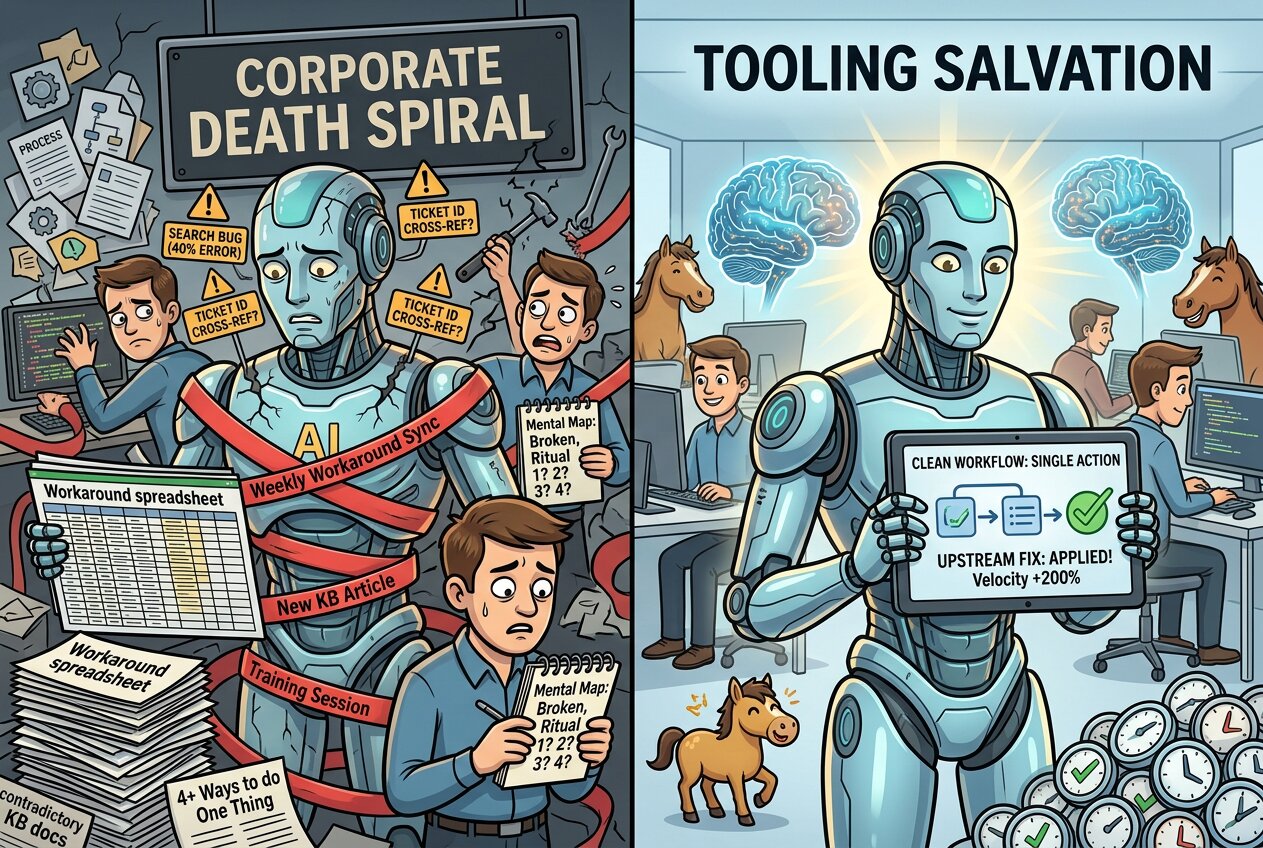
The Quiet Corporate Death Spiral
When Broken Tools Get Buried Under More Processes
There's one unmistakable smell that tells you a company has quietly entered its death spiral. It isn't mass layoffs or missed earnings. It's the moment management looks at a genuinely broken tool, UI, script, or workflow and decides the easiest fix is... another process.
An email goes out. A new KB article appears. Someone records a TOI video. A fresh Slack channel is born. The wiki gets another page that nobody will read after next week. And just like that, the organization has chosen to compensate for bad tooling with human friction.
I watched this exact pattern play out at a mid-sized software company that, on paper, still looked healthy.
The internal escalation tool had a nasty bug in its search function. Simple queries returned incomplete results about 40 % of the time. It had been that way for months. Instead of fixing the underlying indexing issue (which the devs swore would take "only a couple of sprints"), leadership sent the classic memo: "Please use this new workaround when searching for escalations." The workaround involved three extra steps, copying ticket IDs into a separate spreadsheet, cross-referencing with another system, and then posting in a dedicated Slack channel so someone else could verify you hadn't missed anything.
Within weeks, the band-aid became standard operating procedure. Then it snowballed. New KBs were written to explain the workaround. Training sessions were scheduled. A weekly "workaround sync" meeting appeared on the calendar. Before long, the team had three different documents describing four slightly contradictory ways to do the same thing, depending on which version of the bug was currently active.
The power horses 🐎 - the ones who actually kept customer issues moving - started losing track of which process was current. Neurodivergent engineers who thrived on clear, repeatable systems were slowly going insane trying to keep the mental map updated. Simple tasks that should have taken minutes now took fifteen, with a side of anxiety that you'd followed the wrong ritual and would get called out later.
The really dark comedy came when the bug finally got fixed... eight months later. By then, so many overlapping processes, channels, and documents existed that the team spent another three weeks untangling the mess they had built around the original problem. The total time wasted was easily ten times what it would have cost to fix the tool properly in the first place.
That's the brutal truth most leadership teams refuse to accept: broken tooling plus manual workarounds doesn't just create overhead. It compounds negatively. Every new layer multiplies errors, frustration, and context-switching costs across the entire team. The best people eventually conclude the company would rather manage symptoms than cure diseases, and they start looking for the exit.
I've seen the opposite approach too, and the difference is night and day.
The teams that bite the sour apple and fix the tooling upstream experience the opposite compounding effect. One clean fix to a painful workflow can save hundreds of hours per month, reduce errors, lower cognitive load, and make the power horses visibly happier and more productive. The velocity gain is immediate and permanent instead of being slowly bled away by process theater.
For those still stuck in the trenches, here's how to fight this pattern without sounding like the office complainer:
Quantify the pain in hard numbers. Track how many extra hours per week the workaround actually costs the team. Turn it into a simple slide or one-pager: "Current process tax = X hours/week = Y full-time equivalents." Data beats drama every time.
Frame the request as protecting customer outcomes and team capacity, not personal convenience. "This workaround is adding friction that delays critical escalations" lands better than "this sucks."
Keep a living "technical debt list" that includes broken tools and their real business costs. Review it in every ops review. Make it impossible to keep ignoring.
For the neurodivergent brains who just want the system to be predictable: document the workaround clearly once, then immediately start pushing for the real fix. Your clarity obsession is actually a strategic advantage here.
And for leadership reading this: every time you choose another process layer instead of fixing the broken tool, you are quietly voting for a slower, more frustrated, and ultimately more expensive organization. The best companies treat tooling issues as urgent product problems, not support inconveniences. They understand that clean, reliable systems are one of the highest-leverage ways to retain power horses and keep actual work moving.
Fixing broken things upstream always compounds positively. Patching them with human processes compounds negatively until the entire machine grinds to a halt. Pushing additional workload and forcing messy processes onto your team is easy. True leadership requires accountability and willingness to push solutions, even upwards and against other (busy) teams.
The next time you hear "we'll just add a quick process for now," ask the only question that matters: Are we solving the problem, or are we teaching the organization to live with it?
What's the most soul-crushing workaround or extra process your company is currently forcing everyone to follow because the underlying tool is broken? Drop it below. The trenches usually spot these death-spiral signals long before the executive dashboard does. 👇
This article is also available in German.
0 comment(s)
No comments yet. Be the first to comment.
Leave a comment