Three things kill small businesses that never appear in a business plan: the room you work in, the stories you absorb, and the money that was never yours.
I have been self-employed a few times. Before my enterprise career, between two of them, and on the side. None of it made me rich. All of it taught me things you cannot learn from a startup podcast, because podcasts talk about scaling and my problem was that a customer's dog did not like me.
Let me hand over the three lessons that actually cost me something
Your business has a physical address, even when you think it doesn't
Everyone starts in the bedroom, the garage or the study. Fine. Nobody plans the other rooms.
One of my ventures was classic IT service. Persuading stubborn printers to acknowledge the existence of WiFi. Removing pre-installed bloat from our favorite corporate operating system. Explaining, for the fourth time, that a tablet needs updates. Mostly on-site, at people's homes.
Some clients objected to travel fees. Reasonable. They wanted to come to me. Slight problem: I had no office and no presentable workshop. So I invited them into my dining room - statistically the least private room in the house, right up until a stranger sits in it holding a coffee cup and telling me about his divorce while I diagnose a random reboot.
Everyone says "customer first". Almost nobody means it.
Years ago, I shared a few carbonated drinks with an SVP whose management philosophy fit on a bar napkin: "Be employee obsessed."
I was skeptical to the point of rudeness. So I asked him straight: "with that approach, how do you make sure customers get world-class service?"
He didn't blink. "If you hire top performers, you never have to worry about customer satisfaction. I have never once hired a talented support person who wasn't already customer obsessed. Nobody ends up in this job by accident. It's ingrained, or they'd have picked a role where humans don't call you when their week is on fire."
So the model was simple: hire people who are obsessed with customers, then spend your own energy protecting them. Not managing them. Protecting them. From three specific things: corporate nonsense, burnout, and what he cheerfully called "stupid customers".
Let me unpack all three, because each one had teeth.
Burnout is rarely about volume
His claim: information technology has one of the worst burnout rates in white collar work, and the cause is usually misdiagnosed as "too much work". Sometimes it genuinely is too much work. But more often, he said, people are either doing the wrong things, or doing the right things in a broken flow imposed on them by the company.
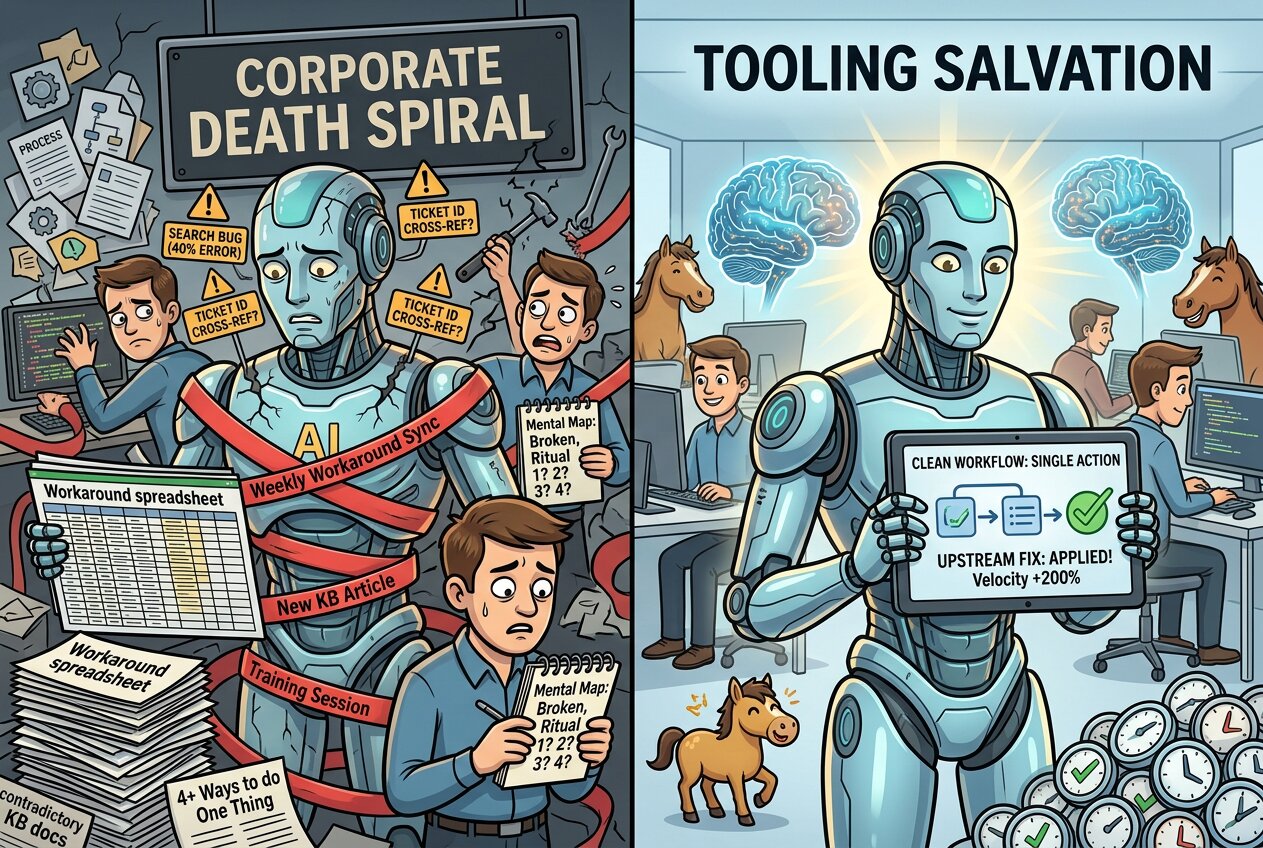
There's one unmistakable smell that tells you a company has quietly entered its death spiral. It isn't mass layoffs or missed earnings. It's the moment management looks at a genuinely broken tool, UI, script, or workflow and decides the easiest fix is... another process.
An email goes out. A new KB article appears. Someone records a TOI video. A fresh Slack channel is born. The wiki gets another page that nobody will read after next week. And just like that, the organization has chosen to compensate for bad tooling with human friction.
I watched this exact pattern play out at a mid-sized software company that, on paper, still looked healthy.
The internal escalation tool had a nasty bug in its search function. Simple queries returned incomplete results about 40 % of the time. It had been that way for months. Instead of fixing the underlying indexing issue (which the devs swore would take "only a couple of sprints"), leadership sent the classic memo: "Please use this new workaround when searching for escalations." The workaround involved three extra steps, copying ticket IDs into a separate spreadsheet, cross-referencing with another system, and then posting in a dedicated Slack channel so someone else could verify you hadn't missed anything.
A while back I met an old colleague for cocktails. We do this every so often - two people who have seen enough server rooms and steering committees to know that the best incident reviews happen over a Negroni.
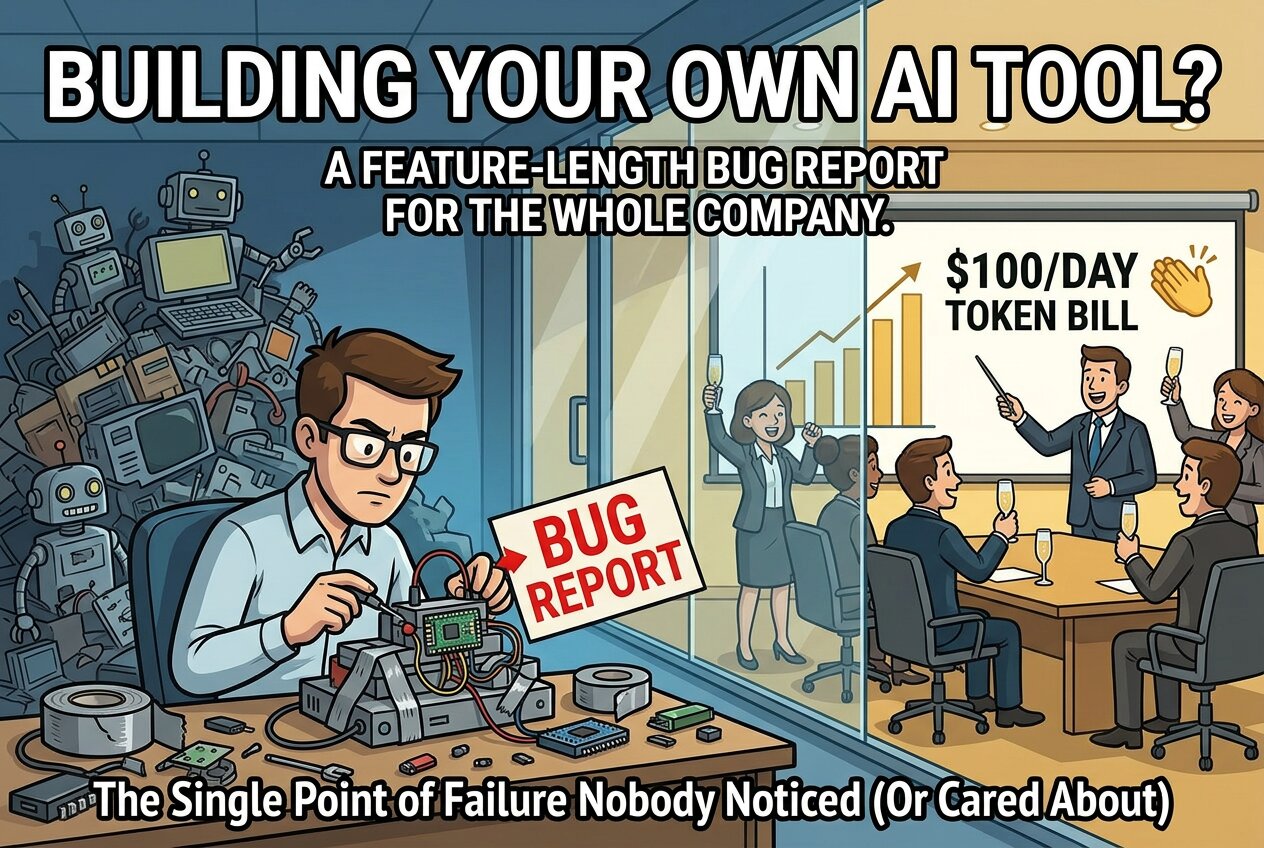
He was in a great mood. His company's vibe coding (quickly developing software using AI like Claude without writing (or sometimes even understanding) the code itself) adoption was through the roof. And not just among developers - consultants, architects, support engineers, basically anyone with a pulse and a Claude license was building tools. Management was celebrating. They threw around numbers like trophies: one engineer burned through 100 dollars a day in tokens. Applause. High fives. Slide decks.
And honestly? Fair enough. If a 100-dollar-a-day token bill produces a tool that saves ten hours of engineering time per week, that's the cheapest employee you ever hired. I am not here to rain on token budgets. Fun fact on the side: "vibe coding" went from a casual Karpathy tweet to Collins Dictionary Word of the Year within roughly twelve months. That's faster adoption than most companies manage for a new expense tool.
But while my colleague was celebrating, I was doing what 20+ years in support trenches trains you to do: listening for the alarm underneath the applause.
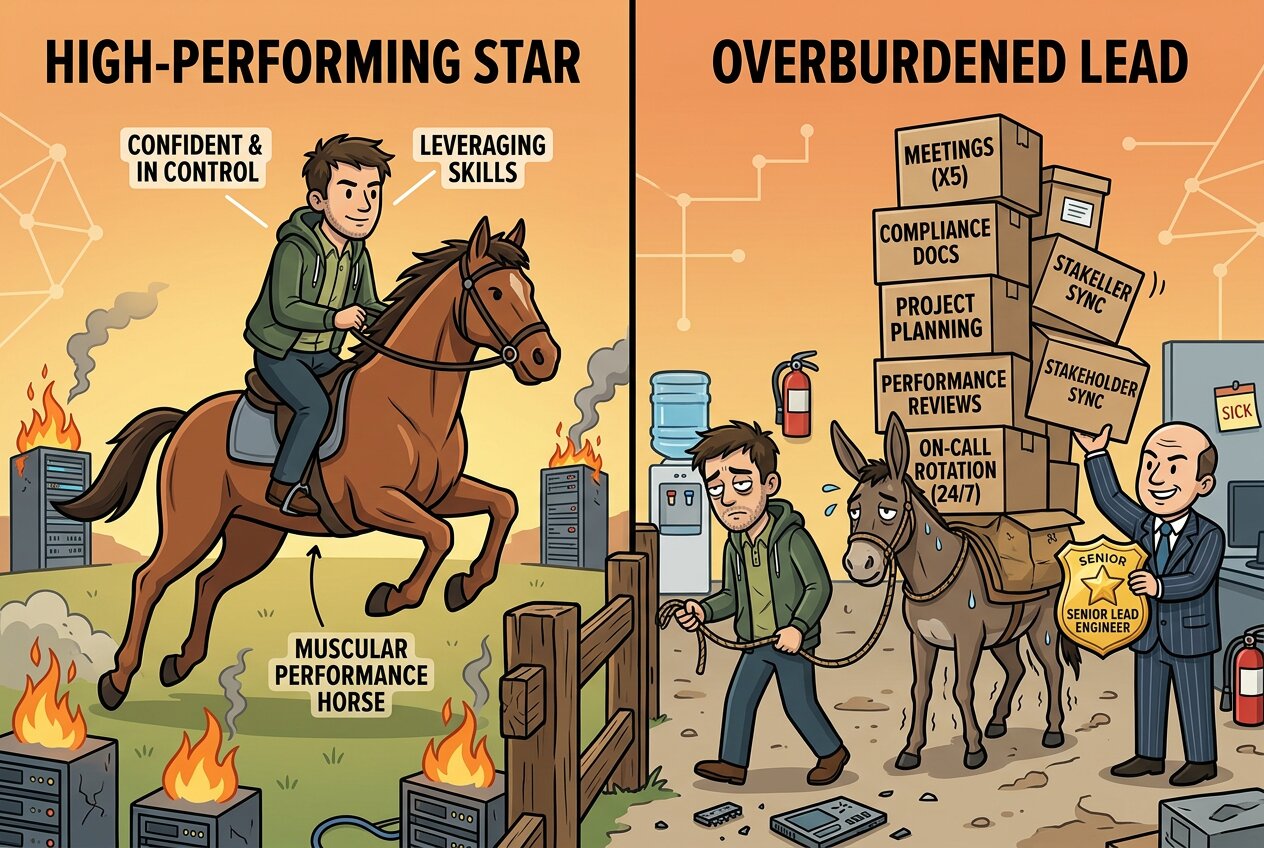
You know the scene. Klaus (or whatever name your local power horse goes by) has been carrying the team for 18 months. Bug fixes, feature work, on-call rotations, mentoring the new grad, troubleshooting the architecture mess the previous lead left behind. He does it all with quiet competence. The quarterly IDP comes around. His manager beams: "Klaus, we're promoting you to Distinguished Engineer." Handshake, new title in the HR system, a 7% bump and a vague promise of "broader responsibilities."
Fast forward three months. Klaus is drowning. He still does everything he did before, plus the project planning, the cross-team alignment meetings, the compliance documentation, and the performance review feedback for his peers. He has no more authority. He has no more decision rights. He just has more work. The new title was a horizontal shuffle dressed up as a promotion. And now he's a pack mule, not a power horse.
I watched this happen at three different companies over the years. Always the same pattern: brilliant individual contributors get "promoted" into roles that expand their scope horizontally without giving them any real leverage. They don't get a seat at the table. They don't get budget authority. They don't get a voice in strategy. They get an extra hour of meetings each day and a new section in the org chart that just means more people can dump work on them.
 TrenchOps 🐎