 TrenchOps 🐎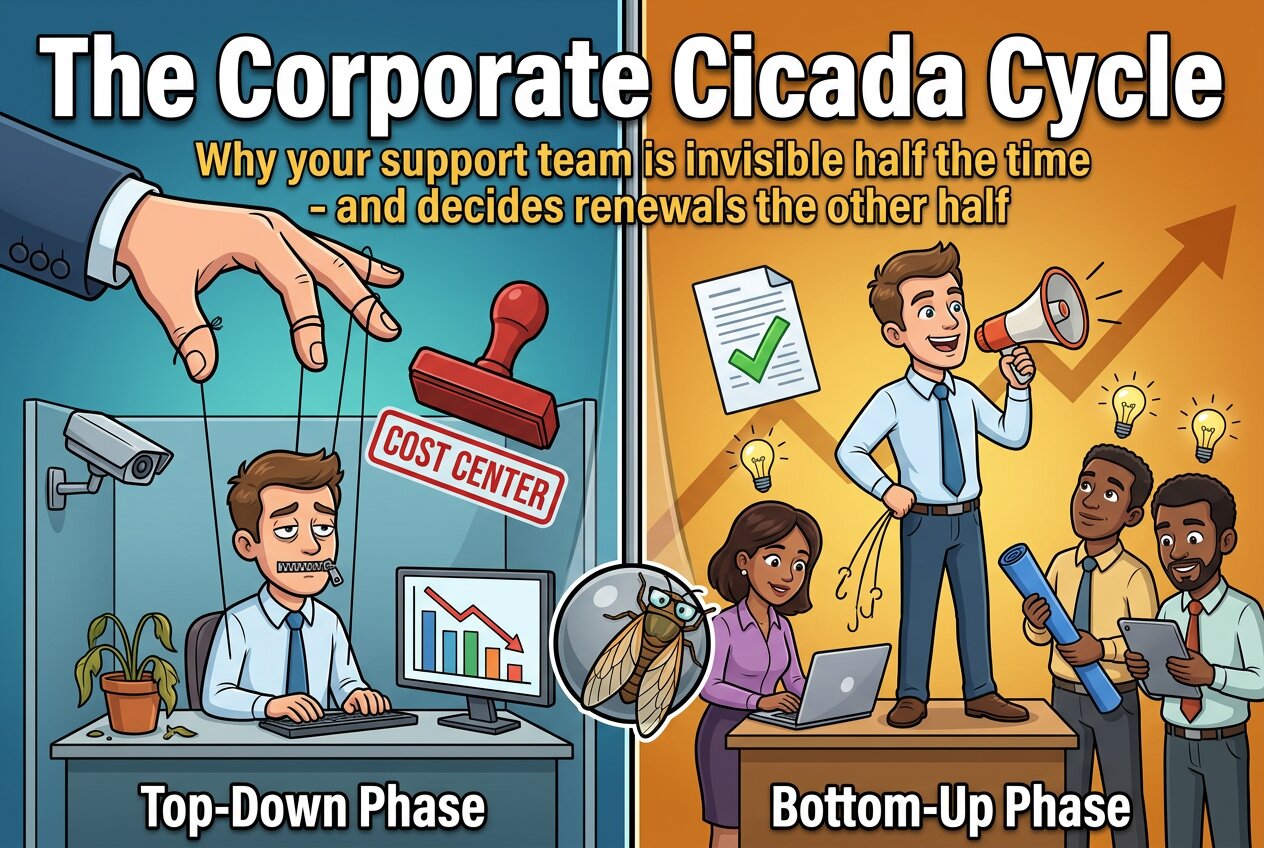
The Corporate Cicada Cycle
Why support is powerless in some years and decides renewals in others - and how to know which year you are in
Cicadas spend most of their lives underground. Then, on a schedule nobody voted for, they climb out, make an unbearable amount of noise, and vanish again. Some species run on a 13 or 17 year clock. Prime numbers, apparently, because predators can't sync to a prime.
Corporate culture has a similar rhythm, just shorter and less elegant. It swings between top-down and bottom-up. And whichever half of the cycle you are standing in determines something most support leaders never account for: whether your work influences revenue at all this year.
Not how good your work is. Whether it counts.
The two weather systems
In a top-down phase, decisions are made somewhere with a nice view and a beverage. The prevailing theory of human nature is that people are fundamentally slacking off and need to be measured harder. Surveillance software gets a budget line. Presence gets confused with output. The message to everyone below director level is: be grateful you have a job, do your job, don't editorialize.
In this phase, support is a cost center. Full stop. You are a number in a spreadsheet next to "cloud spend" and "office plants." Your KPIs are cost-per-ticket and time-to-close, which is another way of saying: "please handle customers faster and think about them less."
In a bottom-up phase, the story flips. Someone in leadership notices that the company is full of expensive, competent adults and wonders aloud whether trusting them might be cheaper than watching them. Admins get evaluation budgets. Architects get to run a bake-off. DevOps teams get to say "this vendor is a liability" and are not immediately reminded of the three-year contract.
And that is the moment support stops being overhead and becomes the deciding vote on renewals.
Why the swing matters more than your CSAT score
Here is the mechanism, and it is the part that gets missed.
Support quality does not cause churn directly. It causes churn through the people who are allowed to complain effectively. A furious senior admin in a top-down organization writes a Slack message into the void, is told to open a ticket, and goes back to work. The same admin in a bottom-up organization writes a two-page evaluation, gets fifteen minutes with the CTO, and your competitor gets a proof of concept by Friday.
Same admin. Same frustration. Wildly different consequence.
Which means: in a top-down year, excellent support is largely invisible in the numbers, and mediocre support gets away with it. In a bottom-up year, both get repriced overnight - and the vendor who quietly kept their escalation muscle in shape during the lean years wins deals they never pitched.
That asymmetry is the whole game. The rewards for support excellence arrive years after the investment, in a phase where nobody remembers who made the investment.
The self-cancelling cycle
The reason this oscillates rather than settling is that each phase destroys its own justification.
Top-down starts with a genuine problem: things are sloppy, cost is up, accountability is fuzzy. So the org measures more. And here Goodhart's law does its thing - the observation, named after economist Charles Goodhart, that once a measure becomes a target it stops measuring anything useful. Ticket counts become the target, so tickets get split. Closure time becomes the target, so tickets get closed and reopened under new numbers. Everyone hits their metrics and the customer's actual problem enters its third month of quiet existence.
Then productivity flatlines, because the workforce has correctly deduced that discretionary effort is unpaid and unwanted. People do exactly their job description. Which, in support, is roughly equivalent to sabotage - because everything valuable in support lives in the gap between the job description and reality.
Eventually, someone runs the numbers and discovers that the surveillance-and-compliance apparatus costs more than the slack it eliminated. Cue the pendulum. Autonomy comes back, gets rebranded as an innovation initiative, and the same people who were "disengaged" last quarter start rewriting workflows for fun.
Then it gets sloppy again. Repeat. The last bottom-up era wound down around the early 2020s, when remote-work optimism curdled into remote-work monitoring.
Where this could go
I do not make predictions, and anyone in this industry who does should be asked to show their track record first. But there is a hypothesis worth holding loosely.
The current top-down phase (as of mid-2026) found a powerful accelerant: AI as a headcount argument. Reduce the team, keep the throughput, let the models absorb the difference. Some of that will hold. Some of it will turn out to have been the corporate equivalent of removing the load-bearing wall because it wasn't in the drawings.
The specific failure mode I would watch for is not "AI gave a wrong answer." It is expertise regeneration. Junior engineers historically learned by grinding through the boring tickets - the ones now handled by automation. Remove the training ground and you keep the seniors, lose the pipeline, and discover the gap only when the seniors leave. There is serious research circulating on exactly this - the erosion of the shared pool that professional expertise regrows from. It is not a fast failure. It is a slow one, which is worse, because slow failures don't trigger anyone's quarterly alarm.
The second failure mode is more human: the meat proxy. The colleague who forwards AI output without reading it, adding zero verification and full apparent authority. In a phase that rewards volume of visible activity, the meat proxy is the optimal strategy. In a phase that rewards correctness, they are a liability with a calendar full of meetings.
If both of those bite around the late 2020s, the pendulum comes back hard, and companies go hunting for exactly the deep-context, high-judgment people they let go. Power horses 🐎 are not fungible and they are not fast to rebuild. The organizations that kept a few will look like geniuses. Mostly they will have been lucky, or stubborn.
What to actually do with this
👉 Diagnose the phase before you pitch. The same support investment proposal that is dead on arrival in a top-down year sails through in a bottom-up year. Read the room, then time the ask. This is rhetoric, not logic, and refusing to play means losing to people who will.
👉 In top-down years, build quietly. Knowledge base depth, root cause discipline, escalation paths that actually work. None of it will show up in your visible metrics. All of it becomes your competitive moat the moment customers regain purchasing autonomy.
👉 In bottom-up years, get loud fast. Instrument the influence. Track which renewals had an engaged admin, an architect who ran an evaluation, a DevOps lead who wrote a recommendation. That is your revenue attribution and the window for collecting it is finite.
👉 Protect the training ground on purpose. If automation ate the tickets your juniors used to learn from, you now owe them a deliberate substitute. Otherwise you are harvesting seniority you never planted.
👉 Bottom-up years are the best opportunity to try something new. If you are looking for a new role, that is a great moment to switch. If you manage people, ensure your best people are happy before they switch to your competitor.
👉 Keep your judgment expensive. Anyone who forwards machine output unread has voluntarily made themselves a wrapper around a free service. Wrappers are the first line item cut.
The pendulum is not your problem to solve. Getting caught facing the wrong way when it swings - that one is on you.
👇 Which phase is your organization in right now, and what is the single clearest tell?
0 comment(s)
No comments yet. Be the first to comment.
Leave a comment