 TrenchOps 🐎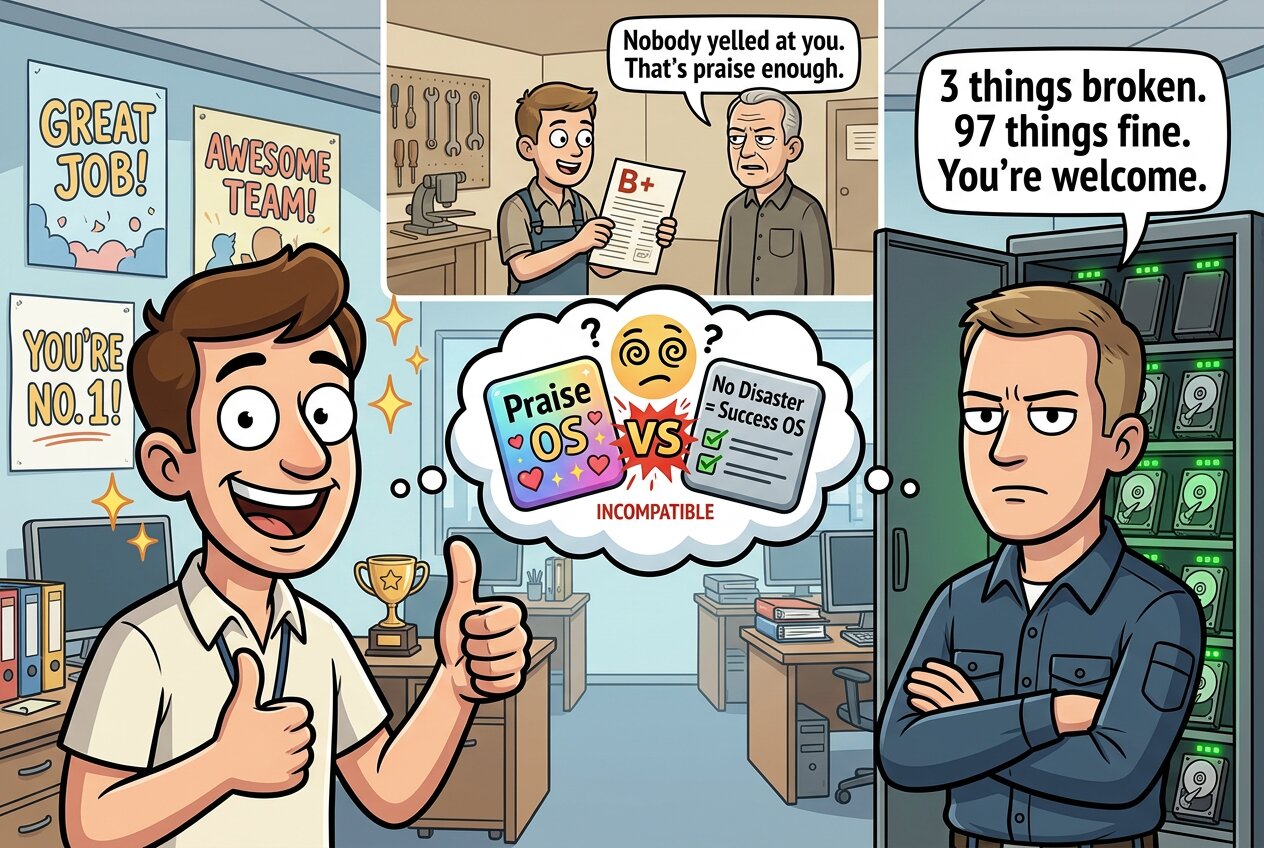
The Foreign Manager's Survival Guide to German Engineers (Yes, We Know We're Weird)
When I was 17 and still an apprentice, I once walked into the office holding a B+ from business school like a cat presenting a dead bird. Proud. Expecting a head pat.
My team lead looked at it, looked at me, and said: "Well. Nobody yelled at you. That's praise enough."
No joke. That sentence raised a generation of German professionals.
And if you've ever managed, hired, or simply tried to befriend a German colleague and walked away thinking "this person is mildly broken" - congratulations, you've met us. Let me translate.
👉 Why your German only reports bad news
Here's the operating system you need to understand: in the German mind, the good is assumed. It's the default. Things working correctly is not an event worth mentioning. Why would you celebrate a server that's up? It's supposed to be up.
So your German engineer walks into the standup and reports only the three things that are broken. To an American manager, this reads as negativity, low morale, maybe even a flight risk. To the German, it's a complete and efficient status report. The other 97 things are fine. You're welcome.
This is conflict number one, and it's a brutal one. American culture runs on positive reinforcement and "great job, team!" German culture runs on the absence of disaster. One side feels starved of praise. The other feels buried in pointless noise. Neither is wrong. They're just running incompatible firmware.
The fix is embarrassingly simple: tell your German directly that you actually want to hear what's going well too, and explain why - it helps you allocate budget, defend the team upstairs, whatever. Give them a reason. Germans don't do things "because it's nice." They do things because there's a logical case. Build the case, and they'll comply with terrifying consistency.
👉 The "how are you" trap
Do not, under any circumstances, answer the question honestly.
When a German asks "how are you," it is not an invitation to share. It's a flowery placeholder, and frankly, half of us resent having to say it at all. The only acceptable answers are "good," "fine," or - if you want to sound worldly - the Irish "not too bad."
If a German senses you're actually struggling and asks again, this is 100% a trap. Smile. Say "all good." Whatever you're carrying, carry it home. We are not equipped, and more importantly, we did not budget the time.
This isn't coldness. It's boundaries. The German emotional warmth is real - it's just reserved for family, lifelong friends, and possibly a dog. Everyone else gets competence and reliability, which we genuinely consider a form of love. Showing up on time is, to us, a deeply romantic gesture.
👉 The robot comparison nobody asked for
There's a running joke that chatting with a default AI feels like talking to a German: blunt, structured, allergic to small talk, straight to the solution. I'll own it. We do that.
A German colleague hears your problem, processes it, hands you a solution, and if you don't want the solution - they turn around and leave. The conversation, in their mind, is over. You had a bug. They patched it. What else is there?
This is where Americans and southern Europeans recoil, because sometimes a person doesn't want a fix; they want to be heard. The German has no module for that with non-family. It's not that they don't care. It's that "being heard" is, to them, an inefficient way to not solve a problem.
If you just want to vent, tell us up front: "I don't need a solution; I just need to complain for two minutes." We'll be confused, but we'll allocate the two minutes. Like a calendar entry.
👉 The geography of the German soul
Think of Europe as a temperature gradient. Scandinavians on the cold end - polite, distant, will let you freeze in the lobby. Southerners on the warm end - feeding you within four minutes of arrival, whether you asked or not.
Germans sit dead center. We are the "this guy, huh? Super weird" (Rick and Morty reference) of European emotional life. Will a German invite you in for a meal? Genuinely a coin flip. Could go either way, and even we don't know which until the moment arrives.
But here's the upside that catches everyone off guard: we are nicer than we appear on first contact. The cold shell is just a cover for a surprisingly loyal core. Invite a German to your BBQ. Get them slightly relaxed. One of two things happens: you find a friend for life, or you discover a creature you'd cross continents to avoid. Especially after the third beer. I warned you. There is no middle outcome.
👉 How to actually manage one
Put a German where they can work without friction. Remove the bureaucratic gravel from their shoes, and they'll out-produce teams twice their size - the quiet, diligent power horse 🐎 who just wants a clean problem and the runway to solve it.
But not every German is the diligent type. Some are deeply, gloriously rebellious: allergic to process for its own sake, ready to argue with you about why the process is dumb. The trick is figuring out which one you've got.
The good news: you can simply ask. Germans are radically, sometimes alarmingly honest. You don't need an engagement survey or a skip-level. Just ask "do you prefer structure or autonomy" and you'll get a true answer, possibly along with feedback on your management style that you didn't request.
And if you really want the unfiltered version, tell a German to be "extra honest." They will deliver. Just make sure HR isn't in the room, and maybe have a glass of water ready - for you.
👉 The neurodivergent footnote
A lot of what reads as "German" overlaps neatly with what reads as autistic or ADHD-flavored: pattern-driven thinking, low tolerance for social theater, brutal honesty, deep focus on systems. Germany didn't invent precision engineering by accident. There's a whole population here that found a culture that rewards their wiring instead of punishing it.
Which is maybe the real lesson for managers everywhere: the people who skip the small talk and obsess over the broken thing are often your best builders. The culture just decides whether you label that "rude" or "elite."
And yes - we do have humor. It lives somewhere between dark British dryness and pure cynicism. Mr. Bean was wildly popular here, which should tell you everything. The reason you can't always tell we're joking is that our delivery is identical to a server outage report. That's not a bug.
Bottom line: with German engineers, you get what you pay for, rough edges included. Reliable, honest, allergic to drama, weird in the best way. If you like the good kind of strange - and most great teams are built on it - it's almost always worth it.
How does your culture handle those aspect? Share it with us. 👇
This article is also available in German.
0 comment(s)
No comments yet. Be the first to comment.
Leave a comment