 TrenchOps 🐎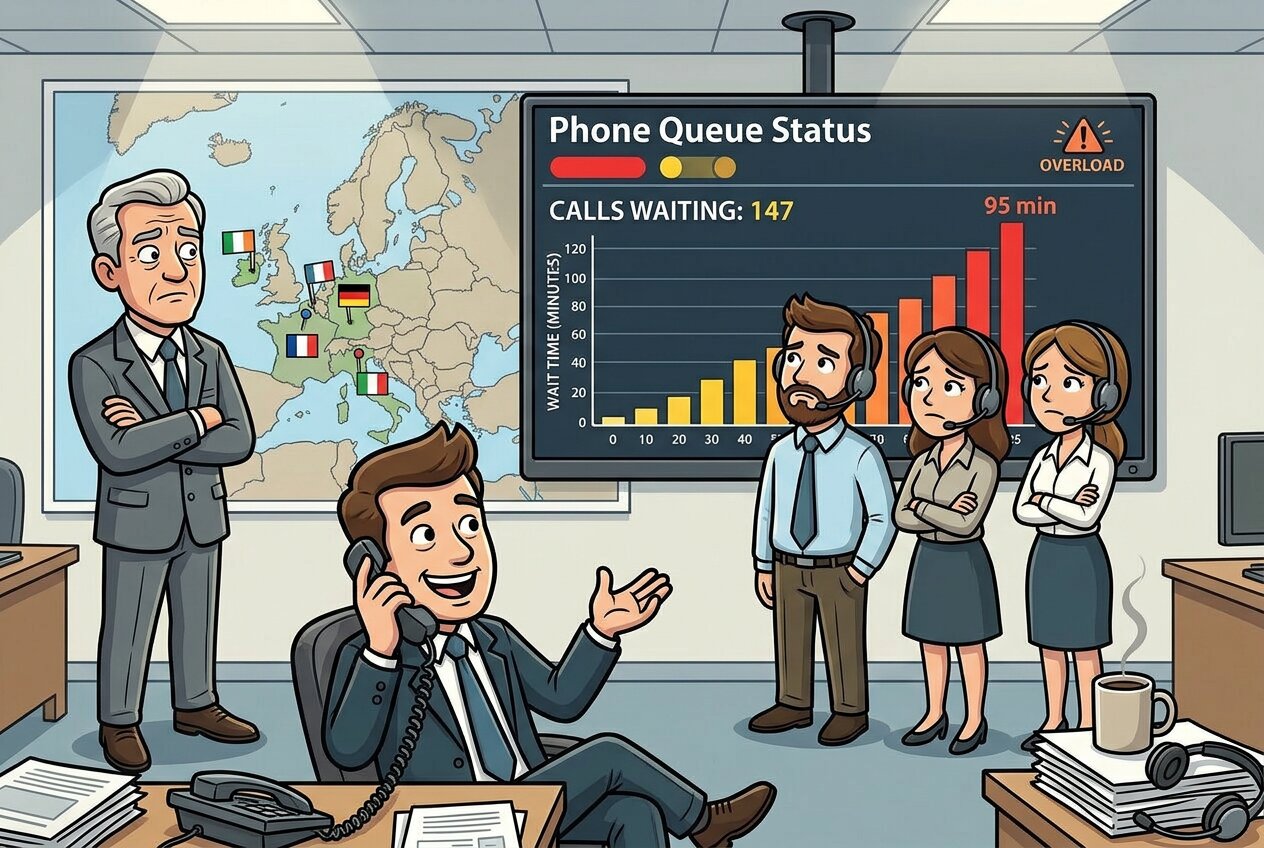
The Five Minute Wall
What happens when a company discovers that other countries are not just America with worse coffee
Years ago I moved from Germany to Ireland for work. My actual plan had been Sweden - some call it Germany without the historical baggage - but the offer came from Ireland, which is also green, also rainy, and considerably more relaxed about deadlines. Fine. Adventure accepted.
What I got was a masterclass in something no onboarding deck ever covers: how much money a company will burn to avoid learning that other cultures exist.
Exhibit A: the man who discovered Italy
A colleague came back from his first holiday on the European mainland genuinely shaken. Not by the food, not by the driving (the Irish drive on the wrong side like the British). By the fact that Italians, in Italy, mostly speak Italian.
He had assumed English was the continental default. Second language, worst case. The idea that a bakery in Naples might not have a fluent English speaker on staff had never crossed his mind. I like to think he still managed to relax. Eventually. Somewhere around day four, probably with the help of the wine, which needs no translation.
Exhibit B: the manager who prepared
Then there was a manager who came to me, beaming, and tried out her freshly learned Spanish. She was heading to Spain and had actually studied a bit, which put her one full evolutionary step ahead of the previous guy.
The catch: her brain had processed "mainland Europe speaks something other than English" but not "mainland Europe speaks roughly forty different somethings." It took a genuine conversation to establish that I speak neither Spanish nor French, that Germany has its own language, and that English would serve us both fine going forward.
She took it well. And she pronounced "buenos días" beautifully.
Exhibit C: the five minute wall
Now the expensive part.
We ran a phone queue that dropped customers directly into second level support. Engineers watched the waiting list on a big screen and picked up calls when they felt brave. Most hated it, because the odds that the caller's problem sat inside your specific area of expertise were roughly the same as the odds of rain in Ireland being brief. Queue length was a team metric. A few minutes of waiting was bad. An abandoned call was a catastrophe.
Our US-based Senior Vice President visited the office and was shocked. Genuinely, theatrically shocked about our high numbers of abandoned calls. The reason was that German and French customers were hanging up at around the five minute mark.
The whole team stared at him. Five minutes? Of course. That is exactly what we would do. Five minutes of hold music is not a queue, it is a statement about how much the vendor values your time.
He explained the American baseline as he knew it: customers put the phone on speaker, let the eight-bit orchestral loop play in the background, and keep working. An hour. Sometimes more. Apparently still preferable to email or a portal ticket.
So we had a genuine cultural gap. Two reasonable interpretations of the same silence. One side hears "we are busy serving people." The other hears "we are not coming."
Here is where it got educational. The gap was real, the diagnosis was correct, and the fix was pure theater. Hiring an additional engineer or two was, naturally, off the table. Instead the team manager got parked in the phone queue as a human airbag - picking up when all engineers were busy, juggling callers, entertaining them with small talk about the weather until a real engineer became available.
A manager on a salary well above an engineer's, employed as a hold-music substitute. Meanwhile the annual executive travel-and-wellness budget of a single SVP would have covered the headcount that actually solved the problem. The math was never the constraint. The math was never even invited into the room.
Exhibit D: the border that only existed on our side
The finale. We had German language support. We offered it exclusively to customers with a German billing address.
Austrian and Swiss customers - same language, same documentation, same engineers sitting right there - got English. No matter how politely they asked. No matter how often. It took years of internal pushing before we opened a best-effort arrangement for them.
Note what was missing. Not the people. Not the language skills. Not the infrastructure. Not the demand. What was missing was the willingness to say yes to something a customer explicitly asked for, because someone once drew a line on a map and nobody wanted to own the paperwork of moving it.
Chesterton's fence says do not tear down a fence before you understand why it was built. Perfectly good advice - with a footnote nobody quotes: sometimes you investigate, discover the fence was built by a man who has since left the company for reasons unrelated to fences, and the correct action is a chainsaw. The rule was not protecting anything. It was just old enough to look load-bearing.
The actual mechanism
None of this was malice. Not one person in these stories woke up wanting to insult a customer. That is what makes it worth writing about.
The mechanism is that everyone runs on a default assumption of how the world works, and defaults are invisible from the inside. If your home market is large enough, monolingual enough, and dominant enough, you can go an entire career without your defaults being challenged. Then you export the product and the defaults come along in the shipping container, uninspected.
Ignorance alone is survivable. It gets cured by one uncomfortable trip to Naples. Ignorance combined with the confidence of a large domestic market is the dangerous compound - because then the customer's behaviour does not get interpreted as data. It gets interpreted as the customer being wrong.
That is the moment the SVP stopped being a manager and became a tourist complaining that the restaurants close at ten.
👉 When customers in one region behave differently, that is a measurement, not a defect. Ask what it tells you before you build a workaround.
👉 Check whether your "cultural problem" is actually a staffing problem wearing a costume. Ours was. The costume cost more than the staffing.
👉 Language support drawn along billing borders instead of language borders is a rule nobody can defend out loud. Find yours. Most companies have at least one.
👉 Intercultural training reads as a soft HR expense until you price a churned enterprise account. Then it reads as the cheapest insurance on the books.
👉 The engineers usually know. In our case the entire team instantly understood why five minutes was the limit, because we were the customers. Nobody asked us. Ask the locals - you are paying them anyway.
You do not have to love your customers' customs. You just have to respect them convincingly enough that they never feel like a foreigner in your queue - because your competitor is currently practicing exactly that, and feeling at home is sometimes the entire switching decision.
👇 What is the most expensive workaround you have seen built to avoid admitting that a market simply works differently?
This article is also available in German.
0 comment(s)
No comments yet. Be the first to comment.
Leave a comment