 TrenchOps 🐎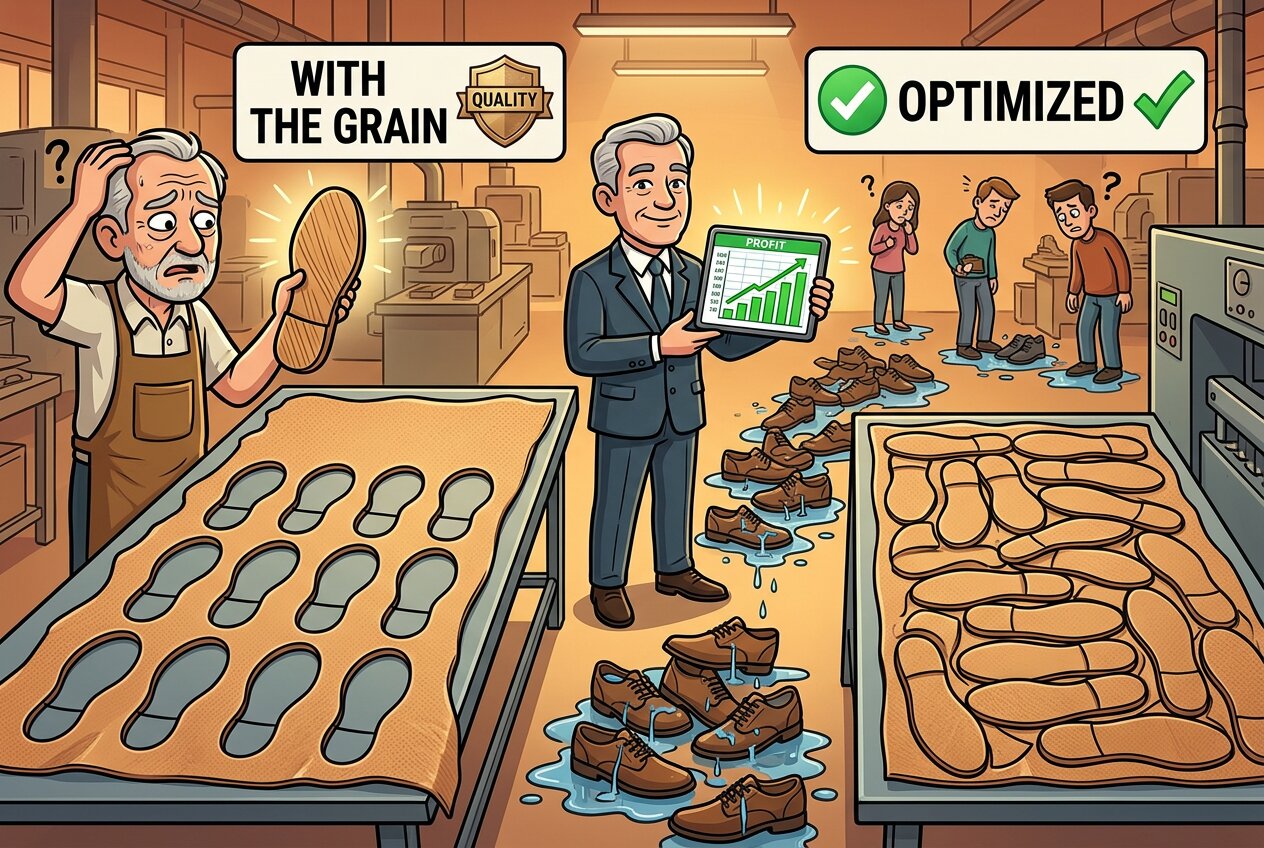
Your Leaky Shoes Might Not Be a Defect. They Might Be a Spreadsheet.
Many moons ago, back when I was an apprentice, a large shoe manufacturer walked into our software shop with a beautifully simple request: make our sole production more efficient.
Their process at the time: punch shoe soles out of the raw material in neat, ordered rows. Like cookies. All facing the same direction, with generous gaps in between. The gaps became scrap, the scrap became cost, and the cost became our project. The ask: write software that arranges the sole shapes in a randomized, compressed, rotated layout - Tetris for footwear - so almost nothing goes to waste.
Technically? A fun little optimization problem. A junior could have shipped it in a week.
But our senior developer did something that took twenty seconds and changed the entire meaning of the project. He picked up a piece of the raw material, squinted at it, and asked:
"Excuse me - I know nothing about shoemaking. But the fibers in this material seem to run in one direction. If we punch soles out at random angles, against the grain... could that hurt the quality of the shoe?"
The customer, without a millisecond of hesitation: "Absolutely. Every sole cut against the fiber flow will be subpar. Those shoes will most likely start leaking early."
Silence.
My colleague dared the follow-up: "Okay... but then why do you want us to build a system that produces subpar shoes?"
And here comes the answer I have never forgotten, delivered in the calm tone of a man reading his grocery list:
"Simple math. We save hundreds of thousands in raw material every year. Roughly 10% of the shoes will be subpar. Of those, fewer than 20% of customers will complain or demand a refund. So: six figures saved, in exchange for about 2% upset customers."
He wasn't ignorant. He wasn't embarrassed. He had a spreadsheet, and the spreadsheet had won.
We took the job. The layout engine worked beautifully. Material waste dropped exactly as promised. And somewhere out there, statistically, are people whose shoes gave up early because of code I helped test as a teenager. You're welcome.
Here is what that neat, "wasteful" row layout actually was: an undocumented quality requirement. Nobody had ever written down "all soles must be cut with the grain" - the ordered punching pattern simply enforced it by accident. The waste wasn't waste. It was insurance. And an optimization project that doesn't ask why the current process looks the way it does will happily delete the insurance along with the cost. Chesterton put up a fence about this once.
The darker lesson sits one level deeper. Our senior's question was perfect - and it changed nothing. Because the decision was never an information problem. The customer knew about the fibers before we did. You cannot fix with facts what was decided with incentives. The 20% who complain are the company's only real quality signal; the silent 80% who shrug and buy new shoes are the margin that funds the whole scheme. Every quiet customer is a co-investor in their own bad product.
👉 Before you optimize away "waste," find out what the waste is paying for. Inefficient legacy processes often encode requirements nobody ever documented.
👉 The one non-technical question - "why is it done this way today?" - is worth more than the entire implementation. Ask it every single time, even when you feel like the dumbest person in the room. Especially then.
👉 When the answer is "we did the math," stop arguing quality. The decision lives in a spreadsheet, and spreadsheets don't read your Slack messages.
👉 Complaining customers are not the problem. They are the only feedback channel with skin in the game. The silent ones are the business model.
We were hired to remove waste. What we actually removed was a quality control nobody knew existed - with the customer's full blessing.
So next time your new shoes leak after a few weeks: it may not be bad luck. It may be math. And whether you become part of the 2% who demand a refund, or the 80% who quietly fund round two - that's your line item in someone else's spreadsheet.
Have you ever "optimized" something, only to discover later what the waste was secretly protecting? 👇
This article is also available in German.
0 comment(s)
No comments yet. Be the first to comment.
Leave a comment