 TrenchOps 🐎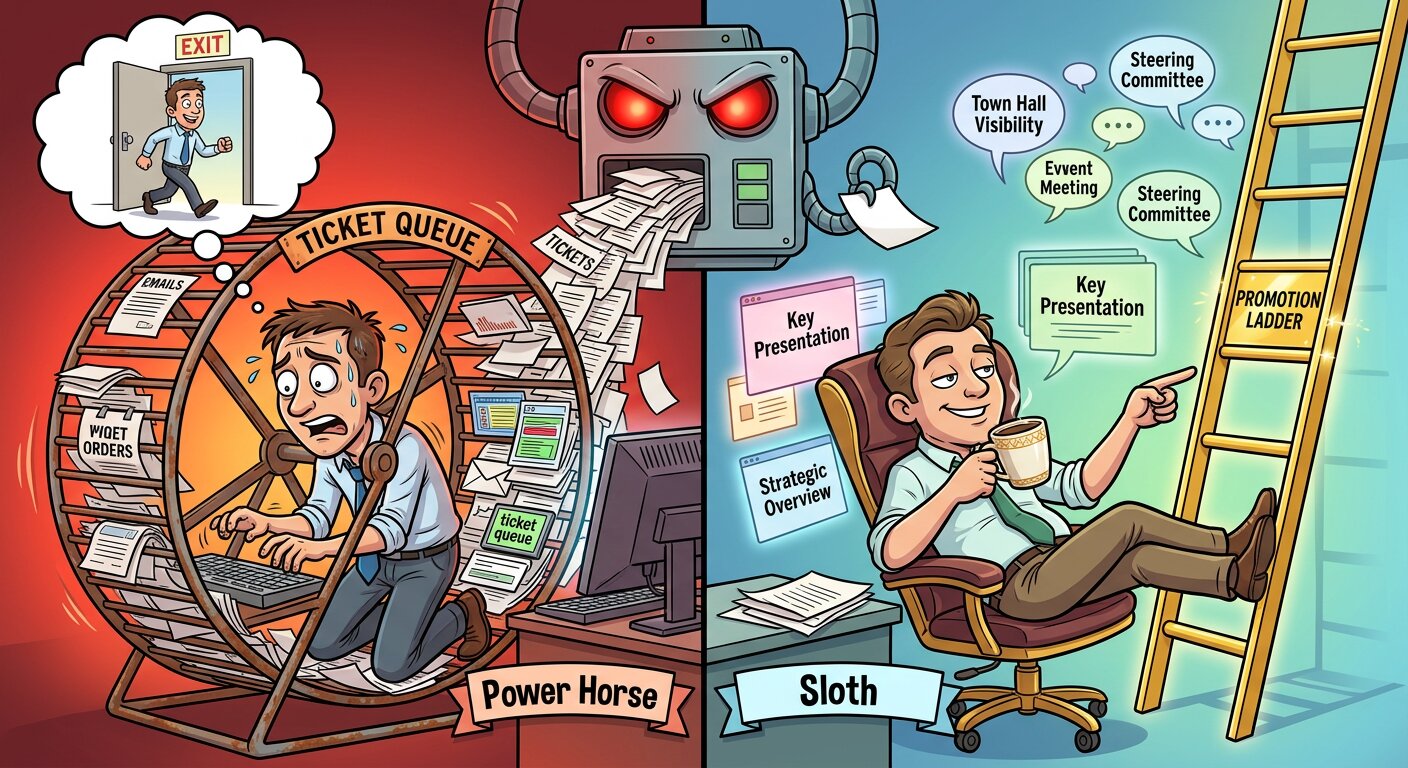
The Feature That Burns Your Best People
It looks like a bug, but it's a feature. Every company I've consulted for has one. Some variation of a queue assignment system - either a duty manager eyeballing tickets or some clever algorithm that claims to balance load. And in every single one, there's a small group of engineers who get absolutely hammered with new work. Not by chance. By design.
You try to fix it. Adjust the weights, add a cap, introduce a "max queue depth" rule. It works for a week. Then the algorithm finds its way back to the same victims. The duty manager, faced with pressure to clear incoming tickets, falls back on the one person who actually closes things fast. The poor souls eventually give up and accept that the system just loves them. Or hates them.
These people share one trait: they are power horses 🐎. They work fast. They empty their queue. And as a reward, they get more work. A bigger queue. A fresh pile of tickets waiting for them on Monday morning, while the guy who sits on his inbox for three days gets exactly one new item. The math is brutal.
But the real damage is what this does to their capacity. They never get to participate in projects, initiatives, or cross-team improvements. They can't even start their own. Their entire day is reaction. Meanwhile, the sloths - the ones who prioritize their side gigs or their LinkedIn presence over their actual queue - generate noise. Lots of it. They show up to meetings, volunteer for pet projects, write proposals that never ship. Management loves noise because it's cheap filler for charts and slides.
"Mr Sloth participated in five new initiatives" sounds way more exciting than "Mr Horse solved 20 customer issues." Because solving issues is what Mr Horse is supposed to do. That's his job. No one writes a slide about a guy doing his job.
This isn't just bad luck. It's a systemic glass ceiling for your hardest workers. The very people you need to retain get locked into a hamster wheel of operational work while their less productive peers climb the ladder on visible activity. I've watched sloths get promoted over power horses. They either become lazy with the new paycheck or leave with the title and rust to a competitor who will exploit them next.
The frustration and morale cost is staggering. Teams become cynical. People start gaming the system. The power horse learns to slow down. Or leaves. And then you wonder why your best engineers are leaving.
Here is the fix. Actually. Stop.
👉 Stop routing purely to "available." Cap intake. A power horse with an empty queue is not a resource to be refilled - it is a strategic reserve. Protected slack is where initiative, mentoring, and your next process improvement actually come from. An organization with zero idle capacity has zero capacity to improve itself.
👉 Measure resolved value, not just resolved volume - and weight by difficulty. If clearing a brutal escalation counts the same as closing a password reset, your metrics are lying to you, and your best people know it before you do.
👉 Separate "visibility work" from "real work" in your own head, then deliberately reward the invisible kind. The engineer who quietly prevented forty tickets from ever being filed is worth more than the one who starred in five kickoff meetings. Find a way to put silent prevention on a slide. That is your job, not theirs.
👉 Audit your queue distribution like you audit your finances. Pull six months of assignment data. If the same three names sit at the top of the volume chart every single month, you do not have coincidence. You have a tax, and your best people are paying it.
👉 Give your horses an explicit off-ramp from the wheel. Protected project time. A rotation out of the queue. Anything that signals: speed buys you freedom here, not more weight. Otherwise, the only off-ramp they will find is the exit interview.
The deep irony is that the fix is cheap and the failure is expensive. Sloths are easy to replace. Power horses are not - and they tend to leave in clusters because the first one out the door reminds the others that leaving is an option.
Your assignment algorithm isn't broken. It is doing exactly what you told it to do. The question is whether you ever stopped to ask what you actually told it.
Go pull the data. I would bet you already know whose name is at the top.
Have you ever been the power horse that just gets rewarded with more work? Let us hear your story 👇
This article is also available in German.
0 comment(s)
No comments yet. Be the first to comment.
Leave a comment