 TrenchOps 🐎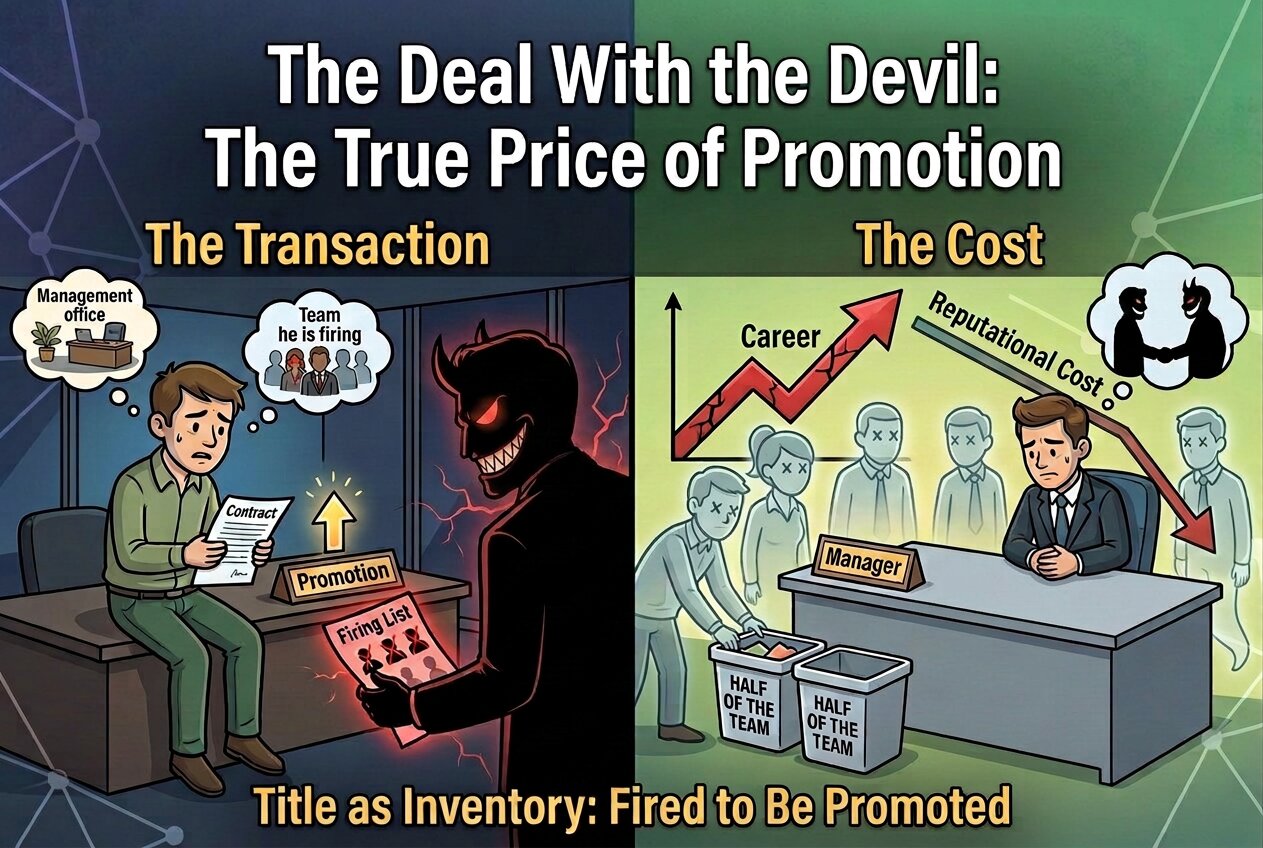
The Deal With the Devil
A Promotion Priced in Other People's Jobs
They finally offered him the promotion he had wanted for years. There was one condition.
Fourteen years, no layoffs. That was the company's quiet flex, repeated in every onboarding and printed in every recruiting deck like a family crest. Then one quarter the music stopped and a slide appeared with the word "rightsizing" on it, in a font nobody in the building had ever seen before.
Honestly? Some of it was overdue. Every company that grows fast accumulates sediment: the sloths you politely forgot to fire during probation, the people who mistook a chair for a career, the middle managers who systematically promoted the loudest guy in the room while the actual power horses 🐎 quietly kept the product alive. Cutting that is not cruelty. It's hygiene.
What one department did next was something else entirely.
Late shift
I was on late shift. I loved late shift. Empty office, pizza arriving around eight, and customers who were audibly relieved that a German-speaking human still picked up the phone at 6 PM. Nobody scheduling "quick syncs." Just work, the good kind.
That evening, a colleague from another department came over and sat on the edge of my desk. Senior CSM. Longer tenure than half my team combined. Genuinely excellent at what he did, and stuck, because his role had roughly the career ceiling of a parking garage. He had asked about moving into management before. Repeatedly. The answer had always been a variation of "not right now."
Now the answer was yes. He was glowing about it. Finally, he could use twelve years of pattern recognition on something other than renewal spreadsheets. He had a whole philosophy ready: treat people differently, coach instead of scold, protect the quiet ones who produce twice as much as the loud ones. He had clearly been rehearsing it in the shower for years.
Then he told me the condition.
He would get the role if he fired half the team.
Not "manage through a difficult period." Not "help us decide." Announce it. Deliver it. Own it. Be the face of it. The names had already been chosen upstairs.
The current management, you see, was not comfortable doing that themselves.
What was actually being purchased
Let's be precise about the transaction, because the mechanism matters more than the outrage.
The existing management had done the arithmetic and reached an interesting conclusion: the numbers were survivable, but the social cost was not. Somebody had to walk into a room full of people they knew by name and end their income. Whoever did that would be marked forever. Every future all-hands, every corridor greeting, every leaving drink - marked.
So they went shopping for someone who would absorb that cost in exchange for a title. And they found a candidate who had been kept hungry for years. That is not an accident. Hunger was the qualification.
For seven-ish years, the company had assessed him as not-quite-manager-material. Then a task appeared that carried a permanent reputational cost, and suddenly his qualifications improved dramatically. Overnight. Without a single new skill on his part.
That tells you exactly what the title was worth to them: nothing. It was never a reward for competence. It was inventory, held in reserve, to be spent when they needed someone to absorb a downside they didn't want on their own record.
The pricing is the tell. A promotion given for performance is a payment. A promotion given for delivering someone else's bad news is a purchase, and what's being purchased is your future relationship with every person in that room. Cheap for them. Non-refundable for him.
Worth noting: nobody in that management chain volunteered to bear the cost themselves. They were happy to make the decision, unwilling to be recognizable for it. There's a word for advice you hand out when somebody else eats the consequences, and it isn't leadership.
The math he did in about four seconds
He wasn't naive. He knew exactly what would happen after the announcement.
The people who stayed would not remember the org chart above him. They'd remember his face saying the words. Every future one-on-one would have a ghost in the chair. Every bit of the empathetic, do-it-better management he'd been dreaming about would arrive pre-poisoned. He'd have gotten the role and lost the only thing that makes the role work: people believing him.
And the ones who left? They'd tell the story for a decade. Correctly, from their point of view.
Best case, he becomes a competent manager of a team that flinches when he schedules a meeting. Worst case, he does the deed, the department shrinks again two quarters later, and the guy who signed the emails turns out to be conveniently expendable in round two. Patsies rarely get long contracts.
He declined.
Then he left, and found a place that valued him without requiring a blood sacrifice as the entry fee. Last I heard, he's doing well. Somewhat annoyingly well, in fact.
No manifesto, no dramatic exit email, no farewell speech with a moral. He just priced the offer, found it insulting, and walked away. Very quietly. Very German of him.
The uncomfortable part
I still think about that conversation more than is probably healthy. Because the layoff itself wasn't the moral failure. Businesses shrink. Sometimes the alternative is everyone losing their job instead of some.
The moral failure was discovering that a career milestone - the thing he'd worked toward for years, been told he wasn't ready for, reorganized his professional identity around - could be handed over instantly the moment it became useful as a bribe. It was never scarce. It was just withheld.
That's the part employees never forget. The research is boringly consistent: trust doesn't break because layoffs happen, it breaks because of how they happen, and the survivors are the ones who quietly recalculate. Roughly two thirds report losing confidence in leadership, and the people with the most options move first. Which is another way of saying the layoff you delegate downward selects against exactly the people you needed to keep.
What to do when the devil calls
The offer rarely arrives as villainy. It arrives as recognition, warmth, "we always knew you had it in you." That is what makes it work.
👉 If an opportunity that was blocked for years opens the same week an unpleasant task appears, the opportunity is the wrapper. The task is the product. Read it in that order. If a promotion arrives bundled with a job nobody above you wants their name on, you're not being promoted. You're being cast.
👉 Ask the question that reveals everything: "Would you have offered me this role six months ago, without this attached - and why aren't you announcing it yourselves?" The hesitation is your answer. If the reply contains the word "bandwidth," you already have it.
👉 Executing a layoff is legitimate leadership work. Being recruited specifically to absorb the blame for someone else's layoff is not. The difference is whether you had a seat in the room where it was decided.
👉 Price the reputational cost properly. A title takes ninety seconds to grant and can be reorganized away by lunch on Monday. Standing inside a building takes years to build, one meeting to lose, and five to rebuild if you're lucky. A title that costs you your team's trust is a net loss on day one.
👉 If you've been kept hungry for years, treat the sudden yes as data, not validation. Nothing about you improved - something about their situation got worse. The people who withhold your growth until it's convenient will do it again. They finally need you. That is a different market from finally valuing you.
👉 If you're leadership: announce your own layoffs. Personally. Delegate the paperwork, never the delivery. Being the recognizable face of a hard decision is most of what authority actually is, and everyone will know it was you anyway. Withhold a promotion for years and then produce it instantly as payment for dirty work, and you've told the whole organization exactly what your career framework is. People compare notes. They always compare notes.
👉 If you're a manager watching someone else get handed this deal: say something. He came to my desk at 9 PM because there was nobody else to think out loud with. That is its own indictment.
A company that will only promote you when the job requires you to be hated has told you exactly what it thinks the promotion is worth.
👇 Has anyone ever offered you a step up that came with a condition you couldn't live with - and how did you decide?
This article is also available in German.
0 comment(s)
No comments yet. Be the first to comment.
Leave a comment