 TrenchOps 🐎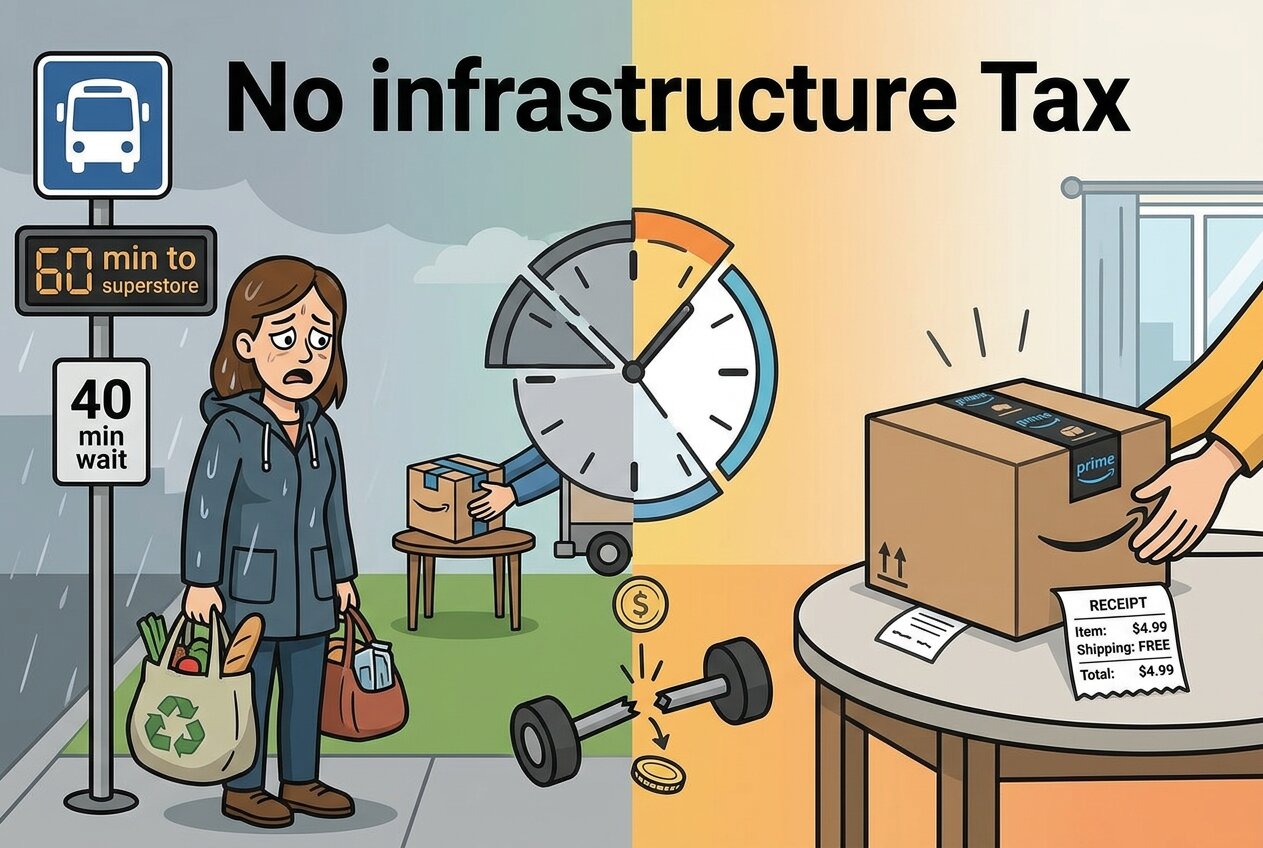
The Amazon Driver Who Accidentally Explained Economics
Why the people who scream loudest about "the rich" are the ones keeping the machine running
I was chatting with my Amazon delivery driver the other day. Casual stuff - weather, workload, the usual pleasantries you exchange with someone who knows your address better than some of your relatives.
I asked if he was worried about the economy.
He laughed. Not a nervous laugh. The kind of laugh that says buddy, I don't have time to worry about the economy because I can barely get a day off. More packages than he can physically deliver. Routes getting longer, not shorter.
So I said what any reasonable person would say: "The rich keep you busy, huh?"
He laughed again. Harder this time.
"Nah man. The mansions? One, maybe two packages. It's the other neighborhoods that bury me."
And then he drove off to his next stop, completely unaware that he'd just delivered the most concise economics lecture I've heard in years.
The consumption paradox nobody wants to talk about
There's a dominant narrative that says the economy is a machine built by the wealthy to extract from the poor. And there's enough truth in that to make it sticky. But the driver's observation reveals something more uncomfortable - and more useful - than any ideology can offer.
The households with the least disposable income are often the highest-volume consumers of convenience retail.
This isn't a moral judgment. It's a logistics fact. The driver doesn't care about your politics. He cares about how many stops are on his route, and the data under his feet tells a clear story.
Why does this happen? A few mechanisms that are worth understanding if you actually want to help people - including yourself - rather than just tweet about it:
The poor pay the "no infrastructure" tax. When you don't have a car, or your nearest store is a 40-minute bus ride, or your work schedule doesn't leave time for a proper shopping trip, that $4.99 item with free Prime shipping isn't a luxury. It's the only rational option. You're not being irresponsible. You're being efficient within a set of constraints that would make most middle-class commentators cry.
Small transactions add up invisibly. A household ordering $15 worth of stuff six times a week is spending more than the mansion that orders a $200 item once a month. But it never feels like spending because each individual purchase is trivial. This is the subscription economy's entire business model applied to physical goods. Death by a thousand small boxes.
Convenience is the most expensive product ever sold. And it's marketed hardest to the people who can least afford it. The real margin isn't on the item. It's on the behavior pattern.
What the mansions actually do differently
Here's the part that's going to be unpopular.
The mansion household that orders two packages isn't wealthier because they order less from Amazon. But the behavioral pattern that leads to fewer impulse purchases and more consolidated, deliberate spending? That's not random. That's a discipline - and it's one that compounds over decades the same way careless spending does, just in the opposite direction.
The wealthy aren't sitting in their living rooms heroically resisting the "Buy Now" button. They've structured their lives so the button is mostly irrelevant. They buy in bulk. They have accounts with specialty vendors. They delegate purchasing. They've built systems that make thoughtless consumption harder, not easier.
This is the same principle that makes elite support teams outperform average ones. It's not that the 🐎 power horses have more willpower on any given ticket. It's that they've built workflows where the stupid, energy-draining decisions are already made. The structure does the discipline, so the human doesn't have to.
The real economics lesson from a delivery route
Your Amazon driver sees the economy from a vantage point that no economist, politician, or LinkedIn thought leader has access to. He sees the actual flow of goods to actual doors. No surveys. No self-reported data. No narrative. Just boxes and addresses, hundreds of times a day.
And what he sees is this: the loudest conversations about economic anxiety come from the same neighborhoods generating the most economic activity for the very machine they're anxious about.
That's not hypocrisy. It's a trap. And the trap works because the system is designed so that the most financially stressed people find the most relief in small, frequent purchases - which in turn increase their financial stress. It's a feedback loop elegant enough to make a systems engineer weep.
So what do you actually do with this?
This isn't a "stop buying things" lecture. Those are useless. Here's what's actually actionable:
👉 Audit your small transactions for one month. Not the big purchases - you already agonize over those. Track every order under $20. The total will be the most educational number you see all year.
👉 Batch, don't drip. One order per week instead of one per day isn't about saving shipping costs. It's about inserting a 24-hour delay between impulse and action. Half of what you'd have ordered today won't matter by Thursday.
👉 Build the system, not the willpower. Remove saved payment methods. Delete the app from your phone and only order from a laptop. Make it slightly harder. Friction is free financial advice.
👉 Apply this at work too. Every "quick fix," every "just this once" shortcut, every unplanned micro-decision is the organizational equivalent of an impulse purchase. It feels insignificant in the moment. It's catastrophic at scale. The best-run teams don't have more discipline. They have fewer decisions to make.
The delivery driver didn't have an economics degree. He had something better - an unfiltered data set and zero incentive to spin it. The most honest economic indicators aren't published in reports. They're loaded on trucks at 5 AM.
👇 What's the most uncomfortable economic truth someone casually dropped on you?
This article is also available in German.
0 comment(s)
No comments yet. Be the first to comment.
Leave a comment