 TrenchOps 🐎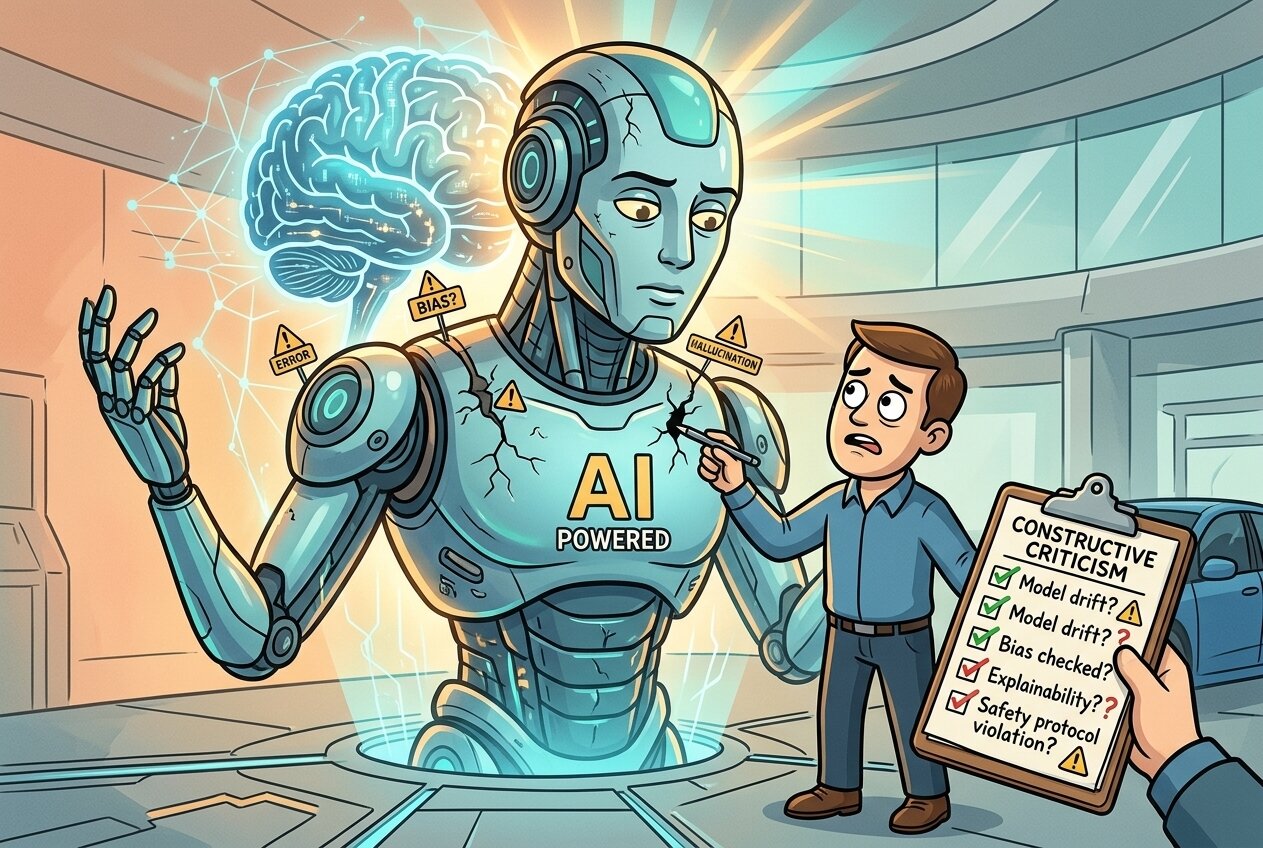
Yes, AI Is the Future. That's Exactly Why I Keep Criticizing It.
People occasionally corner me after a talk or in a comment thread and ask, half accusing: "So you're against AI?"
No. Clear no. I think AI is the future. I also think nuclear energy is one of the greatest inventions of the last century. You can build power plants that bring cheap electricity to millions of people. Or you can build the other thing. The technology doesn't care. The people wielding it decide the outcome - and right now, a lot of them are holding the hammer by the wrong end and wondering why the nail keeps laughing at them.
Being honest about a technology's capabilities, shortcomings, and risks is not opposition. It's the minimum requirement for using it well. Nobody calls a nuclear safety engineer "anti-nuclear."
The number that should end every AI keynote
A study published by the National Bureau of Economic Research surveyed almost 6,000 executives across multiple countries. Roughly 90% of companies implementing AI reported no discernible impact on productivity or employment. Not "underwhelming impact." No measurable effect at all. PwC's global CEO survey landed in the same crater: 56% of CEOs saw neither increased revenue nor decreased costs from AI after a year of deployment.
Read that again. The largest companies on earth, with dedicated AI task forces, data science teams, and budgets that could fund a small country's healthcare system, are mostly unable to prove that any of it worked.
If they can't capitalize on AI without setting money on fire, what makes a mid-sized company with one overworked IT admin think it will?
Why everyone jumped at once
Here's the part almost nobody says out loud: most companies didn't adopt AI because they identified a bottleneck AI could solve. They adopted it because everyone else visibly wanted it. Boards asked "what's our AI strategy?" not because they had a problem, but because the competitor's board asked the same question. Consultants sold the fear, vendors sold the dream, and executives who couldn't spell "transformer" mandated transformation.
Wanting something because others want it is the oldest trap in economics, and it produces the same result every time: bidding wars for the trendy thing, while the actual value sits ignored in the corner. We saw the identical movie with electric vehicles - demand forced top-down through mandates and hype rather than grown bottom-up through genuine pull. The early movers and their shareholders got dirty rich. Everyone who arrived at the party after midnight is now cleaning up the aisle.
Meanwhile, the genuinely valuable move - finding the one unglamorous workflow in your company where AI actually changes an outcome - was available to everyone the whole time. Nobody wanted it because nobody else wanted it. Competition is for losers; the overlooked niche is where the money hides.
The idiot index of your AI bill
Now the invoices are arriving, and CFOs are discovering a fun new metric. Take the cost of an AI-produced output and divide it by the cost of what's actually inside it. A frontier reasoning model, burning tokens like a private jet burns kerosene, summarizing a two-line email. An agentic pipeline with orchestration, monitoring, and retries - to answer a question that a decent knowledge base article solved in 2015 for free.
When the ratio between what you pay and the raw value inside is enormous, the problem is never the price of the input. It's the broken process wrapped around it. Companies are learning this the expensive way: wrong model for the wrong task, AI where a human brain would have been faster and correct, and nobody accountable for the meter running in the background. Forbes recently reported on exploding AI bills as a board-level topic - because "cost per token is falling" turned out to be irrelevant when your architecture multiplies tokens faster than the price drops.
There's a second, quieter cost. Every time someone outsources thinking that they should have done themselves, the output gets worse and the person gets weaker. You're not just paying for compute. You're paying to atrophy your own team.
What I actually recommend
If you're in tech: stay informed. Ruthlessly. The tools are real, the leverage is real, and the people who understand both the capabilities and the failure modes will be worth a fortune. Skills gaps, not tool gaps, are the number one adoption blocker in nearly every serious study.
If you're a decision maker: get into AI, but gather experience before you commit to a budget. Be deeply skeptical of marketing promises and shockingly pessimistic about projected costs. Then find one person - you may already employ this power horse 🐎 without knowing it - and give them the mandate to figure out how to transform your processes safely and integrate proper tooling.
One critical filter: this person must not wear rose-tinted AI goggles. You need someone who can objectively assess where AI helps, where it hurts, and where it silently bleeds money. The last thing you can afford is an AI yes-man who tells the board what it wants to hear. Judge them by a simple test - can they name three things AI should NOT do in your company? If the answer is "AI can do everything," you've hired a salesman, not an engineer.
And the cheapest R&D department in the world: other people's mistakes. The 2023-2025 experiments were paid for by companies far richer than yours. The results are public. Read them before you repeat them.
👉 Being critical of AI hype is not being against AI - it's the prerequisite for profiting from it.
👉 ~90% of companies report no measurable AI impact. Assume you're in the 90% until your own numbers prove otherwise.
👉 Adoption driven by "everyone else is doing it" produces cost, not value. Find the boring workflow nobody's fighting over.
👉 Check the ratio of your AI bill to the actual value inside it. A huge gap means a broken process, not expensive technology.
👉 Hire or empower one realistic assessor with a mandate to say no. An AI yes-man is more expensive than no AI at all.
The vendor got paid, the consultants left, and the AI can’t be sued. Guess whose name is on the cleanup bill.
👇 What's the most expensive AI mistake you've watched a company make - and did anyone learn from it?
This article is also available in German.
0 comment(s)
No comments yet. Be the first to comment.
Leave a comment