 TrenchOps 🐎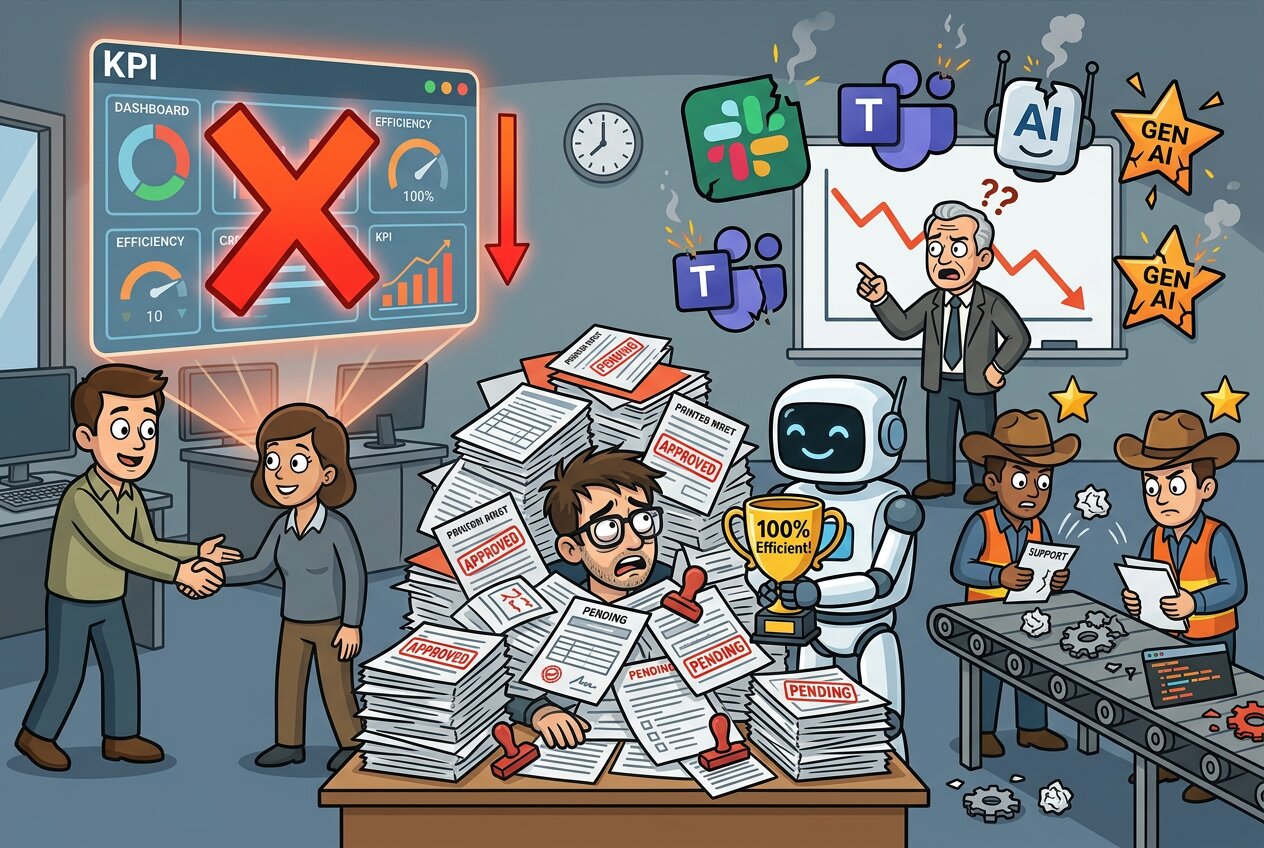
When Efficiency Tools Collide with Human Nature
How Bureaucracy and Broken Recognition Killed Productivity
I walked into a mid-sized tech company a while ago expecting to find a classic story.
They had done everything right. Deployed AI agents. Integrated KCS workflows. Set up sophisticated collaboration platforms. The brochure checklist was complete. Management was baffled because their investment had produced the exact opposite of what they wanted.
Engineers were complaining about high workload. Vehemently. The kind of complaining that kills morale and spreads like a cold in an open office.
But here is where it got interesting. The volume was actually down. Significantly. The AI agents and self-service workflows were deflecting the easy stuff before it ever reached a human. The ticket count had dropped by a healthy margin.
The problem was that the remaining work was harder. The easy fruit had been picked. So each ticket now required more in-depth investigation, more context switching, and heavier cognitive load. But that alone did not explain the misery.
After two weeks of 1:1s and quiet observation, I found the real killers. Two of them. And they are a lot more common than leaders want to admit.
The first killer was bureaucracy dressed up as process.
The company had grown from startup chaos into something that needed structure. That is fine. But somewhere along the way, structure became an end in itself. Every action required documentation. Every decision needed a sign-off. Every change had to go through a review board that met once a week.
The engineers were not solving problems anymore. They were filling out forms. And the smart ones figured out that the path of least resistance was to quietly bypass the system and get things done through backchannels. That worked for a while. Until the system caught up and punished them for not following the rules.
You end up in a stupid loop. Engineers spend more energy hiding their work from management than actually doing it. Productivity drops. Morale drops. And management doubles down on compliance because they think the problem is a lack of discipline.
It is not. The problem is that you replaced trust with paperwork.
The second killer was more subtle. And it is the one that really stung.
Collaboration died.
Not because people became antisocial. Not because they suddenly hated each other. But because the system actively punished generosity.
I sat down with one engineer who was widely regarded as the quiet backbone of the team. He knew the system inside out. People came to him for help constantly. He always helped. Patiently. Thoroughly.
Then I asked him about his KPIs.
He showed me his dashboard. His ticket resolution time was mediocre. His personal numbers looked average. When quarterly reviews came around, he had to explain why he was not performing like the isolated cowboys who just churned through their own queue and ignored everyone else.
He stopped helping.
Not because he wanted to. Because he had a mortgage. And management had made it loud and clear that being generous was a liability.
The tragedy is that management never intended to kill collaboration. They just never made it visible. They never measured it. They assumed it would happen magically because they put Slack channels and AI agents in place.
Tools do not create culture. Incentives do.
If you reward individual output and ignore collective intelligence, you get a team of solo players who hoard knowledge like it is a scarce resource. The irony is that the AI tools they bought to accelerate work only made this worse. Senior engineers now spend their time reviewing AI-generated code that is almost right but not quite. They are slower, not faster. And they get no credit for the invisible labor of fixing what the machine churns out.
The data backs this up. Experienced developers in controlled studies take up to 19% longer with AI assistance when you account for review and debugging time. Yet they perceive themselves as faster. The cognitive load has just shifted from creation to curation. And it is exhausting.
Your best people are not lazy. They are drowning in a system that rewards busywork and punishes collaboration.
So here is the lesson. And it is a hard one.
If you want collaboration, measure it. Track who answers questions. Track who mentors. Track who reviews other people's code with patience and insight. Make that visible in performance reviews and compensation decisions.
If you want efficiency, trust your people to do the right thing and remove the bureaucratic friction that makes them lie to you.
And if you want AI tools to actually deliver on their promise, stop measuring lines of code and start measuring outcomes. Reward the engineer who prevents a bug, not the one who generates a thousand commits that look correct but break in production.
Your tools are not the bottleneck. Your culture is.
This article is also available in German.
0 comment(s)
No comments yet. Be the first to comment.
Leave a comment