 TrenchOps 🐎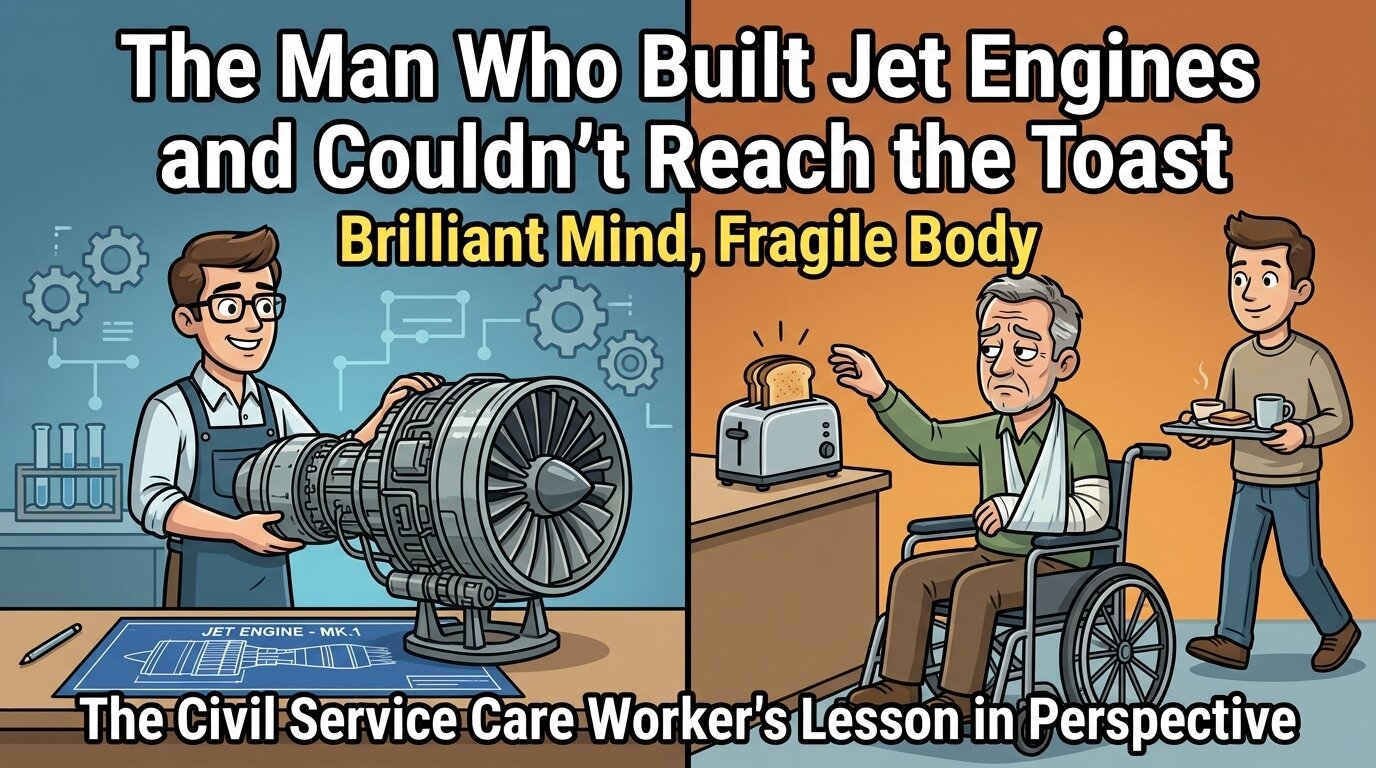
The Man Who Built Jet Engines and Couldn't Reach the Toast
I was eighteen, doing my civil service in Germany. My assignment was a temporary substitute gig - a few weeks covering for someone's vacation. My patient was a man in his early sixties, sitting in a wheelchair, partially paralyzed on one side. He needed help with breakfast. He needed help with the morning toilet routine. Not glamorous work, but someone had to do it.
Every morning started the same way. His wife would prepare a modest portion of bread, cheese, and cold cuts. And every morning he would insist he was still hungry. She would hold the line - firmly, not cruelly - explaining that wheelchair-bound patients gain weight easily, that it would hurt his rehabilitation, that the doctors were clear about his diet. He would argue, push back, and sometimes sulk like a child caught sneaking cookies. She would stay calm and patient, but she never gave in.
I watched this dance and felt uncomfortable. Here was a grown man, a man who had done important things, being treated like a little boy about toast and butter. It felt degrading. But she was right. And he knew it. That only made it worse.
The daily rehabilitation sessions were brutal. He had to relearn how to walk. A man in his early sixties, trying to convince his paralyzed side to cooperate, lifting one leg with his hands, sweating through the simplest exercises. You could see the frustration in his eyes. He had climbed mountains once. Now he struggled to shuffle ten feet with a walker.
One morning, I was making small talk while helping him into his wheelchair. I asked what he used to do for work. He told me quietly, almost apologetically, that he was an engineer. Had been, anyway. He helped design the engine for the Eurofighter jet.
He said it like it was ancient history. Like it happened to someone else.
I learned the rest from his wife. A few years before retirement, they found a tumor in his brain. He went in for surgery. And something went wrong. A mistake during the procedure damaged part of his brain, leaving him hemiplegic. The man who designed propulsion systems for fighter jets could not butter his own bread. The man who hiked the Alps every summer had to learn how to stand up again. The man who was at the peak of his career, respected, sought after, at the top of his game - was now a patient in his own home, dependent on a teenager for a trip to the toilet.
I was eighteen. I had no framework for that. It shook me.
I was there for only a few weeks. I don't know how his story ended. I don't know if he ever walked again. I don't know if he made peace with his new reality or fought it every day until the end. But I never forgot him.
Here is what that experience taught me and what I carry into every conversation with ambitious tech leaders and power-hungry engineers:
Your career is not your identity. That man was a brilliant engineer. He contributed to one of the most advanced aircraft ever built. And in one afternoon, on an operating table, none of that mattered anymore. His credentials did not help him stand. His reputation did not feed him. His career did not give him back his independence.
Health is the one resource you cannot negotiate. You can get laid off and find a better job. You can lose a client and win a bigger one. You can fail a project and bounce back. But if your body breaks, you cannot "crunch" your way out of it. There is no sprint. There is no pivot. There is just the slow, humbling grind of rehabilitation, and even that might not be enough.
Do not let your pride depend on your status. The hardest thing to watch was not the physical struggle. It was watching a proud man lose his dignity in small, daily increments. Being told what to eat. Being helped to the bathroom. Being seen as a burden rather than a creator. That can happen to any of us. And the more you anchor your self-worth to your job title, the harder the fall.
So here is my unsolicited advice to everyone reading this in the tech industry, chasing the next promotion, the next exit, the next badge of honor:
Work hard. Build great things. Be ambitious. But do not bet everything on your career. It is not a fortress. It is a stage, and the curtain can drop at any moment. The only things you truly own are your health, your relationships, and your ability to be grateful for a day where you can stand up, walk to the kitchen, and get your own damn toast.
Be thankful for every morning you wake up independent. And never mistake your job title for the measure of your worth.
This article is also available in German.
0 comment(s)
No comments yet. Be the first to comment.
Leave a comment