 TrenchOps 🐎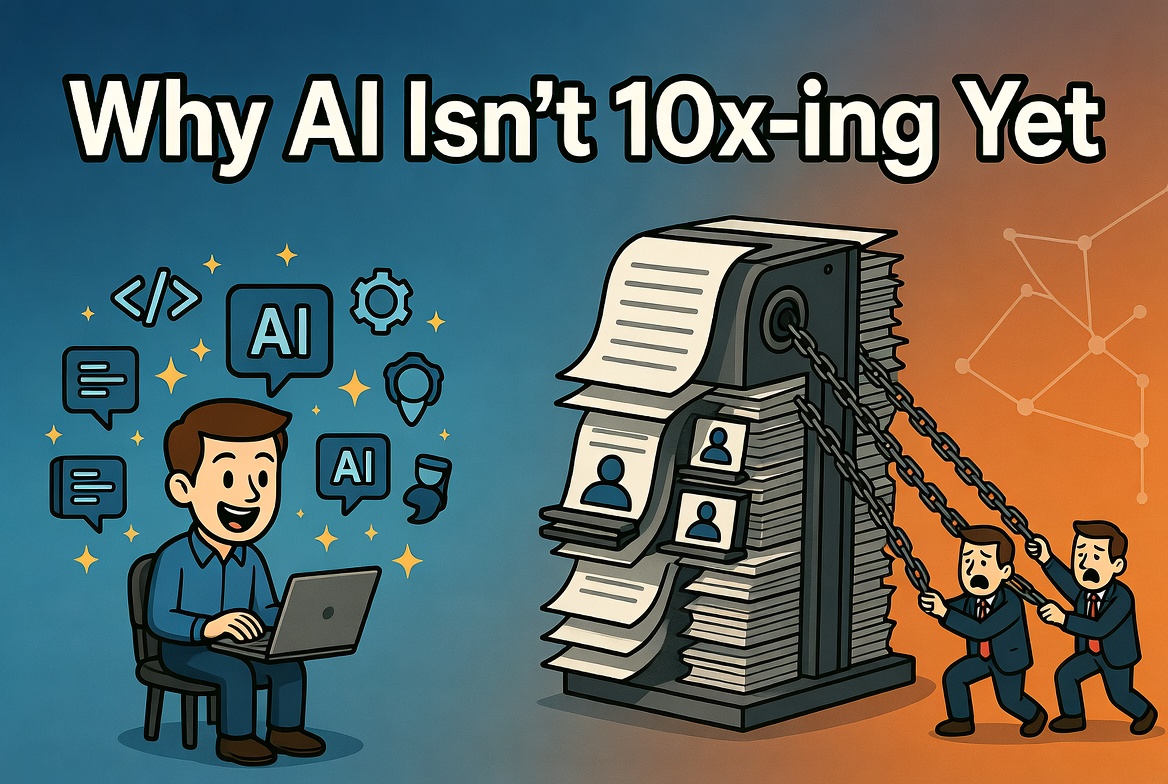
The AI Revolution That Management Is Still Figuring Out How to Unleash
(Why AI Isn't 10x-ing Anything - Yet)
For months we've been told the same story in every LinkedIn post, all-hands, and glossy keynote: AI is going to 1000x software engineering. CEOs are high on their own supply, promising 1000x efficiency, vibe-coded features, and a future where humans are mostly optional. Just prompt it, ship it, profit.
Six months later the dashboards look suspiciously familiar. No 100x. No 10x. Not even a polite 2x that anyone can show without footnotes the size of a small novel.
Funny how that works.
The promise was beautiful: AI writes the code, humans sip coffee, and velocity goes parabolic. The reality is a bit more... human. Vibe coding is genuinely delightful for knocking out a quick 40-line script. But the moment you scale to anything enterprise-shaped - with strict requirements, security audits, scalability, platform support, regression testing, governance, and the whole boring adult checklist - the magic evaporates.
Hallucinations? Still very much a feature, not a bug.
Debugging overhead? Massive.
Security risks? You're basically playing Russian roulette with production data.
And the models start to degrade on complex contexts faster than a free trial on the last day of the month.
But the real killer isn't the AI itself. It's the organizational layer that still moves at 2005 speed while the code generation moves at 2026 speed.
Here's the conceptual truth nobody wants to say too loudly in the strategy off-site: the bottleneck was never the developers. It was the organizational overhead sitting on top of them.
Processes. Bureaucracy. Decision latency. The six-week email chain to "align on requirements." The three layers of sign-off before anyone can change a single scope item. The safety nets that still exist because regulators and customers have this inconvenient habit of expecting things not to explode in production.
AI didn't magically dissolve any of that. It just made the old friction more visible - and a lot more expensive.
You still need:
- Someone to decide what should actually be built
- Clear requirements and scope
- Architecture reviews
- Security audits
- Platform and scalability considerations
- Testing strategies that actually matter
The devs - whether they're using AI or typing the old-fashioned way on a mechanical keyboard - are still waiting for the same things they've always waited for: clear decisions on what to build, realistic guardrails, and the ability to execute without the meeting-before-the-meeting-before-the-meeting.
Blaming the "conservative old-school devs" for insisting on defined scope and preventing feature bloat is easy. Harder is admitting that the business model and processes themselves aren't yet built to move at the speed AI can theoretically deliver.
The good news is none of the top 10 software companies on the planet have figured this out yet either. They're all still doing the same dance: hype the tool, watch the token burn rate skyrocket, quietly add more governance layers "to manage the AI," and wonder why the 1000x efficiency never showed up.
This isn't a failure of AI. It's an invitation for your business.
Management now has the clearest mirror it's ever had. The tool exposed exactly where the real latency lives - and it's not in the code editor. If your decision-making cycles, scoping rituals, and cross-functional alignment still run on 1993 firmware, no amount of prompt engineering will save you.
The fix is refreshingly straightforward:
- Shorten the decision loops.
- Give clear, stable requirements instead of weekly pivots.
- Treat security, scalability, and maintainability as non-negotiable from day one instead of "we'll govern it later."
- Measure the organization's velocity, not just the devs'.
Do that, and AI suddenly stops being an expensive autocomplete and starts becoming the multiplier everyone was promised.
AI didn't remove the need for judgment, accountability, and coordination.
It just made the gap between "idea" and "working code" ridiculously small - while the gap between "working code" and "safe, scalable, production-ready system" stayed exactly the same.
The companies that will actually win aren't the ones with the best prompts.
They're the ones that can finally get their own decision-making machinery to move at something approaching the speed of the tools they're now using.
Until then, all the "AI will replace engineers" talk is just expensive theater.
The Yes Engineer is ready.
The organization... still isn't.
This article is also available in German.
0 comment(s)
No comments yet. Be the first to comment.
Leave a comment