Why I moved back to SUSE after two decades - and why you should re-evaluate your stack while it still works
Somewhere around the year 2000, I bought a computer magazine because it had a CD glued to the cover. SUSE Linux 6.4. ReiserFS. I got as far as "select a mount point for root" and stopped, because I had no idea what a mount point was, and no realistic way to find out. No search engine within reach. No forum. Just me, a beige tower, and a dialog box asking me a question in a language I didn't speak.
I abandoned the installation. My first contact with Linux ended in surrender at the partitioning screen, which I suspect is the most common origin story in our industry.
A few months later, SUSE 7 came out and I ordered the boxed set. Seven CDs. A printed manual thick enough to stop a small projectile. A t-shirt. A sticker of a chameleon. And most importantly: no license key scrawled on a disc in marker by someone's cousin. I installed an operating system that nobody asked me to prove I deserved. That smell of freedom stayed with me longer than the T-shirt did.
Every two weeks, like clockwork, I walked to the kiosk and bought the same magazine. This was back when "the cloud" still meant rain. The pages were glorious. Linux distribution shootouts - Debian vs. SUSE vs. Fedora vs. Ubuntu, complete with benchmark tables nobody asked for and everybody loved. Firewall configs. Server hardware reviews. How to set up remote access so you could SSH into your home box from the office and play terminal Tetris when the boss wasn't looking. How to share your "totally legally acquired" movie collection across the family network. Best open-source database. Troubleshooting tips that actually worked.
It was nerd church. I read every word, including the ads.
Then something shifted. First subtle, then about as subtle as a forklift through a glass door.
The Linux comparison shrank to half a page. Then a quarter. Then a sidebar. In its place: best LCD monitor for Photoshop. Best smartphone for the outdoorsy type. Best printer for home photo printing. Music apps you "cannot live without." Best home cinema projector. Dolby surround systems that cost more than my first car.
The magazine hadn't been cancelled. It had been quietly lobotomized. Same logo, same price, same kiosk. Different soul. It went from "build it yourself" to "buy this and consume." And teenage me was annoyed because none of it helped my career. I didn't want to know which speaker thumped hardest, primarily because I didn't have any money to buy one. I wanted to know how to make the server stop falling over.
I've spent twenty years in the trenches watching two kinds of people argue about the future.
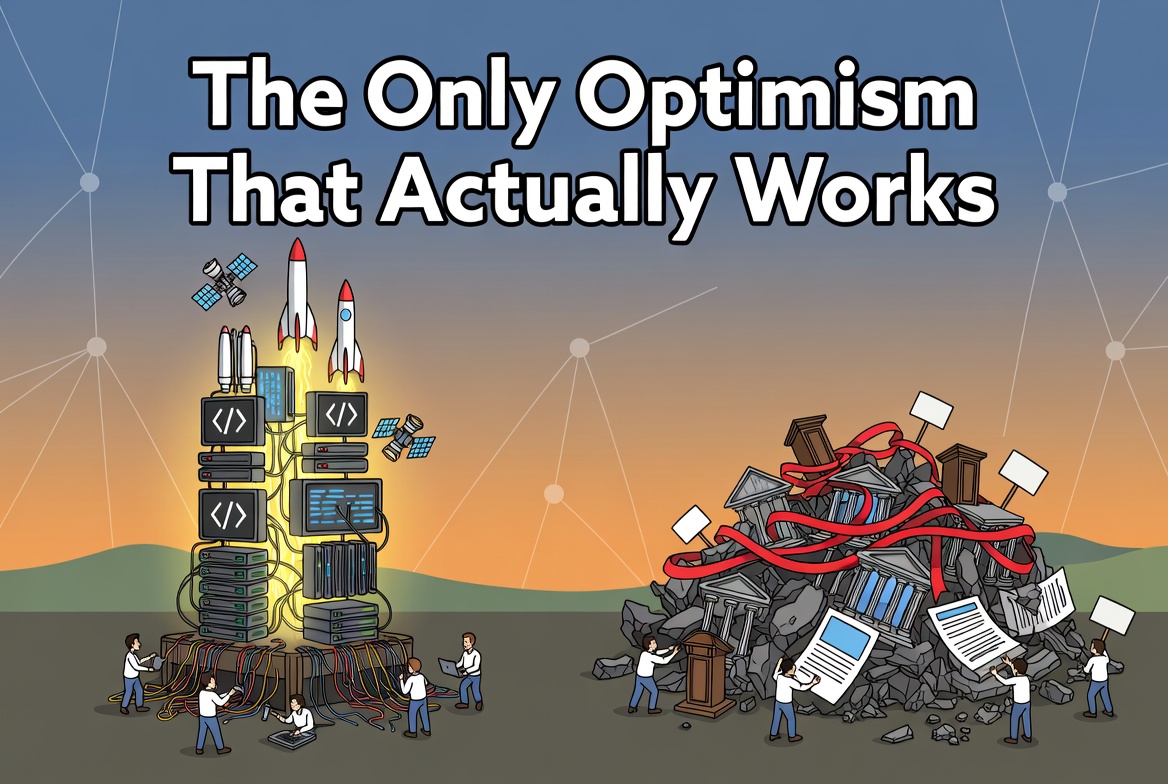
The social and political optimists say: "If we just pass the right laws, fix the culture, and get the right people in charge, everything will finally get better."
The technological optimists say: "Give humans better tools and they'll figure out the rest."
History keeps proving the second group right - and the first group spectacularly wrong.
Look at the pattern. Every decade we get grand promises about how new regulations, new social movements, or new political saviors will solve poverty, inequality, education, or healthcare. The results are usually modest at best, expensive, and sometimes actively harmful. Meanwhile, a few nerds in garages or labs quietly ship a new technology that changes daily life more in five years than ten years of policy ever could.
The smartphone didn't need a government program to connect the world. The internet didn't ask for permission to democratize knowledge. Cheap solar, Starlink, AI, and cloud computing didn't wait for the perfect political moment - they just got built.
In support, we see this every single day. We complain about broken processes, terrible CRMs, and endless bureaucracy. Social optimists would try to "fix" it with more meetings, more policies, and more mandatory training. Technological optimists ship a script, a dashboard, or an automation that actually removes the pain. Guess which one actually moves the needle?
 TrenchOps 🐎